


Community hub
Recent from talks
Knowledge base stats:
Talk channels stats:
Members stats:
Foucault pendulum
The Foucault pendulum or Foucault's pendulum is a simple device named after French physicist Léon Foucault, conceived as an experiment to demonstrate the Earth's rotation. If a long and heavy pendulum suspended from the high roof above a circular area is monitored over an extended period of time, its plane of oscillation appears to change spontaneously as the Earth makes its 24-hourly rotation. This effect is greatest at the poles and diminishes with lower latitude until it no longer exists at Earth's equator.
The pendulum was introduced in 1851 and was the first experiment to give simple, direct evidence of the Earth's rotation. Foucault followed up in 1852 with a gyroscope experiment to further demonstrate the Earth's rotation. Foucault pendulums have become popular in science museums and universities.
Foucault was inspired by observing a thin flexible rod on the axis of a lathe, which vibrated in the same plane despite the rotation of the supporting frame of the lathe.
The first public exhibition of a Foucault pendulum took place in February 1851 in the Meridian of the Paris Observatory. A few weeks later, Foucault made his most famous pendulum when he suspended a 28-kilogram (62 lb) brass-coated lead bob with a 67-metre-long (220 ft) wire from the dome of the Panthéon, Paris.
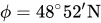
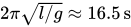
Because the latitude of its location was , the plane of the pendulum's swing made a full circle in approximately , rotating clockwise approximately 11.3° per hour. The proper period of the pendulum was approximately , so with each oscillation, the pendulum rotates by about . Foucault reported observing 2.3 mm of deflection on the edge of a pendulum every oscillation, which is achieved if the pendulum swing angle is 2.1°.


Foucault explained his results in an 1851 paper entitled Physical demonstration of the Earth's rotational movement by means of the pendulum, published in the Comptes rendus de l'Académie des Sciences. He wrote that, at the North Pole:
...an oscillatory movement of the pendulum mass follows an arc of a circle whose plane is well known, and to which the inertia of matter ensures an unchanging position in space. If these oscillations continue for a certain time, the movement of the earth, which continues to rotate from west to east, will become sensitive in contrast to the immobility of the oscillation plane whose trace on the ground will seem animated by a movement consistent with the apparent movement of the celestial sphere; and if the oscillations could be perpetuated for twenty-four hours, the trace of their plane would then execute an entire revolution around the vertical projection of the point of suspension.
The original bob used in 1851 at the Panthéon was moved in 1855 to the Conservatoire des Arts et Métiers in Paris. A second temporary installation was made for the 50th anniversary in 1902.
Hub AI
Foucault pendulum AI simulator
(@Foucault pendulum_simulator)
Foucault pendulum
The Foucault pendulum or Foucault's pendulum is a simple device named after French physicist Léon Foucault, conceived as an experiment to demonstrate the Earth's rotation. If a long and heavy pendulum suspended from the high roof above a circular area is monitored over an extended period of time, its plane of oscillation appears to change spontaneously as the Earth makes its 24-hourly rotation. This effect is greatest at the poles and diminishes with lower latitude until it no longer exists at Earth's equator.
The pendulum was introduced in 1851 and was the first experiment to give simple, direct evidence of the Earth's rotation. Foucault followed up in 1852 with a gyroscope experiment to further demonstrate the Earth's rotation. Foucault pendulums have become popular in science museums and universities.
Foucault was inspired by observing a thin flexible rod on the axis of a lathe, which vibrated in the same plane despite the rotation of the supporting frame of the lathe.
The first public exhibition of a Foucault pendulum took place in February 1851 in the Meridian of the Paris Observatory. A few weeks later, Foucault made his most famous pendulum when he suspended a 28-kilogram (62 lb) brass-coated lead bob with a 67-metre-long (220 ft) wire from the dome of the Panthéon, Paris.
Because the latitude of its location was , the plane of the pendulum's swing made a full circle in approximately , rotating clockwise approximately 11.3° per hour. The proper period of the pendulum was approximately , so with each oscillation, the pendulum rotates by about . Foucault reported observing 2.3 mm of deflection on the edge of a pendulum every oscillation, which is achieved if the pendulum swing angle is 2.1°.
Foucault explained his results in an 1851 paper entitled Physical demonstration of the Earth's rotational movement by means of the pendulum, published in the Comptes rendus de l'Académie des Sciences. He wrote that, at the North Pole:
...an oscillatory movement of the pendulum mass follows an arc of a circle whose plane is well known, and to which the inertia of matter ensures an unchanging position in space. If these oscillations continue for a certain time, the movement of the earth, which continues to rotate from west to east, will become sensitive in contrast to the immobility of the oscillation plane whose trace on the ground will seem animated by a movement consistent with the apparent movement of the celestial sphere; and if the oscillations could be perpetuated for twenty-four hours, the trace of their plane would then execute an entire revolution around the vertical projection of the point of suspension.
The original bob used in 1851 at the Panthéon was moved in 1855 to the Conservatoire des Arts et Métiers in Paris. A second temporary installation was made for the 50th anniversary in 1902.