Recent from talks
Nothing was collected or created yet.
Rule 30
View on WikipediaRule 30 is an elementary cellular automaton introduced by Stephen Wolfram in 1983.[2] Using Wolfram's classification scheme, Rule 30 is a Class III rule, displaying aperiodic, chaotic behaviour.
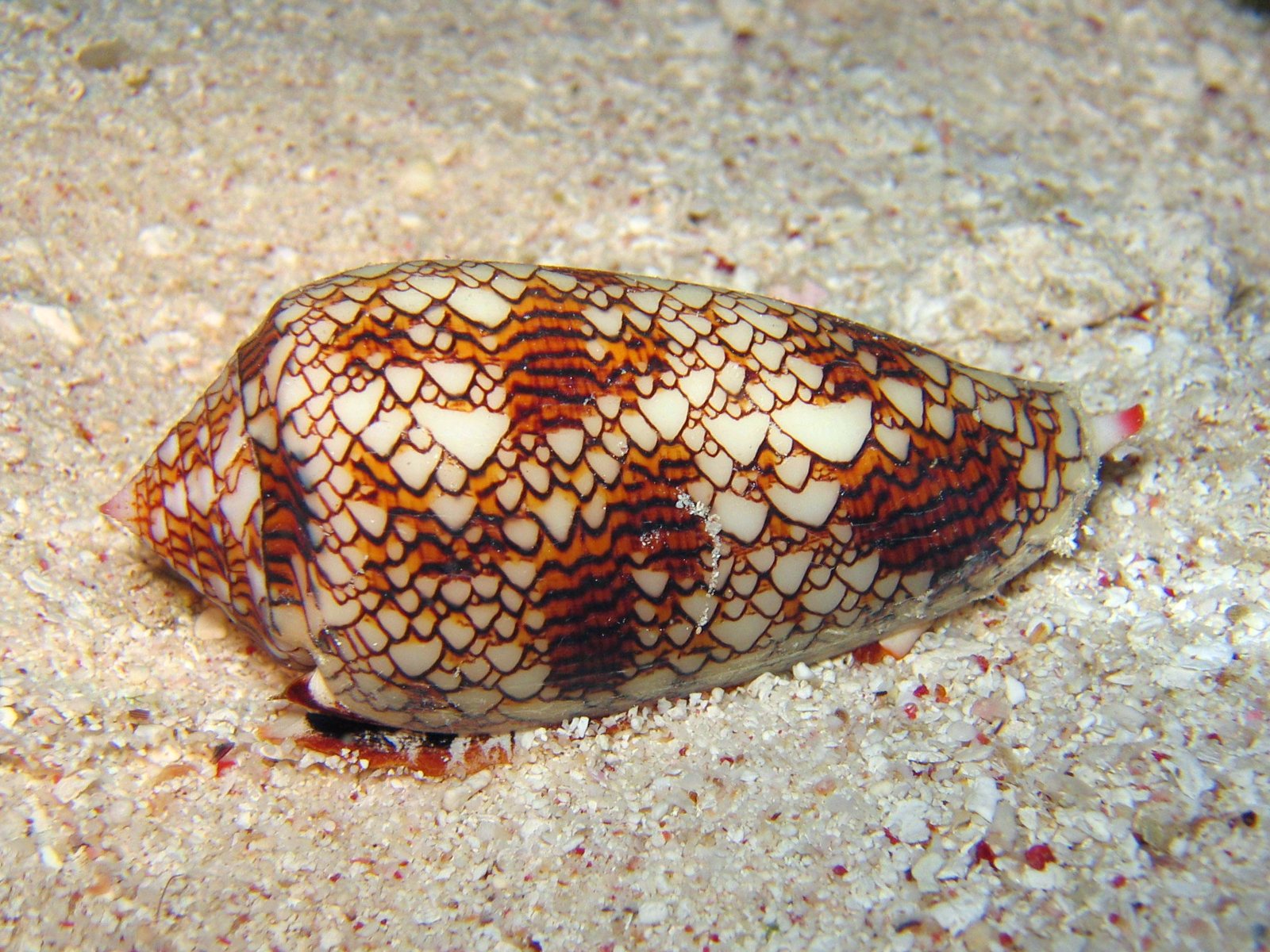
This rule is of particular interest because it produces complex, seemingly random patterns from simple, well-defined rules. Because of this, Wolfram believes that Rule 30, and cellular automata in general, are the key to understanding how simple rules produce complex structures and behaviour in nature. For instance, a pattern resembling Rule 30 appears on the shell of the widespread cone snail species Conus textile. Rule 30 has also been used as a random number generator in Mathematica,[3] and has also been proposed as a possible stream cipher for use in cryptography.[4][5]
Rule 30 is so named because 30 is the smallest Wolfram code which describes its rule set (as described below). The mirror image, complement, and mirror complement of Rule 30 have Wolfram codes 86, 135, and 149, respectively.
Rule set
[edit]In all of Wolfram's elementary cellular automata, an infinite one-dimensional array of cellular automaton cells with only two states is considered, with each cell in some initial state. At discrete time intervals, every cell spontaneously changes state based on its current state and the state of its two neighbors. For Rule 30, the rule set which governs the next state of the automaton is:
| current pattern | 111 | 110 | 101 | 100 | 011 | 010 | 001 | 000 |
|---|---|---|---|---|---|---|---|---|
| new state for center cell | 0 | 0 | 0 | 1 | 1 | 1 | 1 | 0 |
If the left, center, and right cells are denoted (p,q,r) then the corresponding formula for the next state of the center cell can be expressed as p xor (q or r). It is called Rule 30 because in binary, 000111102 = 30.
The following diagram shows the pattern created, with cells colored based on the previous state of their neighborhood. Darker colors represent "1" and lighter colors represent "0". Time increases down the vertical axis.

Structure and properties
[edit]The following pattern emerges from an initial state in which a single cell with state 1 (shown as black) is surrounded by cells with state 0 (white).
Here, the vertical axis represents time and any horizontal cross-section of the image represents the state of all the cells in the array at a specific point in the pattern's evolution. Several motifs are present in this structure, such as the frequent appearance of white triangles and a well-defined striped pattern on the left side; however the structure as a whole has no discernible pattern. The number of black cells at generation is given by the sequence
and is approximately .[citation needed]
Chaos
[edit]Rule 30 meets rigorous definitions of chaos proposed by Devaney and Knudson. In particular, according to Devaney's criteria, Rule 30 displays sensitive dependence on initial conditions (two initial configurations that differ only in a small number of cells rapidly diverge), its periodic configurations are dense in the space of all configurations, according to the Cantor topology on the space of configurations (there is a periodic configuration with any finite pattern of cells), and it is mixing (for any two finite patterns of cells, there is a configuration containing one pattern that eventually leads to a configuration containing the other pattern). According to Knudson's criteria, it displays sensitive dependence and there is a dense orbit (an initial configuration that eventually displays any finite pattern of cells). Both of these characterizations of the rule's chaotic behavior follow from a simpler and easy to verify property of Rule 30: it is left permutative, meaning that if two configurations C and D differ in the state of a single cell at position i, then after a single step the new configurations will differ at cell i + 1.[6]
Applications
[edit]Random number generation
[edit]As is apparent from the image above, Rule 30 generates seeming randomness despite the lack of anything that could reasonably be considered random input. Stephen Wolfram proposed using its center column as a pseudorandom number generator (PRNG); it passes many standard tests for randomness, and Wolfram previously used this rule in the Mathematica product for creating random integers.[7]
Sipper and Tomassini have shown that as a random number generator Rule 30 exhibits poor behavior on a chi squared test when applied to all the rule columns as compared to other cellular automaton-based generators.[8] The authors also expressed their concern that "The relatively low results obtained by the rule 30 CA may be due to the fact that we considered N random sequences generated in parallel, rather than the single one considered by Wolfram."[9]
Decoration
[edit]
The Cambridge North railway station is decorated with architectural panels displaying the evolution of Rule 30 (or equivalently under black-white reversal, Rule 135).[10] The design was described by its architect as inspired by Conway's Game of Life, a different cellular automaton studied by Cambridge mathematician John Horton Conway, but is not actually based on Life.[11][12]
Programming
[edit]The state update can be done quickly by bitwise operations, if the cell values are represented by the bits within one (or more) computer words. Here shown in C++:
#include <stdint.h>
#include <iostream>
int main() {
uint64_t state = 1u << 31;
for (int i = 0; i < 32; ++i) {
for (int j = 64; j--;) {
std::cout << char(state >> j & 1 ? 'O' : '.');
}
std::cout << '\n';
state = (state >> 1) ^ (state | state << 1);
}
}
This program produces the following output:
................................O............................... ...............................OOO.............................. ..............................OO..O............................. .............................OO.OOOO............................ ............................OO..O...O........................... ...........................OO.OOOO.OOO.......................... ..........................OO..O....O..O......................... .........................OO.OOOO..OOOOOO........................ ........................OO..O...OOO.....O....................... .......................OO.OOOO.OO..O...OOO...................... ......................OO..O....O.OOOO.OO..O..................... .....................OO.OOOO..OO.O....O.OOOO.................... ....................OO..O...OOO..OO..OO.O...O................... ...................OO.OOOO.OO..OOO.OOO..OO.OOO.................. ..................OO..O....O.OOO...O..OOO..O..O................. .................OO.OOOO..OO.O..O.OOOOO..OOOOOOO................ ................OO..O...OOO..OOOO.O....OOO......O............... ...............OO.OOOO.OO..OOO....OO..OO..O....OOO.............. ..............OO..O....O.OOO..O..OO.OOO.OOOO..OO..O............. .............OO.OOOO..OO.O..OOOOOO..O...O...OOO.OOOO............ ............OO..O...OOO..OOOO.....OOOO.OOO.OO...O...O........... ...........OO.OOOO.OO..OOO...O...OO....O...O.O.OOO.OOO.......... ..........OO..O....O.OOO..O.OOO.OO.O..OOO.OO.O.O...O..O......... .........OO.OOOO..OO.O..OOO.O...O..OOOO...O..O.OO.OOOOOO........ ........OO..O...OOO..OOOO...OO.OOOOO...O.OOOOO.O..O.....O....... .......OO.OOOO.OO..OOO...O.OO..O....O.OO.O.....OOOOO...OOO...... ......OO..O....O.OOO..O.OO.O.OOOO..OO.O..OO...OO....O.OO..O..... .....OO.OOOO..OO.O..OOO.O..O.O...OOO..OOOO.O.OO.O..OO.O.OOOO.... ....OO..O...OOO..OOOO...OOOO.OO.OO..OOO....O.O..OOOO..O.O...O... ...OO.OOOO.OO..OOO...O.OO....O..O.OOO..O..OO.OOOO...OOO.OO.OOO.. ..OO..O....O.OOO..O.OO.O.O..OOOOO.O..OOOOOO..O...O.OO...O..O..O. .OO.OOOO..OO.O..OOO.O..O.OOOO.....OOOO.....OOOO.OO.O.O.OOOOOOOOO
See also
[edit]References
[edit]- ^ Stephen Coombes (February 2009). "The Geometry and Pigmentation of Seashells" (PDF). www.maths.nottingham.ac.uk. University of Nottingham. Retrieved 2013-04-10.
- ^ Wolfram, S. (1983). "Statistical mechanics of cellular automata". Rev. Mod. Phys. 55 (3): 601–644. Bibcode:1983RvMP...55..601W. doi:10.1103/RevModPhys.55.601.
- ^ "Random Number Generation". Wolfram Mathematica 8 Documentation. Retrieved 31 December 2011.
- ^ Wolfram, S. (1985). "Cryptography with cellular automata". Proceedings of Advances in Cryptology – CRYPTO '85. Lecture Notes in Computer Science 218, Springer-Verlag. p. 429. doi:10.1007/3-540-39799-X_32.
- ^ Meier, Willi; Staffelbach, Othmar (1991). "Analysis of pseudo random sequences generated by cellular automata". Advances in Cryptology – Proc. Workshop on the Theory and Application of Cryptographic Techniques, EUROCRYPT '91. Lecture Notes in Computer Science 547, Springer-Verlag. p. 186. doi:10.1007/3-540-46416-6_17.
- ^ Cattaneo, Gianpiero; Finelli, Michele; Margara, Luciano (2000). "Investigating topological chaos by elementary cellular automata dynamics". Theoretical Computer Science. 244 (1–2): 219–241. doi:10.1016/S0304-3975(98)00345-4. MR 1774395.
- ^ Lex Fridman (2018-03-02), MIT AGI: Computational Universe (Stephen Wolfram), archived from the original on 2021-12-19, retrieved 2018-03-07
- ^ Sipper, Moshe; Tomassini, Marco (1996). "Generating parallel random number generators by cellular programming". International Journal of Modern Physics C. 7 (2): 181–190. Bibcode:1996IJMPC...7..181S. doi:10.1142/S012918319600017X.
- ^ Page 6 of Sipper, Moshe; Tomassini, Marco (1996). "Generating parallel random number generators by cellular programming". International Journal of Modern Physics C. 7 (2): 181–190. Bibcode:1996IJMPC...7..181S. doi:10.1142/S012918319600017X.
- ^ Wolfram, Stephen (June 1, 2017), "Oh My Gosh, It's Covered in Rule 30s!", Stephen Wolfram's blog
- ^ Lawson-Perfect, Christian (May 23, 2017), "Right answer for the wrong reason: cellular automaton on the new Cambridge North station", The Aperiodical
- ^ Purtill, Corinne. "A UK train station's tribute to a famous mathematician got everything right except his math". Quartz. Retrieved 2017-06-12.
- Wolfram, Stephen, 1985, Cryptography with Cellular Automata, CRYPTO'85.
External links
[edit]- Weisstein, Eric W. "Rule 30". MathWorld.
- "Announcing the Rule 30 Prizes". Stephen Wolfram Writings. 1 October 2019.
- Rule 30 in Wolfram's atlas of cellular automata
- Rule 30: Wolfram's Pseudo-random Bit Generator. Recipe 32 at David Griffeath's Primordial Soup Kitchen.
- Repeating Rule 30 patterns. A list of patterns that, when repeated to fill the cells of a Rule 30 automaton, repeat themselves after finitely many time steps. Frans Faase, 2003. Archived from the Original on 2013-08-08
- Paving Mosaic Fractal. Basic introduction to the pattern of Rule 30 from the perspective of a LOGO software expert Olivier Schmidt-Chevalier.
- TED Talk from February 2010. Stephen Wolfram speaks about computing a theory of everything where he talks about rule 30 among other things.
Rule 30
View on GrokipediaBackground
Cellular Automata Basics
Cellular automata are discrete computational systems consisting of a regular grid of cells, where each cell maintains a finite number of states and evolves over discrete time steps according to a fixed local rule that depends on the states of neighboring cells.[4] In the case of one-dimensional elementary cellular automata, the grid forms an infinite line of cells, providing a simple model for studying emergent complexity from basic interactions.[5] Each cell in an elementary cellular automaton typically adopts one of two binary states, denoted as 0 or 1, which are often visualized as white and black, or off and on, respectively, to represent patterns in space-time diagrams.[4] The neighborhood of a cell is defined by itself and its two immediate adjacent cells (left and right), resulting in eight possible configurations for the three-cell tuple that determines the update.[5] All cells update synchronously at each time step, meaning the next state of every cell is computed simultaneously based on the current configuration of its neighborhood, without sequential dependencies.[4] The concept of cellular automata originated in the late 1940s through the work of John von Neumann and Stanislaw Ulam at the Los Alamos National Laboratory, where von Neumann, inspired by Ulam's suggestion of a discrete grid, developed models for self-reproducing automata to explore logical and biological self-replication.[4] Von Neumann's seminal theory, detailed in his posthumously published lectures, laid the groundwork for understanding automata as universal constructors capable of mimicking complex processes like reproduction.[6] In the 1980s, Stephen Wolfram systematized the study of one-dimensional cellular automata, analyzing all 256 possible elementary rules and introducing a classification scheme based on their behavioral patterns. The general update rule for the state of a cell at time in an elementary cellular automaton is given by where represents the state (0 or 1), and is a fixed Boolean function mapping the three input states to the output state.[4] This formulation captures the local, deterministic nature of the evolution, enabling the generation of intricate global patterns from simple initial conditions.[5]Wolfram's Classification
Elementary cellular automata, as studied by Stephen Wolfram, consist of 256 possible rules numbered from 0 to 255, each defined by a binary output for the 8 possible configurations of three neighboring cells (left, center, right) in a one-dimensional grid of binary states.[7] Wolfram proposed a classification scheme dividing these rules into four classes based on their long-term behavior from random or simple initial conditions. Class I rules evolve to a uniform state, where all cells eventually become identical, leading to homogeneous fixed points. Class II rules produce repetitive or nested patterns, such as stable or periodic structures that persist locally but do not propagate complexity extensively. Class III rules exhibit chaotic behavior, generating aperiodic, seemingly random patterns that fill the space without clear structure. Class IV rules, often described as operating at the "edge of chaos," display complex, localized structures that interact and sustain intricate evolutions, potentially supporting computation.[8] This classification was first introduced in Wolfram's 1983 review article on the statistical mechanics of cellular automata, where he analyzed the emergent properties of such systems, and later expanded with detailed examples and simulations in his 2002 book A New Kind of Science.[9] Rule 30 belongs to Class III, characterized by its chaotic evolution that produces irregular, random-like patterns even from simple initial conditions, such as a single live cell. While the vast majority of the 256 rules fall into Classes I and II with simple, predictable behaviors, only a small number exhibit the more intriguing dynamics of Classes III and IV; notable examples include Rule 30 in Class III for its randomness and Rule 110 in Class IV for its capacity to generate complex, glider-like structures.[1][8]Rule Specification
Binary Representation
Rule 30 is defined by an 8-bit binary string that specifies the next state for each possible configuration of three neighboring cells in a one-dimensional cellular automaton.[9] The binary representation is 00011110, which equals 30 in decimal, where the leftmost bit (most significant) corresponds to the neighborhood 111 and the rightmost bit (least significant) to 000.[1] This encoding distinguishes Rule 30 from the other 255 elementary cellular automata rules introduced by Stephen Wolfram.[10] Wolfram's numbering system assigns a unique integer to each rule by interpreting the binary string as a decimal number, effectively summing for each neighborhood configuration (from 0 to 7) that outputs 1. For Rule 30, the neighborhoods producing an output of 1 are 100 (), 011 (), 010 (), and 001 (), yielding .[7] The rule's truth table, which serves as its precise tabular definition, lists all eight possible input neighborhoods and their corresponding outputs:| Neighborhood (left-center-right) | Decimal | Output |
|---|---|---|
| 111 | 7 | 0 |
| 110 | 6 | 0 |
| 101 | 5 | 0 |
| 100 | 4 | 1 |
| 011 | 3 | 1 |
| 010 | 2 | 1 |
| 001 | 1 | 1 |
| 000 | 0 | 0 |
Update Rule
The update rule for Rule 30 specifies the state of each cell in the next generation based on the states of itself and its two immediate neighbors in the current generation. Denoting the left neighbor, center cell, and right neighbor as , , and respectively, the next state is given by the Boolean expression: left XOR (center OR right), where XOR denotes exclusive or and OR denotes inclusive or.[11] This can be formally expressed in mathematical notation as where represents exclusive or and represents inclusive or.[11] The formula derives directly from the binary encoding of Rule 30 (00011110 in decimal 30), which maps each of the eight possible three-cell configurations to an output state. For verification, consider the configuration 100 (left=1, center=0, right=0): , matching the rule's output; similarly, 010 yields , and 111 yields .[11] The structure of the update rule introduces an asymmetry, as the left neighbor is treated differently from the right through the XOR operation, resulting in patterns that exhibit a leftward bias in their evolution.[12] Due to its reliance on a single XOR and a single OR operation, the rule is computationally efficient and can be readily implemented in hardware using basic logic gates or in software with bitwise operations.[7]Dynamic Behavior
Pattern Formation
When Rule 30 is initialized with a single black cell (state 1) at the center surrounded by white cells (state 0), it generates a distinctive triangular pattern that expands outward.[1] The evolution produces self-similar structures, with the left half exhibiting irregular, chaotic motifs resembling random noise, while the right half forms ordered periodic stripes of alternating black and white cells.[1] Key visual motifs include diagonal black lines that propagate leftward, small triangular clusters, and subsets displaying Sierpinski-like fractal patterns, contributing to an overall aperiodic growth that avoids simple repetition.[1] Over generations, the pattern at step spans cells, reflecting the rule's neighborhood radius of 1. The number of black cells in row follows the sequence 1, 3, 3, 6, 4, 9, 5, 12, ..., approximately for large , corresponding to OEIS A070952 and yielding a density approaching 1/2 in the active regions.[13][1] In multi-seed configurations, such as random initial distributions, Rule 30 produces patterns with varying black cell densities but retains similar irregularity, filling the space with chaotic textures akin to the single-seed left side. Periodic initial conditions, like alternating cells, lead to denser or sparser bands but still evolve into non-repeating, motif-rich structures dominated by diagonal and triangular elements. These patterns bear a striking resemblance to natural formations, such as the irregular markings on the shell of the cone snail Conus textile, as observed by Wolfram in his analysis of cellular automata behaviors.Sensitivity to Initial Conditions
Rule 30 demonstrates a profound sensitivity to initial conditions, a defining feature of class 3 cellular automata, where even a minimal alteration in the starting configuration results in dramatically divergent evolutionary patterns over time.[14] This property underscores the rule's chaotic nature, as perturbations propagate rapidly, rendering long-term predictions impractical despite the underlying determinism.[15] An analog to the Lyapunov exponent in continuous dynamical systems captures this exponential divergence in Rule 30, with empirical values around 0.5 indicating that differences between nearby initial states grow exponentially with time steps.[16] Specifically, flipping a single bit at row can affect approximately cells by row , reflecting the rapid amplification of local changes into widespread alterations.[16] For instance, consider two otherwise identical initial rows differing only in one cell; after just 10 steps, the resulting patterns become uncorrelated beyond the immediate vicinity of the original perturbation, with differences filling expanding regions.[15] The diffusion of influence in Rule 30 arises from the rule's inherent asymmetry, which causes perturbations to spread predominantly leftward, forming asymmetric "light cones" of dependency that bound the region influenced by each initial cell.[17] Within these cones, the right edge of differences propagates at the maximum speed of 1 cell per step, while the leftward spread occurs at a slower but still significant rate, leading to a skewed growth pattern.[17] This directional bias contributes to the rule's complex, irregular evolution from simple seeds. To illustrate this sensitivity computationally, one can simulate two parallel evolutions with a perturbed initial state and track the differing cells over iterations. The following pseudocode snippet demonstrates a basic approach using a one-dimensional array representation (assuming periodic boundaries for simplicity and a rule 30 update functionapply_rule30(row) that computes the next row):
initialize rowA as initial configuration (e.g., all 0s except center 1)
initialize rowB = copy of rowA
flip rowB[center] # introduce single-bit perturbation
differences = [0] # track number of differing cells per step
for step from 1 to N:
nextA = apply_rule30(rowA)
nextB = apply_rule30(rowB)
diff_count = count_differences(nextA, nextB)
append diff_count to differences
rowA = nextA
rowB = nextB
output differences # shows exponential growth in differing cells
initialize rowA as initial configuration (e.g., all 0s except center 1)
initialize rowB = copy of rowA
flip rowB[center] # introduce single-bit perturbation
differences = [0] # track number of differing cells per step
for step from 1 to N:
nextA = apply_rule30(rowA)
nextB = apply_rule30(rowB)
diff_count = count_differences(nextA, nextB)
append diff_count to differences
rowA = nextA
rowB = nextB
output differences # shows exponential growth in differing cells
Chaotic Characteristics
Topological Chaos
Rule 30 exhibits topological chaos in the sense of Devaney's definition, which requires a dynamical system to be topologically transitive (having dense orbits), possess a dense set of periodic points, and demonstrate sensitivity to initial conditions.[18] This formal characterization of chaos was applied to elementary cellular automata, including Rule 30, confirming its compliance through analysis of its global mapping on the space of bi-infinite binary configurations.[18] Stephen Wolfram demonstrated the chaotic nature of Rule 30 in his comprehensive study, highlighting its class III behavior with aperiodic and unpredictable evolution from simple initial states.[19] Sensitivity to initial conditions, a key component, manifests in the rapid divergence of nearby configurations, as previously illustrated by examples of pattern disruption from minimal perturbations.[19] A sketch of the proof for Devaney's criteria leverages the asymmetric dynamics of Rule 30. Topological transitivity arises from the leftward-propagating irregularity in the evolution, where the chaotic spreading enables any finite binary pattern to appear as a substring in the orbit of some initial configuration, ensuring dense orbits.[20] Conversely, the dense set of periodic points stems from the rightward regularity, characterized by predictable triangular patterns that permit the construction of periodic configurations dense in the configuration space.[20] These properties, combined with sensitivity, establish chaos under Devaney's framework, as verified through symbolic dynamics on the full shift space.[18] Analysis of space-time diagrams for Rule 30 reveals that the evolution map , which applies the local update rule uniformly across bi-infinite strings, is topologically mixing. This stronger property implies transitivity and ensures that for any pair of open sets in the configuration space, their images under iterated applications of eventually overlap, underscoring the system's ergodic-like mixing behavior.[20] The shift map on bi-infinite strings, defined by serves as a foundational Bernoulli shift, and Rule 30 acts as a factor map of this shift, inheriting chaotic properties on invariant subsystems.[20]Randomness Properties
Rule 30 generates pseudorandom bit sequences by evolving the cellular automaton from an initial single live cell (state 1) at the center, with all other cells dead (state 0), and extracting bits from the center column of successive rows.[3] This central column produces a stream that appears statistically random, leveraging the rule's chaotic dynamics to mix initial conditions effectively over iterations. The output has been evaluated using standard randomness test suites, such as the Diehard battery developed by George Marsaglia. Rule 30 passes many Diehard tests, including those for uniformity and independence in subsets, but fails others, notably serial correlation tests where adjacent bits show subtle dependencies.[21] For instance, analyses of parallel sequences from the generator reveal lower pass rates compared to modern linear congruential generators, attributed to correlations in the underlying cellular structure.[22] Despite these mixed results, the sequence performs well in entropy-based and frequency tests, making it suitable for non-critical simulations.[23] Entropy measures confirm the sequence's near-randomness. The Shannon entropy of the center column approaches 1 bit per cell in the long run, close to the theoretical maximum for a binary alphabet, indicating balanced 0s and 1s with minimal predictability.[24] Spectral analysis of the bitstream, via Fourier transforms, reveals a flat power spectrum with no dominant low-frequency components or short periodicities, further supporting aperiodic behavior up to tested lengths exceeding 2^{30} bits.[25] However, limitations arise from the automaton's spatial structure. The left half of the pattern exhibits ordered, repetitive triangular motifs, making bits there predictable after initial transients, while the right half remains chaotic; the center column, though random, inherits some biases from this asymmetry.[26] Consequently, Rule 30 is not cryptographically secure on its own, as an adversary with knowledge of the seed can reconstruct parts of the stream, necessitating combination with other methods like hashing for security.[27] In the 2020s, Rule 30 has been integrated into hybrid pseudorandom number generators (PRNGs) to enhance performance in parallel computing environments. For example, cellular automaton-based hybrids on FPGAs combine Rule 30 with linear feedback shift registers, passing extended TestU01 suites while improving throughput for simulations.[28] A 2025 survey of PRNGs notes Rule 30's utility in such hybrids for Monte Carlo methods and modeling, though it advises against standalone use in high-stakes cryptography due to residual correlations observed in NIST tests.[23]Applications
Random Number Generation
Stephen Wolfram proposed the use of Rule 30 for pseudorandom number generation in 1985, recognizing its chaotic output as a source of intrinsic randomness suitable for practical applications like sequence generation and cryptography.[29] This approach was integrated into Mathematica starting with version 2.0 in 1991 via the CellularAutomaton function, serving as the default method for generating random integers until version 6 in 2007, where it contributed bits for larger numbers and was used directly for small integers.[21] The method involves evolving the automaton from a simple initial condition, such as a single live cell at the center, and extracting bits from non-periodic regions to form pseudorandom sequences. Specifically, bits can be drawn from positions to in row , which lie within the chaotic central and leftward-expanding regions where patterns avoid the periodic artifacts near the boundaries.[3] This extraction leverages the rule's Class III behavior, producing sequences that appear statistically random without requiring complex seeding beyond the initial state. Key advantages include its simplicity, requiring only local neighborhood computations, which makes it highly efficient for hardware implementation with minimal resources. It supports parallel generation by extracting independent streams from separate columns, and on finite grids of width , it achieves periods up to , exceeding for , far surpassing many traditional linear congruential generators for non-cryptographic needs.[30] Despite these strengths, Rule 30 fails certain statistical tests, such as the overlapping quadruplets serial test (OQSO), due to subtle correlations in its output, limiting its suitability for cryptographic applications without enhancement. To improve entropy, it is often combined with other cellular automaton rules or post-processing techniques. In recent years, particularly in the 2020s, Rule 30 has found use in lightweight Internet of Things (IoT) devices for non-cryptographic randomness, such as key stream generation in resource-constrained encryption schemes for industrial sensors.[31][32][33]Decorative Uses
Rule 30 patterns have found applications in decorative design due to their organic, chaotic appearance, which evokes complexity from simplicity. Stephen Wolfram's 2017 blog post "Oh My Gosh, It’s Covered in Rule 30s!" highlighted the aesthetic potential of these patterns, inspiring their adoption in architecture and art by demonstrating how the automaton's intricate motifs could enhance visual environments.[34] A prominent architectural example is the Cambridge North railway station in the United Kingdom, opened in 2017, where the facade features perforated aluminum panels generated using Rule 30. Designed by Atkins, the panels create a dynamic, light-filtering pattern that mimics natural irregularity, with the chaotic evolution of the automaton providing an organic texture to the building's exterior. This implementation was confirmed by Wolfram himself, who noted the station's widespread use of the pattern for both aesthetic and functional shading purposes.[34][35] Artistically, Rule 30's triangular, dithered patterns bear a striking resemblance to natural fractals, such as the pigmentation on certain seashells like that of the Conus textile mollusk, where similar asymmetric, branching motifs emerge from growth processes. This visual similarity has inspired artists to incorporate Rule 30 into generative art, leveraging its pseudo-random evolution to produce non-repeating designs that echo organic forms. In software environments supporting cellular automata, such as Wolfram's Mathematica, creators generate these patterns for decorative purposes, often adapting the binary states into multi-shade renderings for enhanced visual depth.[36] In digital media, Rule 30 visualizations appear as space-time diagrams in Stephen Wolfram's 2002 book A New Kind of Science, where high-resolution black-and-white evolutions serve as illustrative motifs for computational complexity. These diagrams have influenced desktop wallpapers and screen savers in computational art communities, with the pattern's enduring appeal stemming from its balance of order and unpredictability. To create such decorative elements, artists render large-scale diagrams by simulating the automaton's iterations over time, typically color-coding the binary cells (e.g., black for state 1 and white or shaded gradients for state 0) to produce printable or displayable artwork.Programming Implementations
Rule 30, an elementary one-dimensional cellular automaton, can be efficiently implemented in various programming languages to simulate its evolution from an initial state. These implementations typically iterate over generations by applying the rule to each cell based on its neighborhood, enabling visualization and analysis of the resulting patterns. Common approaches use arrays or matrices to represent the grid, with updates computed in a straightforward manner to avoid artifacts from simultaneous updates. In Python, NumPy provides a vectorized way to generate Rule 30 evolutions. A basic implementation initializes a binary array for the starting row and iteratively computes subsequent rows by convolving with a neighborhood kernel and applying the bitwise operations derived from the rule's binary representation (11110110 in decimal 30). For example, the following code generates n steps from an initial array and visualizes the result using Matplotlib:import numpy as np
import matplotlib.pyplot as plt
def rule30_step(prev_row):
"""Compute the next row using Rule 30."""
padded = np.pad(prev_row, 1, mode='wrap') # Periodic boundaries
left = padded[:-2]
center = padded[1:-1]
right = padded[2:]
neighborhood = (left << 2) | (center << 1) | right # Binary neighborhood index
rule = np.array([0, 0, 0, 1, 1, 0, 1, 1], dtype=bool) # Rule 30 binary
return rule[neighborhood].astype(int) # Direct indexing
def generate_rule30(initial, n_steps):
"""Generate n_steps of Rule 30 from initial state."""
grid = np.zeros((n_steps, len(initial)), dtype=int)
grid[0] = initial
for i in range(1, n_steps):
grid[i] = rule30_step(grid[i-1])
return grid
# Example usage
initial = np.zeros(100, dtype=int)
initial[50] = 1 # Single cell initial condition
grid = generate_rule30(initial, 50)
plt.imshow(grid, cmap='binary', aspect='auto')
plt.title('Rule 30 Evolution')
plt.show()
import numpy as np
import matplotlib.pyplot as plt
def rule30_step(prev_row):
"""Compute the next row using Rule 30."""
padded = np.pad(prev_row, 1, mode='wrap') # Periodic boundaries
left = padded[:-2]
center = padded[1:-1]
right = padded[2:]
neighborhood = (left << 2) | (center << 1) | right # Binary neighborhood index
rule = np.array([0, 0, 0, 1, 1, 0, 1, 1], dtype=bool) # Rule 30 binary
return rule[neighborhood].astype(int) # Direct indexing
def generate_rule30(initial, n_steps):
"""Generate n_steps of Rule 30 from initial state."""
grid = np.zeros((n_steps, len(initial)), dtype=int)
grid[0] = initial
for i in range(1, n_steps):
grid[i] = rule30_step(grid[i-1])
return grid
# Example usage
initial = np.zeros(100, dtype=int)
initial[50] = 1 # Single cell initial condition
grid = generate_rule30(initial, 50)
plt.imshow(grid, cmap='binary', aspect='auto')
plt.title('Rule 30 Evolution')
plt.show()
CellularAutomaton. The syntax CellularAutomaton[{30, {All, All}, {Left, Center, Right}}, init, n] evolves an initial configuration init for n steps, where the rule number 30 specifies the elementary automaton, {All, All} indicates infinite grid extent in both directions, and {Left, Center, Right} defines the neighborhood. For instance, starting from a single live cell at position 51 in a row of 101 cells:
CellularAutomaton[{30, {All, All}, {Left, Center, Right}},
Join[ConstantArray[0, 50], {1}, ConstantArray[0, 50]], 50]
CellularAutomaton[{30, {All, All}, {Left, Center, Right}},
Join[ConstantArray[0, 50], {1}, ConstantArray[0, 50]], 50]
ArrayPlot for immediate display of the chaotic expansion. The function handles boundary conditions and rule application natively, making it suitable for exploratory computations.
For web-based interactivity, JavaScript with HTML5 Canvas allows real-time rendering of Rule 30 evolutions. A simple demo initializes a canvas and uses a 2D array to update cells based on the rule, redrawing the grid each frame. The core logic involves shifting arrays to compute neighborhoods and applying a lookup table for the rule outcomes. Here's a minimal example structure:
<!DOCTYPE html>
<html>
<head><title>Rule 30 Demo</title></head>
<body>
<canvas id="canvas" width="800" height="600"></canvas>
<script>
const canvas = document.getElementById('canvas');
const ctx = canvas.getContext('2d');
const width = 800, height = 600;
let grid = new Array(height).fill(0).map(() => new Array(width).fill(0));
let gen = 0;
// Rule 30 lookup table (0-7 indices)
const rule30 = [0, 0, 0, 1, 1, 0, 1, 1];
function update() {
const prev = grid[gen % height];
const next = new Array(width).fill(0);
for (let x = 0; x < width; x++) {
const left = prev[(x - 1 + width) % width];
const center = prev[x];
const right = prev[(x + 1) % width];
const idx = (left << 2) | (center << 1) | right;
next[x] = rule30[idx];
}
gen++;
grid[gen % height] = next;
draw();
}
function draw() {
ctx.fillStyle = 'white';
ctx.fillRect(0, 0, width, height);
ctx.fillStyle = 'black';
for (let y = 0; y < height; y++) {
for (let x = 0; x < width; x++) {
if (grid[y][x]) ctx.fillRect(x, y, 1, 1);
}
}
}
// Initial single cell
grid[0][width / 2] = 1;
draw();
setInterval(update, 50); // 20 FPS
</script>
</body>
</html>
<!DOCTYPE html>
<html>
<head><title>Rule 30 Demo</title></head>
<body>
<canvas id="canvas" width="800" height="600"></canvas>
<script>
const canvas = document.getElementById('canvas');
const ctx = canvas.getContext('2d');
const width = 800, height = 600;
let grid = new Array(height).fill(0).map(() => new Array(width).fill(0));
let gen = 0;
// Rule 30 lookup table (0-7 indices)
const rule30 = [0, 0, 0, 1, 1, 0, 1, 1];
function update() {
const prev = grid[gen % height];
const next = new Array(width).fill(0);
for (let x = 0; x < width; x++) {
const left = prev[(x - 1 + width) % width];
const center = prev[x];
const right = prev[(x + 1) % width];
const idx = (left << 2) | (center << 1) | right;
next[x] = rule30[idx];
}
gen++;
grid[gen % height] = next;
draw();
}
function draw() {
ctx.fillStyle = 'white';
ctx.fillRect(0, 0, width, height);
ctx.fillStyle = 'black';
for (let y = 0; y < height; y++) {
for (let x = 0; x < width; x++) {
if (grid[y][x]) ctx.fillRect(x, y, 1, 1);
}
}
}
// Initial single cell
grid[0][width / 2] = 1;
draw();
setInterval(update, 50); // 20 FPS
</script>
</body>
</html>
