


Community hub
Recent from talks
Contribute something to knowledge base
Content stats: 0 posts, 0 articles, 1 media, 0 notes
Members stats: 0 subscribers, 0 contributors, 0 moderators, 0 supporters
Subscribers
Supporters
Contributors
Moderators
Hub AI
Rumah ulu AI simulator
(@Rumah ulu_simulator)
Hub AI
Rumah ulu AI simulator
(@Rumah ulu_simulator)
Rumah ulu
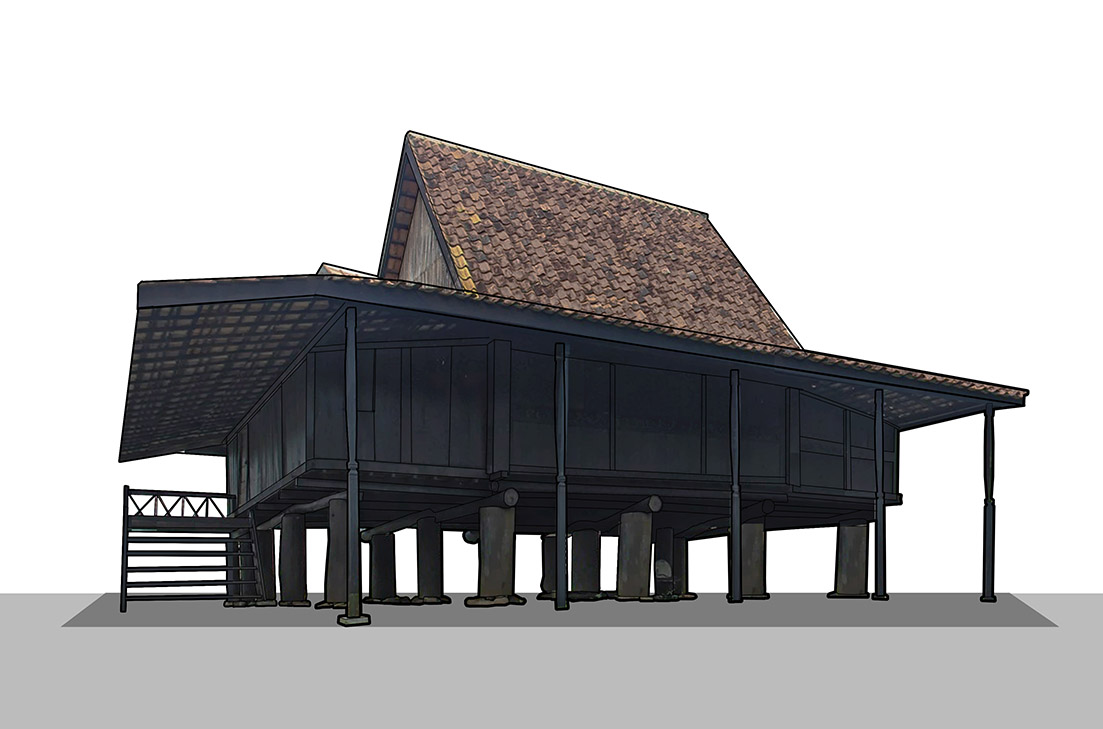
Rumah ulu is a vernacular house found in the highlands of South Sumatra, Indonesia. The house is associated with the Uluan people, who reside in the region upstream of the Ogan and Musi rivers.
Rumah ulu is a traditional house of people living upstream of Musi River, South Sumatra. The name ulu is derived from the word uluan, which means "upstream". The term is also used as a generalization for rural inhabitants of the mountain range of Central Bukit Barisan upstream of the River. The current province of South Sumatra encompasses only a small part of the former administrative region of South Sumatra (the present Sumbagsel or Southern Region of Sumatra), consisting of the provinces of Bengkulu, Jambi, Lampung, and South Sumatra proper (the former Palembang Sultanate).
With modernity, less and less rumah ulu can be found in the hinterland. No new ulu house have been constructed since the 1920s. A 200 years old ulu house is kept in the Balaputradeva Museum. The rumah ulu in the museum was taken from Asamkelat Village in Pengandonan Subdistrict of Ogan Komering Ulu Regency. A couple of old and large rumah ulu can still be found near Baturaja, although without conservation status, these too may be destroyed.
Rumah ulu evolved from an older type of houses known as the rumah uluan, the most basic form of rumah ulu. Rumah uluan is basically a type of wooden stage house, typical vernacular architecture in the Nusantara archipelago.
Rumah uluan was built over very thick wooden posts (tiang duduk/kong), usually numbered six to nine. The posts are about 1.5 metres (4.9 ft) high. A strong hardwood e.g. ulin is used for the posts. The posts are not sunk into the ground, but stand over a flat river stone.
The proper house (dalam) has a square layout. Construction method for the house involves placing a complete frame of the house on top of the posts. The layout is simple, with space divided into two different levels by a 15 centimetres (5.9 in)-high dividing beam (sengkar). The lower area (tempuan), about two-thirds of the total floor area, is where the entrance is located. The lower space is used to prepare and to consume food, with the hearth placed in one corner. In a larger house, the kitchen is located in an additional building known as the beruge. The higher one-third floor area (luan) marks the more private sleeping area. This higher area is also used as the place where elders, or members of the bridge-giving lineage, were seated. The word luan means "stern" of a boat.
Rumah uluan's roof is characterized with projecting gables and rafters which rest on flying roof plates. The construction technique is similar with the Toba Batak houses.
The degree of decorations indicates the wealth of the house owners. Relief carvings (tatahan) are found in places e.g. on the studs and beams of the frame. Frequent motifs are floral e.g., bunge bulan (moonflower) or kembang matahari (sunflower), usually carved on door and the outside of the luan wall.
Rumah ulu
Rumah ulu is a vernacular house found in the highlands of South Sumatra, Indonesia. The house is associated with the Uluan people, who reside in the region upstream of the Ogan and Musi rivers.
Rumah ulu is a traditional house of people living upstream of Musi River, South Sumatra. The name ulu is derived from the word uluan, which means "upstream". The term is also used as a generalization for rural inhabitants of the mountain range of Central Bukit Barisan upstream of the River. The current province of South Sumatra encompasses only a small part of the former administrative region of South Sumatra (the present Sumbagsel or Southern Region of Sumatra), consisting of the provinces of Bengkulu, Jambi, Lampung, and South Sumatra proper (the former Palembang Sultanate).
With modernity, less and less rumah ulu can be found in the hinterland. No new ulu house have been constructed since the 1920s. A 200 years old ulu house is kept in the Balaputradeva Museum. The rumah ulu in the museum was taken from Asamkelat Village in Pengandonan Subdistrict of Ogan Komering Ulu Regency. A couple of old and large rumah ulu can still be found near Baturaja, although without conservation status, these too may be destroyed.
Rumah ulu evolved from an older type of houses known as the rumah uluan, the most basic form of rumah ulu. Rumah uluan is basically a type of wooden stage house, typical vernacular architecture in the Nusantara archipelago.
Rumah uluan was built over very thick wooden posts (tiang duduk/kong), usually numbered six to nine. The posts are about 1.5 metres (4.9 ft) high. A strong hardwood e.g. ulin is used for the posts. The posts are not sunk into the ground, but stand over a flat river stone.
The proper house (dalam) has a square layout. Construction method for the house involves placing a complete frame of the house on top of the posts. The layout is simple, with space divided into two different levels by a 15 centimetres (5.9 in)-high dividing beam (sengkar). The lower area (tempuan), about two-thirds of the total floor area, is where the entrance is located. The lower space is used to prepare and to consume food, with the hearth placed in one corner. In a larger house, the kitchen is located in an additional building known as the beruge. The higher one-third floor area (luan) marks the more private sleeping area. This higher area is also used as the place where elders, or members of the bridge-giving lineage, were seated. The word luan means "stern" of a boat.
Rumah uluan's roof is characterized with projecting gables and rafters which rest on flying roof plates. The construction technique is similar with the Toba Batak houses.
The degree of decorations indicates the wealth of the house owners. Relief carvings (tatahan) are found in places e.g. on the studs and beams of the frame. Frequent motifs are floral e.g., bunge bulan (moonflower) or kembang matahari (sunflower), usually carved on door and the outside of the luan wall.
Recent media
Recent media