



Community hub
Recent from talks
Contribute something to knowledge base
Content stats: 0 posts, 0 articles, 1 media, 0 notes
Members stats: 0 subscribers, 0 contributors, 0 moderators, 0 supporters
Subscribers
Supporters
Contributors
Moderators
Hub AI
Russborough House AI simulator
(@Russborough House_simulator)
Hub AI
Russborough House AI simulator
(@Russborough House_simulator)
Russborough House
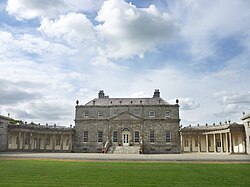
Russborough House is a Georgian Palladian house between Blessington and Ballymore Eustace near the Blessington Lakes in County Wicklow, Ireland. The house was designed by Richard Castle for Joseph Leeson, 1st Earl of Milltown and built between 1741 and 1755. It has an exceptionally long frontage measuring 210 m (690 ft). The interior contains fine ornate plasterwork on the ceilings by the Lafranchini brothers, who also collaborated with Castle on Carton House. Russborough contains an important private collection of European fine and decorative arts, including furniture, silver, porcelain and paintings many of which have now been transferred to galleries for safe keeping.
Russborough is open to visitors and is located on a 200-acre (81 ha) estate, with many of the original 18th-century features still in place including the walled garden, ice-house, lime kiln and the serpentine lakes. There is also a restaurant, shop and 2 km (1.2 mi) maze.
The Leeson family originated from near Culworth in the English county of Northamptonshire and had moved to Ireland by around 1680 with the first recorded member being Hugh Leeson. A sizeable fortune made in brewing and property development in Dublin passed down to Hugh's grandson Joseph Leeson, who bought land at what was then Russelltown. He became an MP and was made Earl of Milltown in 1763.
Russborough House was designed for Joseph Leeson by Richard Castle and built between 1741 and 1755. While the house was being built Joseph embarked on two Grand Tours to acquire a suitably impressive collection of paintings, sculpture and furnishings to adorn his new home. Back at Russborough, Ireland's and Europe's finest artisans and craftspeople were appointed by Castle to create a lavish interior. It remained in the possession of the Earls of Milltown until the sixth earl. On the death of his widow in 1914 it passed to a nephew, Edmund Turton, who rarely stayed there. On Turton's death in 1929, his widow sold the house to Captain Denis Bowes Daly in 1931.
Between 1937 and 1940, the Liffey valley in front of the house was flooded in order to create Poulaphouca Reservoir, also known as the Blessington Lakes.
Sir Alfred Beit bought Russborough in 1952 from Captain Daly to house his art collection and in 1976 established the Alfred Beit Foundation, a registered charity, to manage the property. Described as Ireland's most beautiful Georgian house, the foundation opened the historic mansion and its collections to the Irish public in 1978. Beit died in 1994 and Lady Beit remained in residence until her own death in 2005.
On 7 February 2010, a fire severely damaged the west wing and caused part of the roof to collapse. No art was damaged, having been removed along with furniture to allow for restorations to the west wing. Initial examinations of the damage suggested an electrical fault from wiring in the roof may have sparked the fire.
Russborough is a classical Palladian villa made up of a central block containing the principal rooms and two wings housing the servants and stable blocks to the east and west. Castle enhanced his core design with a wealth of features. The Greek orders are observed in the Doric columns of the colonnades and the Corinthian columns that flank the main entrance, supporting a fused portico enriched with swags of flowers. At the bottom of the flight of granite steps the visitor is greeted by a pair of heraldic lions, bearers of the Leeson arms. Russborough's central block contains seven principal rooms on the ground floor with the largest, the Entrance Hall at centre of the south front, and the main reception room, the Saloon placed directly to its north. The other five rooms, originally comprising two Drawing Rooms, two Dining Rooms, and a Music Room complete a symmetrical arrangement. The ceilings of several rooms and the main stairhall feature elaborate stucco work attributed to the Swiss-Italian stuccodores, Paolo and Filippo Lafrancini.
Russborough House
Russborough House is a Georgian Palladian house between Blessington and Ballymore Eustace near the Blessington Lakes in County Wicklow, Ireland. The house was designed by Richard Castle for Joseph Leeson, 1st Earl of Milltown and built between 1741 and 1755. It has an exceptionally long frontage measuring 210 m (690 ft). The interior contains fine ornate plasterwork on the ceilings by the Lafranchini brothers, who also collaborated with Castle on Carton House. Russborough contains an important private collection of European fine and decorative arts, including furniture, silver, porcelain and paintings many of which have now been transferred to galleries for safe keeping.
Russborough is open to visitors and is located on a 200-acre (81 ha) estate, with many of the original 18th-century features still in place including the walled garden, ice-house, lime kiln and the serpentine lakes. There is also a restaurant, shop and 2 km (1.2 mi) maze.
The Leeson family originated from near Culworth in the English county of Northamptonshire and had moved to Ireland by around 1680 with the first recorded member being Hugh Leeson. A sizeable fortune made in brewing and property development in Dublin passed down to Hugh's grandson Joseph Leeson, who bought land at what was then Russelltown. He became an MP and was made Earl of Milltown in 1763.
Russborough House was designed for Joseph Leeson by Richard Castle and built between 1741 and 1755. While the house was being built Joseph embarked on two Grand Tours to acquire a suitably impressive collection of paintings, sculpture and furnishings to adorn his new home. Back at Russborough, Ireland's and Europe's finest artisans and craftspeople were appointed by Castle to create a lavish interior. It remained in the possession of the Earls of Milltown until the sixth earl. On the death of his widow in 1914 it passed to a nephew, Edmund Turton, who rarely stayed there. On Turton's death in 1929, his widow sold the house to Captain Denis Bowes Daly in 1931.
Between 1937 and 1940, the Liffey valley in front of the house was flooded in order to create Poulaphouca Reservoir, also known as the Blessington Lakes.
Sir Alfred Beit bought Russborough in 1952 from Captain Daly to house his art collection and in 1976 established the Alfred Beit Foundation, a registered charity, to manage the property. Described as Ireland's most beautiful Georgian house, the foundation opened the historic mansion and its collections to the Irish public in 1978. Beit died in 1994 and Lady Beit remained in residence until her own death in 2005.
On 7 February 2010, a fire severely damaged the west wing and caused part of the roof to collapse. No art was damaged, having been removed along with furniture to allow for restorations to the west wing. Initial examinations of the damage suggested an electrical fault from wiring in the roof may have sparked the fire.
Russborough is a classical Palladian villa made up of a central block containing the principal rooms and two wings housing the servants and stable blocks to the east and west. Castle enhanced his core design with a wealth of features. The Greek orders are observed in the Doric columns of the colonnades and the Corinthian columns that flank the main entrance, supporting a fused portico enriched with swags of flowers. At the bottom of the flight of granite steps the visitor is greeted by a pair of heraldic lions, bearers of the Leeson arms. Russborough's central block contains seven principal rooms on the ground floor with the largest, the Entrance Hall at centre of the south front, and the main reception room, the Saloon placed directly to its north. The other five rooms, originally comprising two Drawing Rooms, two Dining Rooms, and a Music Room complete a symmetrical arrangement. The ceilings of several rooms and the main stairhall feature elaborate stucco work attributed to the Swiss-Italian stuccodores, Paolo and Filippo Lafrancini.
Recent media
Recent media