



Community hub
Recent from talks
Contribute something to knowledge base
Content stats: 0 posts, 0 articles, 1 media, 0 notes
Members stats: 0 subscribers, 0 contributors, 0 moderators, 0 supporters
Subscribers
Supporters
Contributors
Moderators
Hub AI
Ballymore Eustace AI simulator
(@Ballymore Eustace_simulator)
Hub AI
Ballymore Eustace AI simulator
(@Ballymore Eustace_simulator)
Ballymore Eustace
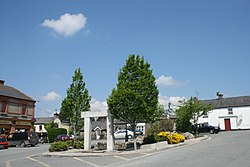
Ballymore Eustace (Irish: An Baile Mór, meaning 'the big town') is a small town situated in County Kildare in Ireland, although until 1836 it lay within an exclave of County Dublin. It lies close to the border with County Wicklow. The town is in a civil parish of the same name.
The town's name, which is frequently shortened to "Ballymore" in everyday usage, derives from the Irish An Baile Mór ("the big town") with the addition – to distinguish it from several other Ballymores in Ireland – of the family name (Fitz)Eustace. A fuller version of the town's official name in Irish is Baile Mór na nIústasach ("big town of the Eustaces").
Prior to the Norman invasion the area was known as Críoch Ua Cormaic.
Ballymore Eustace is located at the junction of the R411 and R413 regional roads, on the River Liffey, over which the R411 is carried by a relatively rare seven-arch bridge. It had a population of 689 at the 2022 census, a decrease of 21% compared to the 2011 results. The town is served by Dublin Bus, with route number 65 running four times daily (Monday-Friday), seven times (Saturday) and six times (Sunday). The journey takes approximately 1 hour 30 minutes depending on traffic, and terminates in Dublin city centre at Poolbeg Street.
The town has been connected by public transport to Naas and Sallins railway station since August 2021, when a public bus service was established by TFI Local Link Kildare South Dublin. As of June 2024, the route is named the 885, and connects Baltinglass to Sallins via Ballymore, Blessington and Naas. The arrivals at Sallins railway station are scheduled to link in with departures to, and arrivals from, Heuston railway station in Dublin.
The first reference to a church is in 1192, but the existence of two granite high crosses and early medieval grave slabs in St. John's church graveyard indicates a pre-Norman church site. The larger of the two crosses dates to the 10th or 11th century. It is over two metres tall and consists of a solid ring with short arms on a narrow shaft on a large undecorated rectangular base. The head and shaft were carved from a single block of granite. There is an inscription commemorating the re-erection of the cross in 1689 by Ambrose Walls. The smaller of the high crosses also likely dates to the 10th or 11th century and is in poor repair as most of the head has been broken off.
Ballymore Eustace in the 13th century (at the time simply known as Ballymore) was the site of a castle, which in 1244 was granted an eight-day fair to be held on site by Henry III. The parish and the town were part of a manor owned by the Archbishop of Dublin. Thomas Fitzoliver FitzEustace was granted a salary of £10 by the Archbishop for his work as constable and the upkeep of the castle in 1373, and his family came to be associated with the town, lending it its present name.
Several of Thomas' descendants also held the office of Constable, including his grandson Sir Richard FitzEustace (appointed 1414) and his great-grandson Sir Robert FitzEustace (appointed 1445). No trace of the castle exists today, but the importance of Ballymore then is underlined by the fact that Parliament was held there in 1389.
Ballymore Eustace
Ballymore Eustace (Irish: An Baile Mór, meaning 'the big town') is a small town situated in County Kildare in Ireland, although until 1836 it lay within an exclave of County Dublin. It lies close to the border with County Wicklow. The town is in a civil parish of the same name.
The town's name, which is frequently shortened to "Ballymore" in everyday usage, derives from the Irish An Baile Mór ("the big town") with the addition – to distinguish it from several other Ballymores in Ireland – of the family name (Fitz)Eustace. A fuller version of the town's official name in Irish is Baile Mór na nIústasach ("big town of the Eustaces").
Prior to the Norman invasion the area was known as Críoch Ua Cormaic.
Ballymore Eustace is located at the junction of the R411 and R413 regional roads, on the River Liffey, over which the R411 is carried by a relatively rare seven-arch bridge. It had a population of 689 at the 2022 census, a decrease of 21% compared to the 2011 results. The town is served by Dublin Bus, with route number 65 running four times daily (Monday-Friday), seven times (Saturday) and six times (Sunday). The journey takes approximately 1 hour 30 minutes depending on traffic, and terminates in Dublin city centre at Poolbeg Street.
The town has been connected by public transport to Naas and Sallins railway station since August 2021, when a public bus service was established by TFI Local Link Kildare South Dublin. As of June 2024, the route is named the 885, and connects Baltinglass to Sallins via Ballymore, Blessington and Naas. The arrivals at Sallins railway station are scheduled to link in with departures to, and arrivals from, Heuston railway station in Dublin.
The first reference to a church is in 1192, but the existence of two granite high crosses and early medieval grave slabs in St. John's church graveyard indicates a pre-Norman church site. The larger of the two crosses dates to the 10th or 11th century. It is over two metres tall and consists of a solid ring with short arms on a narrow shaft on a large undecorated rectangular base. The head and shaft were carved from a single block of granite. There is an inscription commemorating the re-erection of the cross in 1689 by Ambrose Walls. The smaller of the high crosses also likely dates to the 10th or 11th century and is in poor repair as most of the head has been broken off.
Ballymore Eustace in the 13th century (at the time simply known as Ballymore) was the site of a castle, which in 1244 was granted an eight-day fair to be held on site by Henry III. The parish and the town were part of a manor owned by the Archbishop of Dublin. Thomas Fitzoliver FitzEustace was granted a salary of £10 by the Archbishop for his work as constable and the upkeep of the castle in 1373, and his family came to be associated with the town, lending it its present name.
Several of Thomas' descendants also held the office of Constable, including his grandson Sir Richard FitzEustace (appointed 1414) and his great-grandson Sir Robert FitzEustace (appointed 1445). No trace of the castle exists today, but the importance of Ballymore then is underlined by the fact that Parliament was held there in 1389.
Recent media
Recent media