



Community hub
Recent from talks
Knowledge base stats:
Talk channels stats:
Members stats:
Russian language in Ukraine
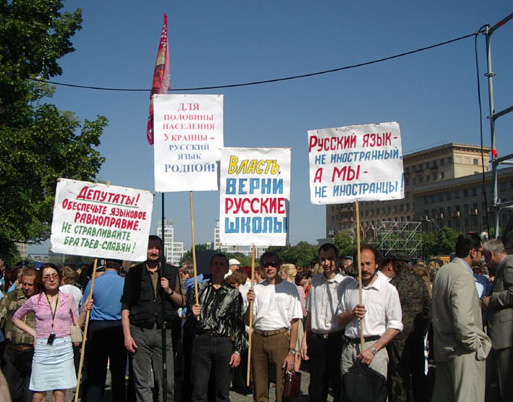
Russian is the most common first language in the Donbas and Crimea regions of Ukraine and the city of Kharkiv, and the predominant language in large cities in the eastern and southern portions of the country.[needs update] The usage and status of the language is the subject of political disputes. Ukrainian is the country's sole state language since the adoption of the 1996 Constitution, which prohibits an official bilingual system at state level but also guarantees the free development, use and protection of Russian and other languages of national minorities. In 2017 a new Law on Education was passed which restricted the use of Russian as a language of instruction.
The East Slavic languages originated in the language spoken in Rus in the medieval period. Significant differences in spoken language in different regions began after the division of the Rus lands between the Golden Horde (from about 1240) and the Grand Duchy of Lithuania. The Lithuanian state eventually allied with the Kingdom of Poland in the Polish–Lithuanian Commonwealth of 1569–1795. Russians under the Golden Horde developed what became the modern Russian language; people in the northern Lithuanian sector developed Belarusian, and in the southern Polish sector Ukrainian.
The ethnonym "Ukrainian" for the south-eastern Slavic people did not become well-established until the 19th century, although English-speakers (for example) called those peoples' land "Ukraine" in English from before the 18th century (the Oxford English Dictionary traces the word "Ukrainian" in English back as far as 1804, and records its application to the Ukrainian language from 1886). The western part of the country, Austrian Galicia, Bukovina, and Carpathian Ruthenia, was generally known in German, French and English as "Ruthenia", and the people as "Ruthenians." The Russian imperial centre, however, preferred the names "Little" and "White" Russias for the Ukrainian and Belarusian lands respectively, as distinct from Great Russia.
No definitive geographical border separated people speaking Russian and those speaking Ukrainian – rather gradual shifts in vocabulary and pronunciation marked the areas between the historical cores of the languages.
Although Goriuns resided in the Putyvl region (in present-day northern Ukraine) in the times of Grand Duchy of Lithuania or perhaps even earlier, the Russian language mostly came through the migration of ethnic Russians to Ukraine and through the adoption of the Russian language by Ukrainians during the Russification of Ukraine.[citation needed]
The first new waves of Russian settlers onto what is now Ukrainian territory came in the late-16th century to the empty lands of Slobozhanshchyna (in the region of Kharkiv) that Russia had gained from the Tatars, or from the Grand Duchy of Lithuania[citation needed] - although Ukrainian peasants from the Polish-Lithuanian west escaping harsh exploitative conditions outnumbered them.
More Russian speakers appeared in the northern, central and eastern territories of modern Ukraine during the late-17th century, following the Cossack Rebellion (1648–1657) which Bohdan Khmelnytsky led against Poland. The Khmelnytsky Uprising led to a massive movement of Ukrainian settlers to the Slobozhanshchyna region, which converted it from a sparsely inhabited frontier area to one of the major populated regions of the Tsardom of Russia.[citation needed] Following the Pereyaslav Rada of 1654 the northern and eastern parts of present-day Ukraine came under the hegemony of the Russian Tsardom. This brought the first significant, but still small, wave of Russian settlers into central Ukraine (primarily several thousand soldiers stationed in garrisons,[need quotation to verify] out of a population of approximately 1.2 million non-Russians). Although the number of Russian settlers in Ukraine prior to the 18th century remained small, the local upper-classes within the part of Ukraine acquired by Russia came to use the Russian language widely.
Beginning in the late 18th century, large numbers of Russians (as well as of Armenians, Bulgarians, Greeks and of other Christians and Jews) settled in newly acquired lands in what is now southern Ukraine, a region then known as Novorossiya ("New Russia"). These lands – previously known as the Wild Fields – had been sparsely populated prior to the 18th century due to the threat of Crimean-Tatar raids, but once Saint Petersburg had eliminated the Tatar state as a threat, Russian nobles were granted large tracts of fertile land for working by newly arrived peasants, most of them ethnic Ukrainians but many of them Russians.
Hub AI
Russian language in Ukraine AI simulator
(@Russian language in Ukraine_simulator)
Russian language in Ukraine
Russian is the most common first language in the Donbas and Crimea regions of Ukraine and the city of Kharkiv, and the predominant language in large cities in the eastern and southern portions of the country.[needs update] The usage and status of the language is the subject of political disputes. Ukrainian is the country's sole state language since the adoption of the 1996 Constitution, which prohibits an official bilingual system at state level but also guarantees the free development, use and protection of Russian and other languages of national minorities. In 2017 a new Law on Education was passed which restricted the use of Russian as a language of instruction.
The East Slavic languages originated in the language spoken in Rus in the medieval period. Significant differences in spoken language in different regions began after the division of the Rus lands between the Golden Horde (from about 1240) and the Grand Duchy of Lithuania. The Lithuanian state eventually allied with the Kingdom of Poland in the Polish–Lithuanian Commonwealth of 1569–1795. Russians under the Golden Horde developed what became the modern Russian language; people in the northern Lithuanian sector developed Belarusian, and in the southern Polish sector Ukrainian.
The ethnonym "Ukrainian" for the south-eastern Slavic people did not become well-established until the 19th century, although English-speakers (for example) called those peoples' land "Ukraine" in English from before the 18th century (the Oxford English Dictionary traces the word "Ukrainian" in English back as far as 1804, and records its application to the Ukrainian language from 1886). The western part of the country, Austrian Galicia, Bukovina, and Carpathian Ruthenia, was generally known in German, French and English as "Ruthenia", and the people as "Ruthenians." The Russian imperial centre, however, preferred the names "Little" and "White" Russias for the Ukrainian and Belarusian lands respectively, as distinct from Great Russia.
No definitive geographical border separated people speaking Russian and those speaking Ukrainian – rather gradual shifts in vocabulary and pronunciation marked the areas between the historical cores of the languages.
Although Goriuns resided in the Putyvl region (in present-day northern Ukraine) in the times of Grand Duchy of Lithuania or perhaps even earlier, the Russian language mostly came through the migration of ethnic Russians to Ukraine and through the adoption of the Russian language by Ukrainians during the Russification of Ukraine.[citation needed]
The first new waves of Russian settlers onto what is now Ukrainian territory came in the late-16th century to the empty lands of Slobozhanshchyna (in the region of Kharkiv) that Russia had gained from the Tatars, or from the Grand Duchy of Lithuania[citation needed] - although Ukrainian peasants from the Polish-Lithuanian west escaping harsh exploitative conditions outnumbered them.
More Russian speakers appeared in the northern, central and eastern territories of modern Ukraine during the late-17th century, following the Cossack Rebellion (1648–1657) which Bohdan Khmelnytsky led against Poland. The Khmelnytsky Uprising led to a massive movement of Ukrainian settlers to the Slobozhanshchyna region, which converted it from a sparsely inhabited frontier area to one of the major populated regions of the Tsardom of Russia.[citation needed] Following the Pereyaslav Rada of 1654 the northern and eastern parts of present-day Ukraine came under the hegemony of the Russian Tsardom. This brought the first significant, but still small, wave of Russian settlers into central Ukraine (primarily several thousand soldiers stationed in garrisons,[need quotation to verify] out of a population of approximately 1.2 million non-Russians). Although the number of Russian settlers in Ukraine prior to the 18th century remained small, the local upper-classes within the part of Ukraine acquired by Russia came to use the Russian language widely.
Beginning in the late 18th century, large numbers of Russians (as well as of Armenians, Bulgarians, Greeks and of other Christians and Jews) settled in newly acquired lands in what is now southern Ukraine, a region then known as Novorossiya ("New Russia"). These lands – previously known as the Wild Fields – had been sparsely populated prior to the 18th century due to the threat of Crimean-Tatar raids, but once Saint Petersburg had eliminated the Tatar state as a threat, Russian nobles were granted large tracts of fertile land for working by newly arrived peasants, most of them ethnic Ukrainians but many of them Russians.