


Community hub
Recent from talks
Contribute something
Nothing was collected or created yet.
Novorossiya
View on Wikipedia | This article needs additional citations for verification. (June 2023) |

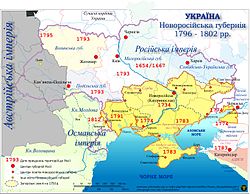
Novorossiya[nb 1] is a historical name, used during the era of the Russian Empire for an administrative area that would later become the southern mainland of Ukraine: the region immediately north of the Black Sea and Crimea. The name Novorossiya, which means "New Russia", entered official usage in 1764, after the Russian Empire conquered the Crimean Khanate, and annexed its territories,[1] when Novorossiya Governorate (or Province) was founded. Official usage of the name ceased after 1917, when the entire area (minus Crimea) was annexed by the Ukrainian People's Republic, precursor of the Ukrainian SSR.
Novorossiya Governorate was formed in 1764 from military frontier regions and parts of the southern Hetmanate, in anticipation of a war with the Ottoman Empire.[2] It was further expanded by the annexation of the Zaporozhian Sich in 1775. At various times, Novorossiya encompassed the modern Ukraine's regions of the Black Sea littoral (Prychornomoria), Zaporizhzhia, Tavria, the Azov Sea littoral (Pryazovia), the Tatar region of Crimea, the area around the Kuban River, and the Circassian lands.
History
[edit]Before 18th century
[edit]

The modern history of the region follows the fall of the Golden Horde. The eastern portion was claimed by the Crimean Khanate (one of its multiple successors), while its western regions were divided between Moldavia and Lithuania. With the expansion of the Ottoman Empire, the whole Black Sea northern littoral region came under the control of the Crimean Khanate that in turn became a vassal of the Ottomans.[3] Sometime in the 16th century the Crimean Khanate allowed the Nogai Horde which were displaced from its native Volga region by Muscovites and Kalmyks to settle in the Black Sea steppes.[4]
Vast regions to the North of the Black Sea were sparsely populated and were known on medieval maps as Loca deserta (Latin for 'Desolated Places'), Wild Fields (as translated from Polish or Ukrainian), or Dykra (in Lithuanian). There were, however, many settlements along the Dnieper River. The Wild Fields had covered roughly the southern territories of modern Ukraine; some[who?] say they extended into the modern Southern Russia (Rostov Oblast).[citation needed]
Russian Empire (1764–1917)
[edit]
The Russian Empire gradually gained control over the area, signing peace treaties with the Cossack Hetmanate and with the Ottoman Empire at the conclusion of the Russo-Turkish Wars of 1735–39, 1768–74, 1787–92 and 1806–12. In 1764 the Russian Empire established the Novorossiysk Governorate; it was originally to be named after the Empress Catherine, but she decreed that it should be called New Russia instead.[5] Imperial Russia's view of New Russia was described in 2006 by the historian Willard Sunderland:
The old steppe was Asian and stateless; the current one was state-determined and claimed for European-Russian civilization. The world of comparison was now even more obviously that of the Western empires. Consequently it was all the more clear that the Russian empire merited its own New Russia to go along with everyone else's New Spain, New France, and New England. The adoption of the name of New Russia was in fact the most powerful statement imaginable of Russia's national coming of age.[6]
The administrative center of the Novorossiysk Governorate was at the Fortress of St. Elizabeth (today in Kropyvnytskyi) in order to protect the southern borderlands from the Ottoman Empire, and in 1765 this passed to Kremenchuk.[5][7]
After the annexation of the Ottoman territories to Novorossiya in 1774, the Russian authorities commenced a broad program of colonization, encouraging large migrations from a broader spectrum of ethnic groups. Catherine the Great invited European settlers to these newly conquered lands: Romanians (from Moldavia, Wallachia and Transylvania), Bulgarians, Serbs, Greeks, Albanians, Germans, Poles, Italians, and others.[citation needed] Catherine the Great granted Prince Grigori Potemkin (1739–1791) the powers of an absolute ruler over the area from 1774, after which he directed the Russian colonization of the land. The rulers of Novorossiya gave out land generously to the Russian nobility (dvoryanstvo) and the enserfed peasantry—mostly from Ukraine and fewer from Russia—to encourage immigration for the cultivation of the then sparsely populated steppe.[citation needed] According to the Historical Dictionary of Ukraine:
The population consisted of military colonists from hussar and lancer regiments, Ukrainian and Russian peasants, Cossacks, Serbs, Montenegrins, Hungarians, and other foreigners who received land subsidies for settling in the area.[8]
In 1775, the Russian Empress Catherine the Great forcefully liquidated the Zaporizhian Sich and annexed its territory to Novorossiya, thus eliminating the independent rule of the Ukrainian Cossacks.[citation needed] The governorate was dissolved in 1783.[citation needed] In 1792, the Russian government declared that the region between the Dniester and the Bug was to become a new principality named "New Moldavia", under Russian suzerainty.[9] According to the first Russian census of the Yedisan region conducted in 1793 (after the expulsion of the Nogai Tatars) 49 villages out of 67 between the Dniester and the Southern Bug were Romanian.[10] From 1796 to 1802 Novorossiya was the name of the reestablished Governorate with the capital Novorossiysk (previously and subsequently Ekaterinoslav, the present-day Ukrainian city of Dnipropetrovsk not to be confused with present-day Novorossiysk, Russian Federation). In 1802 it was divided into three governorates, the Yekaterinoslav, Kherson, and the Taurida.[citation needed]

From 1822 to 1873 the Novorossiysk-Bessarabia General Government was centred in Odesa. The region remained part of the Russian Empire until its collapse following the Russian February Revolution in early March 1917.
Soviet era (1918–1990)
[edit]The territory became part of the short-lived Russian Republic for one year, then in 1918 it was largely included in the Ukrainian State and in the Ukrainian Soviet Republic at the same time. In 1918–1920 it was, to varying extents, under the control of the anti-Bolshevik White movement governments of South Russia, whose defeat signified the Soviet control over the territory, which became part of the Ukrainian Soviet Socialist Republic within the Soviet Union in 1922.
Legacy
[edit]Following the Soviet Union's collapse on 26 December 1991 and concurrent with the lead-up to Ukrainian independence on 24 August 1991, a nascent movement began in Odesa for the restoration of Novorossiya region; it however failed within days and never defined its borders.[11][12][13] The initial conception had not developed exact borders, but focus centred on the Odesa, Mykolaiv, Kherson, and Crimean oblasts, with eventually other oblasts joining as well.[13][14]
The name received renewed emphasis when Russian President Vladimir Putin stated in an interview on 17 April 2014 that the territories of Kharkiv, Luhansk, Donetsk, Kherson, Mykolaiv and Odesa were part of what was called Novorossiya.[15][16][nb 2] In May 2014, the self-proclaimed Donetsk People's Republic and Luhansk People's Republic proclaimed the confederation of Novorossiya and its desire to extend its control towards all of southeastern Ukraine.[19][20][21] The confederation had little practical unity and within a year the project was abandoned: on 1 January 2015 the founding leadership announced the project had been put on hold, and on 20 May the constituent members announced the freezing of the political project.[22][23][24]
Anna Nemtsova forecast this disintegration in August 2014, and she predicted the 2022 Russian invasion of Ukraine then too.[25] Oksana Yanyshevskaya, a Ukrainian government official, in a July 2014 interview with her said that Novorossiya "is some sort of artificial idea that lives only in the minds of people in the Kremlin."[25]
In 2016 Marlène Laruelle wrote that Alexander Prokhanov formed the Izborsky Club around the Novorossiya meme.[26][27]
Gerard Toal opines that "In breaking apart a sovereign territorial state, it is helpful, if not always necessary, to have an alternative geopolitical imaginary at the ready and for this ersatz replacement to have some degree of local credibility and support." The Novorossiya idea is just this portmanteau.[28][29]
The idea of Novorossiya goes hand-in-hand with the erasure of Ukrainian statehood,[30] or as Vladislav Surkov said in his defenestration interview in February 2020, "There is Ukrainian-ness. That is, a specific disorder of the mind. An astonishing enthusiasm for ethnography, driven to the extreme." Surkov claims that Ukraine is "a muddle instead of a state. […] But there is no nation. There is only a brochure, 'The Self-Styled Ukraine', but there is no Ukraine."[31]
During the Wagner Group mutiny in June 2023, President Putin used the phrase in a speech responding to the mutiny, praising those "who fought and gave their lives to Novorossiya and for the unity of the Russky Mir".[32]
In an interview in August 2025, Russian Foreign Minister Sergey Lavrov used the term to refer to an area separate from the Donbas and Crimea, alleging that, despite Russia's invasion, "Neither Crimea, nor Donbas, nor Novorossiya as territories have ever been our goal."[33]
Demographics
[edit]Ethnicity
[edit]The ethnic composition of Novorossiya changed during the beginning of the 19th century due to the intensive movement of colonists who rapidly created towns, villages, and agricultural colonies. During the Russo-Turkish Wars, the major Turkish fortresses of Ozu-Cale, Akkerman, Khadzhibey, Kinburn and many others were conquered and destroyed. New cities and settlements were established in their places. Over time the ethnic composition varied.[clarification needed]
Multiple ethnicities[clarification needed] participated in the founding of the cities of Novorossiya (most of these cities were expansions of older settlements[34]). For example:
- Zaporizhzhia as formerly the site of a Cossack fort
- Odesa, founded in 1794 on the site of a Tatar village (the first recorded mention of a settlement located in current Odesa was in 1415[34]) by a Spanish general in Russian service, José de Ribas, had a French mayor, Richelieu (in office 1803–1814)
- Donetsk, founded in 1869, was originally named Yuzovka (Yuzivka) in honor of John Hughes, the Welsh industrialist who developed the coal region of the Donbas
According to the report of governor Aleksandr Shmidt (ru), the ethnic composition of Kherson Governorate (which included the city of Odesa) in 1851 was as follows:[35]
| Nationality | Number | % |
|---|---|---|
| Ukrainians (Malorussians) | 703,699 | 69.14 |
| Romanians (Moldavians and Vlachs) | 75,000 | 7.37 |
| Jews | 55,000 | 5.40 |
| Russian-Germans | 40,000 | 3.93 |
| Great Russians | 30,000 | 2.95 |
| Bulgarians | 18,435 | 1.81 |
| Belarusians | 9,000 | 0.88 |
| Greeks | 3,500 | 0.34 |
| Romani people | 2,516 | 0.25 |
| Poles | 2,000 | 0.20 |
| Armenians | 1,990 | 0.20 |
| Karaites | 446 | 0.04 |
| Serbs | 436 | 0.04 |
| Swedes | 318 | 0.03 |
| Tatars | 76 | 0.01 |
| Former Officials | 48,378 | 4.75 |
| Nobles | 16,603 | 1.63 |
| Foreigners | 10,392 | 1.02 |
| Total Population | 1,017,789 | 100 |
Language
[edit]With regard to language usage, Russian was commonly spoken in the cities and some outside areas, while Ukrainian generally predominated in rural areas, smaller towns, and villages.[clarification needed]
The 1897 All-Russian Empire Census statistics show that Ukrainian was the native language spoken by most of the population of Novorossiya, but with Russian and Yiddish languages dominating in most city areas.[36][37][38]

| Language | Kherson Guberniya | Yekaterinoslav Guberniya | Tavrida Guberniya |
|---|---|---|---|
| Ukrainian | 53.4% | 68.9% | 42.2% |
| Russian | 21.0% | 17.3% | 27.9% |
| Belarusian | 0.8% | 0.6% | 6.7% |
| Polish | 2.1% | 0.6% | 0.6% |
| Bulgarian | 0.9% | – | 2.8% |
| Romanian | 5.3% | 0.4% | 0.2% |
| German | 4.5% | 3.8% | 5.4% |
| Jewish (sic) | 11.8% | 4.6% | 3.8% |
| Greek | 2.3% | 2.3% | 1.2% |
| Tatar | 8.2% | 8.2% | 13.5% |
| Turkish | 2.6% | 2.6% | 1.5% |
| Total Population | 2,733,612 | 2,311,674 | 1,447,790 |
The 1897 All-Russian Empire Census statistics:[39]
| Language | Odesa | Yekaterinoslav | Mykolaiv | Kherson | Sevastopol | Mariupol | Donetsk district |
|---|---|---|---|---|---|---|---|
| Russian | 198,233 | 47,140 | 61,023 | 27,902 | 34,014 | 19,670 | 273,302 |
| Jewish (sic) | 124,511 | 39,979 | 17,949 | 17,162 | 3,679 | 4,710 | 7 |
| Ukrainian | 37,925 | 17,787 | 7,780 | 11,591 | 7,322 | 3,125 | 177,376 |
| Polish | 17,395 | 3,418 | 2,612 | 1,021 | 2,753 | 218 | 82 |
| German | 10,248 | 1,438 | 813 | 426 | 907 | 248 | 2,336 |
| Greek | 5,086 | 161 | 214 | 51 | 1,553 | 1,590 | 88 |
| Total Population | 403,815 | 112,839 | 92,012 | 59,076 | 53,595 | 31,116 | 455,819 |
List of founded cities
[edit]Many of the cities that were founded (most of these cities were expansions of older settlements[34]) during the imperial period are major cities today.
Imperial Russian regiments were used to build these cities, at the expense of hundreds of soldiers' lives.[34]
First wave
[edit]- Yelisavetgrad (Kropyvnytskyi) (1754)
- Aleksandrovsk (Zaporizhzhia) (1770)
- Yekaterinoslav (Dnipro) (1776)
- Kherson (1778)
- Mariupol (1778)
- Olviopol (Pervomaisk) (1781)
- Sevastopol (1783)
- Simferopol (1784)
- Melitopol (1784)
- Pavlohrad (1784)
Second wave
[edit]Third wave
[edit]- Berdiansk (1827)
- Novorossiysk (1838)
- Melitopol (1842)
See also
[edit]Notes
[edit]- ^ lit. "New Russia"; Russian: Новороссия, romanized: Novorossiya, IPA: [nəvɐˈrosʲːɪjə] ⓘ; Ukrainian: Новоросія, romanized: Novorosiia, IPA: [nowoˈrɔs⁽ʲ⁾ijɐ]; Romanian: Novorusia or Noua Rusie; Polish: Noworosja.
- ^ Kharkiv was the centre of the historical region of Sloboda Ukraine.[17] A portion of modern Kharkiv Oblast includes territory of the late-eighteenth century Novorossiya Governorate.[18]
References
[edit]- ^ "Plan for the Colonization of New Russia Gubernia" issued by the Russian Senate – New Russia Gubernia at the Encyclopedia of Ukraine
- ^ Magocsi, Paul R. "A History of Ukraine: The Land and Its Peoples," p. 284.
- ^ Kabotyanski, Daniil. Crimean Khanate and the Northern Black Sea Steppe in the 16th Century (PDF) (MA thesis). Budapest: Central European University. Retrieved 1 December 2025.
- ^ Vintserovich, Trepavlov Vadim. "Trepavlov V. V. Steppe shield of the Yurt: formation of the Noghay population of the Crimean Khanate (the 16th – the 1st half of the 17th century). Krymskoe istoricheskoe obozrenie, Crimean Historical Review. 2019, no. 2, pp. 108–125". Crimean Review. Retrieved 1 December 2025.
{{cite web}}: CS1 maint: url-status (link) - ^ a b Nataliya Polonska-Vasylenko (1955). The Settlement of the Southern Ukraine (1750–1775). Ukrainian Academy of Arts and Sciences in the U.S. p. 190.
- ^ Willard Sunderland (2006). Taming the Wild Field: Colonization and Empire on the Russian Steppe. Cornell University Press. p. 70. ISBN 0-8014-7347-0.
- ^ "New Russian gubernia". Encyclopedia of Ukraine. Archived from the original on 15 August 2015. Retrieved 4 January 2015.
- ^ Ivan Katchanovski; Zenon E. Kohut; Bohdan Y. Nebesio; Myroslav Yurkevich (21 June 2013). Historical Dictionary of Ukraine. Scarecrow Press. p. 392. ISBN 978-0-8108-7847-1.
- ^ E. Lozovan, Romanii orientali, "Neamul Romanesc", 1/1991, p.14
- ^ E. Lozovan, Romanii orientali, "Neamul Romanesc", 1/1991, p.32.
- ^ "The CIS Handbook", edited by Patrick Heenan, Monique Lamontagne, Fitzroy Dearborn Publishers, 1999, p. 75.
- ^ "Federal State of Novorossiya". GlobalSecurity.org. Archived from the original on 9 August 2014. Retrieved 18 February 2015.
A Russian ethnic republic in Ukraine was named Novorossiya and was proclaimed in 1992 but fell some days after.
- ^ a b Paul Kolstoe. "Russians in the Former Soviet Republics", Indiana University Press, June 1995, p. 176.
- ^ Zbigniew Brzezinski; Paige Sullivan (1997). Russia and the Commonwealth of Independent States: Documents, Data, and Analysis. Center for Strategic and International Studies (Washington, D.C.); M.E. Sharpe Inc. p. 639. ISBN 978-1-56324-637-1.
- ^ Adam Taylor (18 April 2014). "'Novorossiya,' the latest historical concept to worry about in Ukraine". Washington Post.
- ^ "Transcript: Vladimir Putin's April 17 Q&A". Washington Post. Archived from the original on 8 February 2015. Retrieved 18 February 2015.
- ^ Unmaking Imperial Russia: Mykhailo Hrushevsky and the Writing of Ukrainian History by Serhii Plokhy, University of Toronto Press, 2005, ISBN 0802039375 (page 19)
- ^ Frontline Ukraine: Crisis in the Borderlands by Richard Sakwa, I.B. Tauris, 2015, ISBN 1784530646 (page 9)
- ^ "Death of Novorossia: Why Kremlin Abandoned Ukraine Separatist Project". 25 May 2015.
- ^ СМИ: Террористы из "ДНР" и "ЛНР" объединились [Mass media: Terrorists of the "LNR" and "DNR" have united] (in Russian). UNIAN. 24 May 2014. Archived from the original on 25 May 2014. Retrieved 26 May 2014.
- ^ Katarzyna Chawryło (29 December 2014). "Russian nationalists on the Kremlin's policy in Ukraine". OSW Commentary. Centre for Eastern Studies.
- ^ "Russian-backed 'Novorossiya' breakaway movement collapses". Ukraine Today. 20 May 2015. Archived from the original on 21 May 2015. Retrieved 17 June 2016.
Vladimir Dergachev; Dmitriy Kirillov (20 May 2015). Проект «Новороссия» закрыт [Project "New Russia" is closed]. Gazeta.ru (in Russian). Archived from the original on 19 December 2016. Retrieved 17 June 2016. - ^ "Why the Kremlin Is Shutting Down the Novorossiya Project". Carnegie Endowment for International Peace. Archived from the original on 22 December 2015. Retrieved 20 December 2015.
- ^ Marsh, Christopher (2023). "Putin's Playbook: The Development of Russian Tactics, Operations, and Strategy from Chechnya to Ukraine". The Great Power Competition Volume 5. pp. 161–183. doi:10.1007/978-3-031-40451-1_8. ISBN 978-3-031-40450-4.
- ^ a b "Novorossiya is Coming Apart at the Seams". 16 May 2024.
- ^ LARUELLE, MARLENE. “The Izborsky Club, or the New Conservative Avant-Garde in Russia.” The Russian Review 75, no. 4 (2016): 626–44. http://www.jstor.org/stable/43919640.
- ^ Laruelle, Marlene (2016). "The three colors of Novorossiya, or the Russian nationalist mythmaking of the Ukrainian crisis". Post-Soviet Affairs. 32: 55–74. doi:10.1080/1060586X.2015.1023004.
- ^ Toal, Gerard (2017). "The Novorossiya Project". Near Abroad. doi:10.1093/oso/9780190253301.003.0013. ISBN 978-0-19-025330-1.
- ^ John O'Loughlina, Gerard Toal, and Vladimir Kolosov: "The rise and fall of "Novorossiya": examining support for a separatist geopolitical imaginary in southeast Ukraine", Post Soviet Affairs Vol 32, no. 2 (2017), 124-144.
- ^ Arutunyan, Anna (2022). Hybrid Warriors: Proxies, Freelancers and Moscow's Struggle for Ukraine. London: C. Hurst & Co. ISBN 978-1-78738-972-4.
- ^ ""There is no Ukraine": Fact-Checking the Kremlin's Version of Ukrainian History". July 2020.
- ^ "'Internal betrayal': Transcript of Vladimir Putin's address". Al Jazeera.
- ^ Psaropoulos, John T. "A week of summits reveals Trump is closer to Moscow than Europe". Al Jazeera. Retrieved 26 November 2025.
- ^ a b c d Odesa: Through Cossacks, Khans and Russian Emperors Archived 24 October 2018 at the Wayback Machine, The Ukrainian Week (18 November 2014)
- ^ Шмидт А. "Материалы для географии и статистики, собранные офицерами генерального штаба. Херсонская губерния. Часть 1". (tr. "Schmidt A.: Materials for geography and statistics collected by officers of the general staff. Kherson province. Part 1") St. Petersburg, 1863, p. 465-466
- ^ "First General Census of the Russian Empire of 1897. Breakdown of population by mother tongue: Kharkov governorate – total population". Demoskop Weekly. No. 623–624. 31 December 2014. ISSN 1726-2887. Archived from the original on 2 May 2014. Retrieved 4 January 2015.
- ^ "First General Census of the Russian Empire of 1897. Breakdown of population by mother tongue: Kherson district – the city of Kherson". Demoskop Weekly. No. 623–624. 31 December 2014. ISSN 1726-2887. Archived from the original on 4 March 2016. Retrieved 4 January 2015.
- ^ "First General Census of the Russian Empire of 1897. Breakdown of population by mother tongue: Kherson district – the city of Nikolayev (military governorate)". Demoskop Weekly. No. 623–624. 31 December 2014. ISSN 1726-2887. Archived from the original on 17 May 2014. Retrieved 4 January 2015.
- ^ "First General Census of the Russian Empire of 1897. Breakdown of population by mother tongue: Donetsk district – total population". Demoskop Weekly. No. 623–624. 31 December 2014. ISSN 1726-2887. Archived from the original on 11 September 2014. Retrieved 4 January 2015.
External links
[edit] Media related to Novorossiya at Wikimedia Commons
- Map of Novorossiya (New Russia)
- Novorossiya leaders and Odesa mayors Archived 3 March 2016 at the Wayback Machine

47°30′N 34°30′E / 47.5°N 34.5°E
| International | |
|---|---|
| National | |

Novorossiya
View on GrokipediaDefinition and Geography
Historical Extent and Boundaries
The Novorossiya Governorate was established in 1764 by the Russian Empire to administer southern frontier territories acquired from the Zaporozhian Cossacks, Hetman state, and adjacent steppe regions.[5] [6] Its initial extent included New Serbia, Slavo-Serbia, the Ukrainian Line, Slobidskyi Regiment territories, and portions of the Poltava, Myrhorod, Lubny, and Pereiaslav regiments of the Hetmanate.[5] The administrative center was relocated to Kremenchuk in 1765.[5] The governorate was divided into the Elizabethan Province west of the Dnieper River, consisting of five regiments, and the Catherinian Province east of the Dnieper, incorporating four regiments along with Bakhmut county.[5] Following the Russo-Turkish War (1768–1774, its boundaries expanded southward to incorporate lands between the Dnieper and Southern Bug rivers as well as the Black Sea littoral annexed from the Ottoman Empire.[5] In 1775, the territory further integrated the dissolved Zaporozhian Sich's free lands.[5] By 1776, administrative subdivisions included counties centered in Kremenchuk, Yelysavethrad (three counties), Poltava (two counties), Sloviansk and Nikopol (three counties), and Kherson (three counties).[5] The unit was reorganized as the Katerynoslav Vicegerency in 1783, briefly revived as New Russia Gubernia in 1797, and subdivided into separate governorates in 1802.[5] Throughout the 19th century, the designation Novorossiya persisted to describe the broader colonized steppe region of southern Ukraine, generally bounded by the Black Sea to the south, the Dnieper River to the east, the Southern Bug to the west, and extending northward into the forest-steppe transition zones, encompassing areas of intensive Russian settlement and agricultural development.[2] This extent roughly aligned with the later Kherson, Yekaterinoslav, and Tavrida governorates, reflecting ongoing imperial consolidation along the northern Black Sea coast.[5]Modern Territorial Claims
In May 2014, amid unrest following Ukraine's Euromaidan Revolution, leaders of the self-proclaimed Donetsk People's Republic (DPR) and Luhansk People's Republic (LPR) declared the formation of a Federal State of Novorossiya, aspiring to unite eight southeastern Ukrainian oblasts—Donetsk, Luhansk, Kharkiv, Dnipropetrovsk, Zaporizhzhia, Kherson, Mykolaiv, and Odesa—into a confederation aligned with Russia.[1] [7] This initiative sought to revive the historical concept of Novorossiya as a distinct geopolitical entity, citing cultural and ethnic ties to Russia, but gained effective control only in portions of Donetsk and Luhansk oblasts due to limited local support elsewhere and Ukrainian military counteroffensives.[3] The project was formally suspended in late 2015 after failed attempts to expand beyond the Donbas, with no referendums or governance structures established in the other targeted regions.[1] The concept reemerged in Russian rhetoric during the escalation of conflict in 2022. On February 21, 2022, Russian President Vladimir Putin, in announcing recognition of DPR and LPR independence, invoked historical Novorossiya to argue that southeastern Ukraine—including Kharkiv, Odesa, Mykolaiv, and adjacent areas—had been artificially incorporated into Ukraine by Soviet authorities, framing these territories as inherently Russian lands requiring "reunification."[8] This narrative positioned the claims as corrective of Bolshevik-era borders rather than new conquests, emphasizing ethnic Russian populations and historical settlement patterns.[9] Following Russia's full-scale invasion on February 24, 2022, Moscow advanced territorial assertions by organizing referendums in occupied areas of Donetsk, Luhansk, Kherson, and Zaporizhzhia oblasts from September 23–27, 2022, purporting overwhelming support for joining Russia.[7] On September 30, 2022, Russia formally annexed these four oblasts in their entirety—totaling approximately 120,000 square kilometers and encompassing about 15% of Ukraine's pre-2014 territory—declaring them federal subjects and integral to a restored Novorossiya aligned with Russian security interests.[10] [7] Putin described the annexations as irreversible, tying them to protection of Russian speakers and reversal of post-Soviet fragmentation, though actual control remains partial in Kherson and Zaporizhzhia, with ongoing fighting as of October 2025.[10] These claims exclude the broader 2014 ambitions for Kharkiv, Dnipropetrovsk, Mykolaiv, and Odesa, focusing instead on the four oblasts as the viable core of historical Novorossiya.[9] Internationally, the annexations lack recognition beyond Russia and its allies, viewed as violations of Ukraine's sovereignty under the 1994 Budapest Memorandum and UN Charter.[11]Historical Development
Pre-Russian Settlement
![Beauplan's 17th-century map of the region][float-right] The Novorossiya region, corresponding to the northern Pontic-Caspian steppe, exhibits archaeological evidence of human activity from the Chalcolithic period, with the Yamnaya culture representing early pastoralist societies around 3300–2600 BCE, characterized by kurgan burials and mobile herding economies.[12] These groups, often linked to proto-Indo-European expansions, maintained low population densities suited to the grassland environment.[13] From the 8th century BCE, nomadic Indo-Iranian tribes such as the Cimmerians inhabited the steppe, followed by the Scythians who dominated from the 7th to 3rd centuries BCE, engaging in horse-based warfare and trade with neighboring settled societies.[14] Sarmatians succeeded the Scythians, continuing nomadic pastoralism until the early centuries CE, while Greek colonists established emporia like Olbia (near modern Ochakiv) along the Black Sea coast starting in the 6th century BCE for grain and slave trade.[15] Subsequent migrations included Germanic Goths in the 3rd century CE and Hunnic incursions in the 4th–5th centuries, fragmenting prior polities and reinforcing the steppe's nomadic character. Early Slavic settlements appeared northward from the 5th century CE, but the southern expanses remained under Turkic nomads like Pechenegs and Cumans by the 10th–12th centuries, with limited sedentary agriculture due to insecurity.[16] The Mongol Golden Horde conquest in the 13th century integrated the region into vast nomadic domains, succeeded by the Crimean Khanate after 1441, where Nogai and Crimean Tatar groups conducted seasonal grazing and raids, rendering permanent settlements rare. Known as the Wild Fields in 16th–18th-century European accounts, the area featured sparse Cossack outposts by Zaporozhian hosts from the mid-16th century, primarily for defense against Tatar incursions rather than dense colonization.[17] This pattern of nomadic dominance and minimal fixed habitation persisted until Russian imperial campaigns in the late 18th century.[2]Imperial Colonization and Administration (1764–1917)
The Novorossiya Governorate was established in 1764 under Catherine II to administer the southern steppe territories, including military frontier zones and parts of the southern Hetmanate, as a strategic measure ahead of conflicts with the Ottoman Empire.[6] This administrative unit initially covered lands between the Dnieper and Southern Bug rivers, facilitating Russian control over sparsely populated Cossack-held areas. In 1775, the destruction of the Zaporozhian Sich further integrated these territories, eliminating autonomous Cossack governance and enabling systematic state-directed settlement.[18] Grigory Potemkin, appointed governor-general of New Russia in 1774 following the Russo-Turkish War (1768–1774), directed extensive colonization efforts to populate and develop the region.[19] He oversaw the founding of key ports and cities, such as Kherson in 1778, and promoted settlement by offering land grants, tax exemptions for up to 30 years, and religious freedoms to attract diverse groups including Russian state peasants, Ukrainian migrants, Germans, Serbs, Greeks, Armenians, and Bulgarians fleeing Ottoman rule.[20] Catherine's 1763 manifesto specifically invited foreign colonists to cultivate the "wild fields," resulting in organized migrations, such as German farming communities in the Black Sea region.[21] These policies aimed to secure borders, boost agriculture, and establish naval bases, with Potemkin coordinating infrastructure like fortresses and roads. The governorate was restructured multiple times: abolished in 1783 amid administrative reforms, briefly revived in 1796–1802 under Paul I with Yekaterinoslav as its center, and then divided into separate entities including the Yekaterinoslav, Kherson, and Tavrida governorates in 1802.[22] By the 19th century, "Novorossiya" functioned as a historical-geographic designation for these southern provinces rather than a formal unit, governed by appointed Russian officials from St. Petersburg emphasizing centralized control and economic integration.[2] Colonization intensified after the 1783 annexation of Crimea, incorporating diverse settlers and fostering trade-oriented ports like Odessa (founded 1794), while agricultural estates dominated, supported by serf labor until emancipation in 1861. Administrative focus shifted toward Russification from the 1860s, promoting Russian language in schools and bureaucracy amid growing industrialization in areas like the Donets Basin.[23]Soviet Reorganization and Russification (1918–1991)
Following the Bolshevik victory in the Russian Civil War, the territories historically associated with Novorossiya—encompassing modern-day eastern and southern oblasts of Ukraine such as Donetsk, Luhansk, Kherson, Zaporizhzhia, and Odesa—were incorporated into the newly formed Ukrainian Soviet Socialist Republic (Ukrainian SSR) by 1922, as part of the broader Soviet reorganization to consolidate control over former imperial lands.[24] Initial administrative divisions placed these regions under guberniyas (provinces) that were gradually restructured into raions and later oblasts, with Donetsk Governorate established in 1920 to oversee the industrial Donbas area before further subdivisions in the 1930s.[25] However, border adjustments occurred early on; in 1924, the Russian SFSR annexed the Taganrog district and eastern portions of the Donbas from the Ukrainian SSR, reducing Ukrainian territorial claims in that coal-rich zone by approximately 5,000 square kilometers.[26] These changes reflected Moscow's prioritization of resource control over ethnic delineations, stabilizing the Ukrainian SSR's southern and eastern boundaries by the late 1920s with minimal further alterations until 1954's Crimean transfer, which lay outside core Novorossiya but reinforced centralized Soviet oversight.[27] The 1920s saw a temporary policy of korenizatsiya (indigenization), promoting Ukrainian language and cadre recruitment in administration and education within the Ukrainian SSR, including Novorossiya's urban centers, as a tactical concession to stabilize Bolshevik rule amid peasant unrest.[28] This shifted dramatically in the 1930s under Stalin, with purges targeting Ukrainian cultural elites and a pivot to Russification, evidenced by the suppression of Ukrainian orthography reforms and the elevation of Russian as the language of Soviet administration and industry, particularly in eastern oblasts where industrial output demanded unified command structures.[29] The Holodomor famine of 1932–1933, which killed an estimated 3.9 million in Ukraine including significant numbers in southern grain-producing regions like Kherson and Odesa, facilitated demographic reconfiguration by depopulating rural Ukrainian areas and enabling influxes of Russian-speaking settlers.[29] Language policies explicitly restructured Ukrainian vocabulary to align with Russian norms, removing "archaic" terms and mandating Russian in technical education, which entrenched linguistic hierarchies favoring Russian in Novorossiya's ports and factories.[30] Soviet industrialization via the Five-Year Plans accelerated Russification through targeted migration to Novorossiya's resource hubs. In the Donbas, coal production surged from 20 million tons in 1928 to 110 million by 1940, drawing over 1 million workers, predominantly from Russian SFSR regions, altering the ethnic composition; by the 1939 census, Russians comprised 25% of Donetsk Oblast's population, concentrated in urban mining centers where they dominated leadership roles.[31] Similar patterns emerged in Zaporizhzhia and Kherson, where heavy industry and agriculture collectivization imported Russian overseers, fostering bilingualism skewed toward Russian as the prestige language of mobility and Party affiliation.[32] Post-World War II reconstruction intensified this, with the 1944–1950s seeing mass resettlement of ethnic Russians into war-devastated eastern Ukraine, reaching 30% of the urban population in Donetsk and Luhansk by 1959, as Soviet planners viewed these zones as extensions of Russian industrial heartlands.[33] By the Brezhnev era (1964–1982), Russification solidified through institutional inertia: Russian held de facto official status in education and media across southern and eastern oblasts, with Ukrainian confined to rural spheres, contributing to a 1989 survey showing 40–60% native Russian speakers in Donetsk and Luhansk despite nominal Ukrainian majorities.[32] Odesa, as a Black Sea hub, mirrored this with Russian dominance in its multiethnic port economy, where Soviet policies prioritized Cyrillic uniformity under Russian linguistic norms.[30] These measures, rooted in centralist ideology rather than organic assimilation, created enduring Russian-speaking enclaves, as corroborated by declassified Soviet demographic records indicating engineered ethnic balances to preempt nationalist deviations.[29] The 1989 Language Law belatedly affirmed Ukrainian as state language, but enforcement lagged in Russified industrial belts until the USSR's dissolution.[34]Post-Soviet Fragmentation (1991–2013)
Following the dissolution of the Soviet Union in December 1991, the territories comprising historical Novorossiya—primarily the modern Ukrainian oblasts of Odesa, Mykolaiv, Kherson, Zaporizhzhia, Dnipro (formerly Dnipropetrovsk), Kharkiv, Donetsk, Luhansk, and Crimea—were incorporated into the newly independent Ukraine without territorial partition.[11] Ukraine's December 1, 1991, independence referendum garnered 92.3% approval nationwide, including majorities in eastern and southern regions despite their substantial ethnic Russian populations (e.g., 43.6% in Donetsk and 44.8% in Luhansk as of early 1990s censuses) and predominant use of Russian as the primary language.[35][36] These areas retained strong economic ties to Russia, particularly in heavy industry and energy, with Donbas coal and steel production historically oriented toward Soviet-era markets that persisted post-independence.[37] Regional tensions surfaced through demands for greater autonomy rather than outright secession. In Crimea, where ethnic Russians formed a plurality, the local parliament declared sovereignty in January 1992 and pursued independence gestures, but by June 1992, Ukraine's Verkhovna Rada formalized Crimea's status as an Autonomous Republic with expanded self-governance powers under the national constitution, averting deeper fragmentation.[38] In Donbas, miners' strikes from 1993 onward protested economic collapse—hyperinflation exceeding 10,000% in 1993 and industrial output halving by 1999—but centered on wage arrears, welfare reforms, and Ukraine's economic sovereignty from lingering Soviet structures, not separation.[37] Proposals for federalization, including autonomy for Donetsk and Luhansk, emerged sporadically (e.g., minor "Donetsk Republic" initiatives in the early 2000s), yet lacked broad support and were rebuffed in Kyiv's unitary framework.[39] Electoral divides underscored pro-Russian leanings: eastern and southern oblasts delivered strong backing for candidates like Viktor Yanukovych (e.g., 90%+ in Donetsk during his 2010 presidential win), reflecting preferences for closer Moscow ties amid cultural-linguistic affinities and gas dependency disputes, such as the 2006 and 2009 supply crises.[36][40] Despite these fissures—exacerbated by Ukraine's post-Soviet economic turmoil, with GDP contracting 60% from 1991 to 1999—no viable separatist entities formed outside Crimean autonomy arrangements.[40] Pro-Russian political forces, including the Party of Regions dominant in the east, channeled sentiments into national politics rather than irredentism, maintaining territorial integrity until external shocks in 2014.[41] This stability persisted amid low-intensity Russian influence operations, including support for local extremists since the 1990s, but without triggering systemic breakup.[42]The 2014 Separatist Initiative
Origins in Euromaidan Protests
The Euromaidan protests, initially triggered on November 21, 2013, by President Viktor Yanukovych's refusal to sign an association agreement with the European Union, evolved into widespread demonstrations against government corruption and authoritarianism, culminating in violent clashes and Yanukovych's flight from Kyiv on February 22, 2014.[43] This power shift, which installed a pro-Western interim government, was perceived in Russian-speaking eastern regions like Donetsk as an illegitimate coup influenced by external actors, sparking immediate counter-mobilization rooted in opposition to perceived threats to bilingualism, regional autonomy, and economic ties with Russia.[39] Pro-Russian rallies in Donetsk drew thousands on March 1, 2014, voicing demands for federalization, rejection of the new authorities, and alignment with the Eurasian Customs Union over EU integration.[44] These demonstrations rapidly escalated amid building occupations and armed standoffs. On March 7, 2014, local pro-Russian figure Pavel Gubarev declared himself "people's governor" of Donetsk during a press conference, calling for separation from Kyiv and closer Russian ties, before his detention by Ukrainian security forces later that month.[45] By early April, protesters seized the Donetsk Regional State Administration building on April 6, leading to the formal proclamation of the Donetsk People's Republic (DPR) the following day, April 7, 2014, with initial claims to self-governance and referendums on status.[46] Parallel unrest in Luhansk resulted in the Luhansk People's Republic (LPR) declaration on April 27, 2014, framing both as defenses against cultural and political marginalization post-Euromaidan.[47] The Novorossiya concept emerged explicitly as a unifying framework for these separatist entities. On May 24, 2014, leaders of the DPR and LPR signed a treaty establishing the "Federal State of Novorossiya," a proposed confederation intended to encompass Donetsk, Luhansk, Kharkiv, Odesa, Zaporizhzhia, Kherson, Mykolaiv, and Dnipropetrovsk oblasts, invoking historical Russian imperial precedents to justify territorial ambitions and resistance to central Kyiv control.[48] This initiative, promoted by figures like Gubarev through the newly formed New Russia Party, positioned Novorossiya as a bulwark against the post-Maidan government's Western orientation, though it quickly faced military pushback and failed to consolidate beyond Donbas core areas.[49] Local support stemmed from economic dependencies on Russia and grievances over language policies, but the movement's momentum relied on armed groups and external backing, as evidenced by subsequent international sanctions targeting organizers.[45]Declaration and Initial Territorial Control
On 22 May 2014, leaders of the self-proclaimed Donetsk People's Republic (DPR) and Luhansk People's Republic (LPR) announced the creation of Novorossiya as a confederal entity incorporating the two republics.[50] This followed the DPR's declaration of independence on 11 May 2014 after a disputed referendum, and a similar LPR referendum on the same date.[45] The announcement was made by Pavel Gubarev, who had earlier positioned himself as "people's governor" of Donetsk oblast in March 2014. Two days later, on 24 May 2014, representatives of the DPR and LPR signed a treaty formalizing their unification under the name Federal State of Novorossiya, with the stated intent to include additional southeastern Ukrainian territories such as Kharkiv, Dnipropetrovsk (now Dnipro), Zaporizhzhia, Kherson, Mykolaiv, and Odesa oblasts.[1] [51] The entity's leadership, including figures like Oleg Tsaryov as self-appointed head of its parliament, envisioned it as a sovereign state seeking ties with Russia, including potential accession to the Russia-Belarus-Kazakhstan Customs Union.[45] At the time of declaration, Novorossiya's effective territorial control was confined to separatist-held areas within Donetsk and Luhansk oblasts, estimated at roughly 20-30% of each oblast's territory.[3] Separatist forces, numbering several thousand armed militants, had seized key administrative buildings and cities including Donetsk (occupied in early April), Luhansk (mid-April), Horlivka, Sloviansk (captured 12 April 2014), and Kramatorsk.[46] These gains stemmed from coordinated takeovers amid the Euromaidan aftermath, with limited Ukrainian military response until the Anti-Terrorist Operation intensified in mid-April.[52] Outside Donbas, initial attempts to extend control—such as brief occupations in Kharkiv (early April) and clashes in Odesa (2 May)—failed to establish lasting footholds, limiting Novorossiya's de facto authority to the two eastern republics' contested zones.[11]Collapse Outside Donbas
In spring 2014, following the declaration of the self-proclaimed Donetsk and Luhansk People's Republics, pro-Russian separatists and coordinators like Oleg Tsarev envisioned Novorossiya as a confederation encompassing eight southeastern Ukrainian oblasts: Donetsk, Luhansk, Kharkiv, Dnipropetrovsk, Zaporizhzhia, Mykolaiv, Kherson, and Odesa.[53] [7] However, outside Donetsk and Luhansk oblasts—where industrial ties to Russia and higher concentrations of Russian speakers enabled partial territorial seizures—separatist initiatives faltered within weeks due to insufficient local mobilization, rapid Ukrainian security responses, and weaker underlying grievances compared to the Donbas.[54] In Kharkiv Oblast, the most populous of the targeted regions, pro-Russian activists seized the regional state administration building on April 7, 2014, raising a flag and declaring a "Kharkiv People's Republic" in coordination with similar actions in Donetsk and Luhansk.[55] Ukrainian interior ministry forces, supported by local police, retook the building the same day without significant casualties, detaining dozens of participants.[56] By April 9, the government-launched Anti-Terrorist Operation (ATO) had detained over 70 suspected separatists in Kharkiv, restoring order amid protests that drew only limited crowds of several thousand, far short of the sustained insurgencies in Donbas.[57] Subsequent rallies in Kharkiv dwindled as pro-Ukrainian counter-demonstrations grew, reflecting broader regional ambivalence toward secession despite Russian-speaking majorities.[58] Odesa Oblast saw the most violent but ultimately decisive failure on May 2, 2014, when street clashes between pro-Ukrainian "football fans" and pro-Russian "Anti-Maidan" activists escalated after the latter retreated to the Trade Unions House, which burned in a fire amid gunfire from both sides, killing 48 people—predominantly pro-Russian protesters—and injuring over 200.[59] The incident, investigated by Ukrainian authorities as mutual combat with arson elements, shattered separatist momentum in Odesa, a historically diverse Black Sea port with strong Ukrainian national sentiment post-Euromaidan; mass pro-Ukrainian rallies followed, and no further building seizures occurred.[60] Russian state media framed the event as a "massacre" to rally support, but it instead consolidated local opposition to separatism, marking a symbolic endpoint for broader Novorossiya ambitions beyond Donbas.[3] In Zaporizhzhia, Kherson, Mykolaiv, and Dnipropetrovsk oblasts, unrest manifested as sporadic protests and brief occupations—such as a May 2014 administration building takeover in Zaporizhzhia quickly reversed by Ukrainian forces—but lacked the armed groups or popular backing to persist, with crowds rarely exceeding hundreds.[61] The ATO, initiated April 14, 2014, prioritized these areas with SBU (Security Service of Ukraine) raids and military deployments, recapturing sites without major battles by mid-May and preventing escalation through intelligence on Russian-backed agitators.[1] Analysts note that these regions' relative economic integration with Kyiv, lower ethnic Russian populations (under 30% in most), and absence of Donbas-style coal-and-steel dependencies to Russia undermined separatist viability, even as Moscow provided rhetorical and limited covert aid insufficient for multi-front insurgencies.[62] By late June 2014, Ukrainian forces had confined active conflict to Donetsk and Luhansk, rendering Novorossiya's extraterritorial claims defunct in practice.[63]Integration into Russian Special Military Operation (2022–Present)
Revival of Novorossiya Rhetoric
Following Russia's full-scale invasion of Ukraine on February 24, 2022, official rhetoric referencing Novorossiya reemerged prominently to justify expanded territorial claims, particularly over regions historically associated with the 18th-century imperial designation, including parts of Donetsk, Luhansk, Kherson, Zaporizhzhia, Kharkiv, and Odesa oblasts.[64] This revival contrasted with the term's diminished use after the 2014 separatist project's collapse outside Donbas, reframing the military operation as a restoration of historical Russian administrative unity rather than mere defense of ethnic kin.[65] In a September 21, 2022, address announcing partial mobilization, President Vladimir Putin explicitly invoked Novorossiya, stating that its residents "do not want to live under the yoke of the neo-Nazi regime" in Kyiv and had endured eight years of conflict since 2014. Nine days later, during ceremonies for the annexation of Donetsk, Luhansk, Kherson, and Zaporizhzhia oblasts—territories overlapping core Novorossiya areas—Putin signed treaties integrating them into Russia, portraying the move as fulfilling the "will of the people" in these historically Russian-settled lands. Russian Foreign Ministry spokesperson Maria Zakharova echoed this in subsequent briefings, describing the annexed regions as part of Novorossiya rejecting "Russophobic" policies.[66] The rhetoric persisted into 2023–2025, with Putin declaring in a 2023 speech that Novorossiya fighters had reclaimed "Russian land," and by April 2025 asserting that "Novorossiya is an integral part of Russia."[67] Kremlin spokesperson Dmitry Peskov defined Novorossiya broadly as encompassing areas from Kharkiv to Odesa, signaling unyielding claims on unoccupied Ukrainian territories despite stalled advances.[64] Official statements on the third anniversary of annexations in September 2025 reiterated referendums in "Donbass and Novorossiya" as expressions of self-determination, tying the narrative to long-term integration efforts amid ongoing hostilities.[66] This usage, drawn from imperial history, served to legitimize administrative consolidation and reject negotiations short of full concession, as evidenced by Putin's consistent demands for Ukrainian cession of these areas.[65]Annexations of Donetsk, Luhansk, Kherson, and Zaporizhzhia
Following Russian military advances in the special military operation launched on February 24, 2022, authorities in the occupied portions of Ukraine's Donetsk, Luhansk, Kherson, and Zaporizhzhia oblasts organized referendums on joining Russia, announced by President Vladimir Putin on September 21, 2022, with voting scheduled from September 23 to 27.[68] The process occurred under the supervision of Russian-installed local administrations and military presence, amid reports of coercion and restrictions on independent monitoring from Ukrainian and Western observers.[69] [70] Russian state media reported voter turnout exceeding 75% across the regions, with approval rates for accession ranging from 87% in Kherson to over 98% in Donetsk and Luhansk, which Russian officials presented as evidence of local support for integration.[70] On September 30, 2022, Putin signed treaties in the Kremlin formalizing Russia's annexation of the four oblasts in their entirety, despite controlling only partial territories at the time—approximately 60-80% of Donetsk and Luhansk, and less in Kherson and Zaporizhzhia.[71] The accords defined the annexed areas as federal subjects of Russia, with Putin framing the move as correcting historical injustices and protecting Russian-speaking populations from alleged Ukrainian persecution, invoking self-determination principles under international law as interpreted by Moscow.[72] Russia incorporated the regions into its legal framework, issuing passports, aligning currencies to the ruble, and initiating administrative reforms, though implementation varied due to incomplete control.[71] The annexations drew unanimous condemnation from Ukraine, the United States, European Union, and United Nations, which deemed the referendums illegitimate due to their conduct under duress and without adherence to Ukraine's constitution or free expression standards, viewing them as a violation of the 1994 Budapest Memorandum and post-Cold War territorial norms.[73] [74] No major international body or state outside Russia's allies recognized the claims, leading to expanded sanctions on Russian entities and officials involved.[73] Post-annexation, Ukrainian counteroffensives altered control dynamics: in November 2022, forces recaptured the west bank of the Dnipro River in Kherson Oblast, including the city of Kherson, reducing Russian-held territory there to roughly one-third.[75] Similar advances in Zaporizhzhia liberated areas west of the front line, leaving Russia with partial occupation, including the Zaporizhzhia Nuclear Power Plant.[76] As of October 2025, Russia maintains effective control over nearly all of Donetsk and Luhansk oblasts, including recent gains around Pokrovsk and Kurakhove in Donetsk, but holds only about two-thirds of Kherson and Zaporizhzhia combined, with ongoing attrition warfare preventing full consolidation.[77] [78] These annexations effectively revived the Novorossiya framework by subsuming historical southeastern territories under Russian sovereignty, though persistent Ukrainian resistance and Western military aid have sustained incomplete de facto control.[79]Ongoing Military and Administrative Consolidation (2022–2025)
Following Russia's formal annexation of Donetsk, Luhansk, Kherson, and Zaporizhzhia oblasts on September 30, 2022, military operations focused on consolidating control amid ongoing Ukrainian resistance. Russian forces achieved near-complete territorial dominance in Luhansk Oblast by mid-2022 and maintained it through incremental advances, capturing the remainder of key settlements despite Ukrainian counteroffensives. In Donetsk Oblast, advances were slower but persistent, with Russian troops gaining approximately 146 square miles between early September and late October 2025, primarily around frontline areas like Pokrovsk, at the cost of high casualties and equipment losses. By October 2025, Russian control extended to roughly 77% of Donetsk Oblast, though Ukraine retained pockets near the administrative center.[80][81] In the southern oblasts, consolidation faced greater setbacks. Ukrainian forces liberated Kherson city and the right bank of the Dnipro River in November 2022, reducing Russian holdings to about 73% of Kherson Oblast, confined largely to the left bank by 2025. Zaporizhzhia Oblast saw similarly limited progress, with Russian positions stabilizing around occupied cities like Melitopol and Enerhodar but failing to advance significantly beyond initial 2022 gains, holding approximately 73% of the territory amid stalled offensives and Ukrainian incursions. Overall, Russian territorial gains across these regions totaled around 123 square miles from mid-September to mid-October 2025, reflecting a tactical emphasis on attrition rather than rapid breakthroughs.[82][81][83] Administratively, Russia integrated the regions through legal, economic, and institutional reforms aligned with federal structures. Accession treaties signed in September 2022 enabled the issuance of Russian passports to over 1 million residents by 2023, alongside the adoption of the ruble as currency and alignment of legal codes, education curricula, and taxation systems with Russian norms. Governance bodies, such as the Donetsk People's Republic administration under Denis Pushilin, coordinated socioeconomic development, including infrastructure repairs and pension payments from Moscow, as discussed in Kremlin meetings through 2025. Efforts included relocating administrative functions to secure areas and suppressing dissent via security measures, though implementation varied by local control, with southern regions experiencing disruptions from contested frontlines. Russia rejected territorial concessions in peace talks, framing consolidation as irreversible reunification.[84][85][86]Demographics and Identity
Ethnic Composition and Historical Migrations
The historical region of Novorossiya, encompassing parts of modern-day Donetsk, Luhansk, Kherson, and Zaporizhzhia oblasts, was initially sparsely populated steppe lands inhabited by nomadic groups and Zaporozhian Cossacks prior to the late 18th century Russian imperial expansion. Following the Russian Empire's conquest of the area from the Crimean Khanate in 1783, Empress Catherine II initiated organized colonization efforts, encouraging migrations from central Russia, Ukrainian Cossack territories, and foreign ethnic groups including Serbs, Bulgarians, Greeks, Germans, and Moldovans to fortify borders and develop agriculture. These settlements established a mixed Slavic core, with Ukrainians and Russians forming the predominant groups through state-sponsored land grants and military colonies.[87] Industrialization in the 19th century, particularly in the Donbas coal and steel sectors, accelerated Russian inward migration as workers were drawn to emerging factories and mines from across the empire, altering local demographics toward greater ethnic Russian presence in urban centers. Soviet policies from the 1920s onward intensified this trend through forced industrialization, internal passport systems favoring Russian labor transfers, and Russification campaigns that promoted Russian language and culture, leading to a dilution of Ukrainian ethnic identification in eastern areas despite nominal majorities. Post-World War II resettlements, including deportations of Crimean Tatars and influxes of Russian settlers to repopulate devastated zones, further entrenched bilingual Slavic demographics with minorities like Greeks and Tatars persisting in pockets.[88] According to Ukraine's 2001 census, the last comprehensive pre-war enumeration, ethnic Ukrainians constituted majorities across Novorossiya's core oblasts, though with substantial Russian minorities, reflecting self-identified affiliations amid historical intermixing:| Oblast | Ukrainians (%) | Russians (%) | Other (%) |
|---|---|---|---|
| Donetsk | 56.9 | 38.2 | 4.9 |
| Luhansk | 58.0 | 38.9 | 3.1 |
| Kherson | 82.0 | 14.1 | 3.9 |
| Zaporizhzhia | 70.8 | 24.7 | 4.5 |