



Community hub
Recent from talks
Contribute something to knowledge base
Content stats: 0 posts, 0 articles, 1 media, 0 notes
Members stats: 0 subscribers, 0 contributors, 0 moderators, 0 supporters
Subscribers
Supporters
Contributors
Moderators
Hub AI
Russians AI simulator
(@Russians_simulator)
Hub AI
Russians AI simulator
(@Russians_simulator)
Russians
Russians (Russian: русские, romanized: russkiye [ˈruskʲɪje] ⓘ) are an East Slavic ethnic group native to Eastern Europe. Their mother tongue is Russian, the most spoken Slavic language. The majority of Russians adhere to Orthodox Christianity, ever since the Middle Ages. By total numbers, they compose the largest Slavic and European nation.
Genetic studies show that Russians are closely related to Poles, Belarusians, Ukrainians, as well as Estonians, Latvians, Lithuanians, and Finns. They were formed from East Slavic tribes, and their cultural ancestry is based in Kievan Rus'. The Russian word for the Russians is derived from the people of Rus' and the territory of Rus'. Russians share many historical and cultural traits with other European peoples, and especially with other East Slavic ethnic groups, specifically Belarusians and Ukrainians.
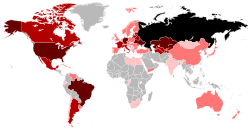
The vast majority of Russians live in native Russia, but notable minorities are scattered throughout other post-Soviet states such as Belarus, Kazakhstan, Moldova, Ukraine, and the Baltic states. A large Russian diaspora (sometimes including Russian-speaking non-Russians), estimated at 25 million people, has developed all over the world, with notable numbers in the United States, Germany, Brazil, and Canada.
There are two Russian words which are commonly translated into English as "Russians". One is русские (russkiye), which in modern Russia most often means "ethnic Russians". The other one is россияне (rossiyane), derived from Россия (Rossiya, Russia), which denotes "people of Russia", regardless of ethnicity or religious affiliation. In daily usage, those terms are often mixed up, and since Vladimir Putin became president, the ethnic term русские has supplanted the non-ethnic term.
The name of the Russians derives from the early medieval Rus' people, a group of Norse merchants and warriors who relocated from across the Baltic Sea and played an important part in the foundation of the first East Slavic state that later became the Kievan Rus'.
The idea of a single "all-Russian nation" encompassing the East Slavic peoples, or a "triune nation" of three brotherly "Great Russian", "Little Russian" (i.e. Ukrainian), and "White Russian" (i.e. Belarusian) peoples became the official doctrine of the Russian Empire from the beginning of the 19th century onwards.
The ancestors of modern Russians are the Slavic tribes, whose original home is thought by some scholars to have been the wooded areas of the Pinsk Marshes, one of the largest wetlands in Europe. The East Slavs gradually settled Western Russia with Moscow included in two waves: one moving from Kiev toward present-day Suzdal and Murom and another from Polotsk toward Novgorod and Rostov. Prior to the Slavic migration in the 6-7th centuries, the Suzdal-Murom and Novgorod-Rostov areas were populated by Finnic peoples, including the Merya, the Muromians, and the Meshchera.
From the 7th century onwards, the East Slavs slowly assimilated the native Finnic peoples, so that by year 1100, the majority of the population in Western Russia was Slavic-speaking. Recent genetic studies confirm the presence of a Finnic substrate in modern Russian population.
Russians
Russians (Russian: русские, romanized: russkiye [ˈruskʲɪje] ⓘ) are an East Slavic ethnic group native to Eastern Europe. Their mother tongue is Russian, the most spoken Slavic language. The majority of Russians adhere to Orthodox Christianity, ever since the Middle Ages. By total numbers, they compose the largest Slavic and European nation.
Genetic studies show that Russians are closely related to Poles, Belarusians, Ukrainians, as well as Estonians, Latvians, Lithuanians, and Finns. They were formed from East Slavic tribes, and their cultural ancestry is based in Kievan Rus'. The Russian word for the Russians is derived from the people of Rus' and the territory of Rus'. Russians share many historical and cultural traits with other European peoples, and especially with other East Slavic ethnic groups, specifically Belarusians and Ukrainians.
The vast majority of Russians live in native Russia, but notable minorities are scattered throughout other post-Soviet states such as Belarus, Kazakhstan, Moldova, Ukraine, and the Baltic states. A large Russian diaspora (sometimes including Russian-speaking non-Russians), estimated at 25 million people, has developed all over the world, with notable numbers in the United States, Germany, Brazil, and Canada.
There are two Russian words which are commonly translated into English as "Russians". One is русские (russkiye), which in modern Russia most often means "ethnic Russians". The other one is россияне (rossiyane), derived from Россия (Rossiya, Russia), which denotes "people of Russia", regardless of ethnicity or religious affiliation. In daily usage, those terms are often mixed up, and since Vladimir Putin became president, the ethnic term русские has supplanted the non-ethnic term.
The name of the Russians derives from the early medieval Rus' people, a group of Norse merchants and warriors who relocated from across the Baltic Sea and played an important part in the foundation of the first East Slavic state that later became the Kievan Rus'.
The idea of a single "all-Russian nation" encompassing the East Slavic peoples, or a "triune nation" of three brotherly "Great Russian", "Little Russian" (i.e. Ukrainian), and "White Russian" (i.e. Belarusian) peoples became the official doctrine of the Russian Empire from the beginning of the 19th century onwards.
The ancestors of modern Russians are the Slavic tribes, whose original home is thought by some scholars to have been the wooded areas of the Pinsk Marshes, one of the largest wetlands in Europe. The East Slavs gradually settled Western Russia with Moscow included in two waves: one moving from Kiev toward present-day Suzdal and Murom and another from Polotsk toward Novgorod and Rostov. Prior to the Slavic migration in the 6-7th centuries, the Suzdal-Murom and Novgorod-Rostov areas were populated by Finnic peoples, including the Merya, the Muromians, and the Meshchera.
From the 7th century onwards, the East Slavs slowly assimilated the native Finnic peoples, so that by year 1100, the majority of the population in Western Russia was Slavic-speaking. Recent genetic studies confirm the presence of a Finnic substrate in modern Russian population.
Recent media
Recent media