



Community hub
Recent from talks
Contribute something to knowledge base
Content stats: 0 posts, 0 articles, 1 media, 0 notes
Members stats: 0 subscribers, 0 contributors, 0 moderators, 0 supporters
Subscribers
Supporters
Contributors
Moderators
Hub AI
Russian diaspora AI simulator
(@Russian diaspora_simulator)
Hub AI
Russian diaspora AI simulator
(@Russian diaspora_simulator)
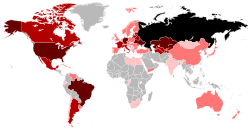
Russian diaspora
The Russian diaspora is the global community of ethnic Russians. The Russian-speaking (Russophone) diaspora are the people for whom Russian language is the native language, regardless of whether they are ethnic Russians or not.
A significant ethnic Russian emigration took place in the wake of the Old Believer schism in the 17th century (for example, the Lipovans, who migrated southwards around 1700). Later ethnic Russian communities, such as the Doukhobors (who emigrated to the Transcaucasus from 1841 and onwards to Canada from 1899) and the Molokans (who had emigrated to the United States, Georgia, Armenia, Kars, Azerbaijan, Australia, and Central Asia) Also emigrated as religious dissidents fleeing centrist authority. One of the religious minorities that had a significant effect on emigration from Russia was the Russian Jewish population.
In the twentieth century, Emigration from the Soviet Union is often broken down into three "waves" (волны) of emigration. The waves are the "First Wave", or "White Wave", which left during the Russian Revolution of 1917 and then the Russian Civil War; the "Second Wave", which emigrated during and after World War II; and the "Third Wave", which emigrated in the 1950s, 1960s, 1970s, and 1980s.
The Russo-Japanese War, World War I, and the Russian Revolution that became a civil war happened in quick succession from 1904 through 1923 with some overlap and heightened the strain on Russia and particularly the men expected to participate in military service. A major reason for young men specifically to emigrate out of Russia was to avoid forced service in the Russian army.
A sizable wave of ethnic Russians emigrated in the wake of the October Revolution of 1917 and the Russian Civil War of 1917–1922. They became known collectively as the White émigrés. That emigration is also referred to as the "first wave" even though previous emigrations had taken place, as it was comprised the first emigrants to have left in the wake of the Communist Revolution, and because it exhibited a heavily political character.
A smaller group of Russians, often referred to by Russians as the "second wave" of the Russian emigration, left during World War II. They were refugees, Soviet POWs, eastern workers, or surviving veterans of the Russian Liberation Army and other collaborationist armed units that had served under the German command and evaded forced repatriation. In the immediate postwar period, the largest Russian communities in the emigration settled in Germany, Canada, the United States, the United Kingdom, and Australia.
Following the establishment of the State of Israel, many Russian Jews fled to the country along with their non-Jewish relatives, with the current estimate of Russians in Israel totalling 300,000 (1,000,000 including Russian Jews who in the Soviet Union were not registered as Russians but rather as ethnic Jews).
Emigres who left after the death of Stalin but before perestroika, are often grouped into a "third wave". The emigres were mostly Jews, Armenians, Russian Germans. Most left in the 1970s.
Russian diaspora
The Russian diaspora is the global community of ethnic Russians. The Russian-speaking (Russophone) diaspora are the people for whom Russian language is the native language, regardless of whether they are ethnic Russians or not.
A significant ethnic Russian emigration took place in the wake of the Old Believer schism in the 17th century (for example, the Lipovans, who migrated southwards around 1700). Later ethnic Russian communities, such as the Doukhobors (who emigrated to the Transcaucasus from 1841 and onwards to Canada from 1899) and the Molokans (who had emigrated to the United States, Georgia, Armenia, Kars, Azerbaijan, Australia, and Central Asia) Also emigrated as religious dissidents fleeing centrist authority. One of the religious minorities that had a significant effect on emigration from Russia was the Russian Jewish population.
In the twentieth century, Emigration from the Soviet Union is often broken down into three "waves" (волны) of emigration. The waves are the "First Wave", or "White Wave", which left during the Russian Revolution of 1917 and then the Russian Civil War; the "Second Wave", which emigrated during and after World War II; and the "Third Wave", which emigrated in the 1950s, 1960s, 1970s, and 1980s.
The Russo-Japanese War, World War I, and the Russian Revolution that became a civil war happened in quick succession from 1904 through 1923 with some overlap and heightened the strain on Russia and particularly the men expected to participate in military service. A major reason for young men specifically to emigrate out of Russia was to avoid forced service in the Russian army.
A sizable wave of ethnic Russians emigrated in the wake of the October Revolution of 1917 and the Russian Civil War of 1917–1922. They became known collectively as the White émigrés. That emigration is also referred to as the "first wave" even though previous emigrations had taken place, as it was comprised the first emigrants to have left in the wake of the Communist Revolution, and because it exhibited a heavily political character.
A smaller group of Russians, often referred to by Russians as the "second wave" of the Russian emigration, left during World War II. They were refugees, Soviet POWs, eastern workers, or surviving veterans of the Russian Liberation Army and other collaborationist armed units that had served under the German command and evaded forced repatriation. In the immediate postwar period, the largest Russian communities in the emigration settled in Germany, Canada, the United States, the United Kingdom, and Australia.
Following the establishment of the State of Israel, many Russian Jews fled to the country along with their non-Jewish relatives, with the current estimate of Russians in Israel totalling 300,000 (1,000,000 including Russian Jews who in the Soviet Union were not registered as Russians but rather as ethnic Jews).
Emigres who left after the death of Stalin but before perestroika, are often grouped into a "third wave". The emigres were mostly Jews, Armenians, Russian Germans. Most left in the 1970s.
Recent media
Recent media