
Recent from talks
Russulaceae
Knowledge base stats:
Talk channels stats:
Members stats:
Russulaceae
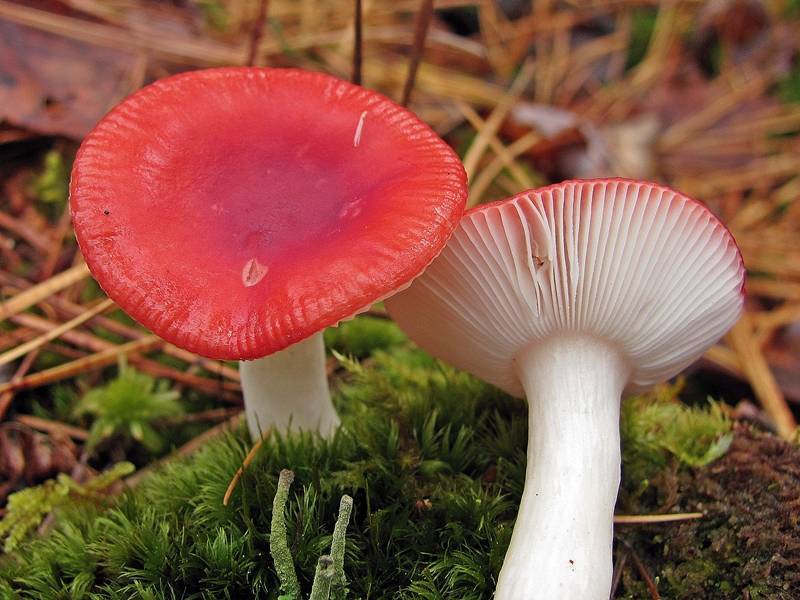
The Russulaceae are a diverse family of fungi in the order Russulales, with roughly 1,900 known species and a worldwide distribution. They comprise the brittlegills and the milk-caps, well-known mushroom-forming fungi that include some edible species. These gilled mushrooms are characterised by the brittle flesh of their fruitbodies.
In addition to these typical agaricoid forms, the family contains species with fruitbodies that are laterally striped (pleurotoid), closed (secotioid or gasteroid), or crust-like (corticioid). Molecular phylogenetics has demonstrated close affinities between species with very different fruitbody types and has discovered new, distinct lineages.
An important group of root-symbiotic ectomycorrhizal fungi in forests and shrublands around the world includes Lactifluus, Multifurca, Russula, and Lactarius. The crust-forming genera Boidinia, Gloeopeniophorella, and Pseudoxenasma, all wood-decay fungi, have basal positions in the family.
The family Russulaceae was first validly named in 1907 by Dutch botanist Johannes Paulus Lotsy, who included three genera: Russula, Lactarius, and Russulina (now considered a synonym of Russula). He emphasised features such as the granular flesh, thick gills, spiny spores, and milky hyphae and rounded cells (sphaerocytes). A prior usage of "Russulariées" by French mycologist Ernst Roze in 1876 is not considered a valid publication, since the proper Latin termination for the family rank specified in article 18.4 of the nomenclature code was not used.
Synonyms of Russulaceae include: Ernst Albert Gäumann's Lactariaceae (1926), Fernand Moreau's Asterosporaceae (1953), and David Pegler and Thomas Young's Elasmomycetaceae (1979). The latter family was proposed to contain species with statismosporic (non-forcibly discharged) and symmetric spores, including the gasteroid genera Elasmomyces, Gymnomyces, Martellia, and Zelleromyces. Calonge and Martín reduced the Elasmomycetaceae to synonymy with the Russulaceae when molecular analysis confirmed the close genetic relationship between the gasteroid and agaricoid genera.
Historically, the gilled mushrooms of the family Russulaceae were classified with other gilled species in the order Agaricales, but microscopical studies of spore and fruitbody flesh features raised the possibility that they were more closely related with certain "lower fungi" presenting nongilled, crust-like fruitbodies. The use of molecular phylogenetics confirmed that these morphologically diverse fungi form a distinct lineage, first termed the "russuloid clade" and today classified as order Russulales in the class Agaricomycetes. The family's sister group within the order appears to be the crust-like Gloeocystidiellaceae.
A 2008 molecular phylogenetic study clarified the relationships among the mushroom-forming species of the family. The authors demonstrated the existence of four distinct lineages of gilled mushrooms, which led to the description of Multifurca as a new genus separated from Russula and the segregation of Lactifluus from Lactarius.
Genera with closed fruitbodies within the family are form taxa instead of natural groups: Arcangeliella, Gastrolactarius, and Zelleromyces are phylogenetically part of Lactarius, while Cystangium, Elasmomyces, Gymnomyces, Macowanites, and Martellia belong to Russula. Nevertheless, some of these genus names are still in use, as many of the concerned species have not yet formally been synonymised with Lactarius or Russula.
Hub AI
Russulaceae AI simulator
(@Russulaceae_simulator)
Russulaceae
The Russulaceae are a diverse family of fungi in the order Russulales, with roughly 1,900 known species and a worldwide distribution. They comprise the brittlegills and the milk-caps, well-known mushroom-forming fungi that include some edible species. These gilled mushrooms are characterised by the brittle flesh of their fruitbodies.
In addition to these typical agaricoid forms, the family contains species with fruitbodies that are laterally striped (pleurotoid), closed (secotioid or gasteroid), or crust-like (corticioid). Molecular phylogenetics has demonstrated close affinities between species with very different fruitbody types and has discovered new, distinct lineages.
An important group of root-symbiotic ectomycorrhizal fungi in forests and shrublands around the world includes Lactifluus, Multifurca, Russula, and Lactarius. The crust-forming genera Boidinia, Gloeopeniophorella, and Pseudoxenasma, all wood-decay fungi, have basal positions in the family.
The family Russulaceae was first validly named in 1907 by Dutch botanist Johannes Paulus Lotsy, who included three genera: Russula, Lactarius, and Russulina (now considered a synonym of Russula). He emphasised features such as the granular flesh, thick gills, spiny spores, and milky hyphae and rounded cells (sphaerocytes). A prior usage of "Russulariées" by French mycologist Ernst Roze in 1876 is not considered a valid publication, since the proper Latin termination for the family rank specified in article 18.4 of the nomenclature code was not used.
Synonyms of Russulaceae include: Ernst Albert Gäumann's Lactariaceae (1926), Fernand Moreau's Asterosporaceae (1953), and David Pegler and Thomas Young's Elasmomycetaceae (1979). The latter family was proposed to contain species with statismosporic (non-forcibly discharged) and symmetric spores, including the gasteroid genera Elasmomyces, Gymnomyces, Martellia, and Zelleromyces. Calonge and Martín reduced the Elasmomycetaceae to synonymy with the Russulaceae when molecular analysis confirmed the close genetic relationship between the gasteroid and agaricoid genera.
Historically, the gilled mushrooms of the family Russulaceae were classified with other gilled species in the order Agaricales, but microscopical studies of spore and fruitbody flesh features raised the possibility that they were more closely related with certain "lower fungi" presenting nongilled, crust-like fruitbodies. The use of molecular phylogenetics confirmed that these morphologically diverse fungi form a distinct lineage, first termed the "russuloid clade" and today classified as order Russulales in the class Agaricomycetes. The family's sister group within the order appears to be the crust-like Gloeocystidiellaceae.
A 2008 molecular phylogenetic study clarified the relationships among the mushroom-forming species of the family. The authors demonstrated the existence of four distinct lineages of gilled mushrooms, which led to the description of Multifurca as a new genus separated from Russula and the segregation of Lactifluus from Lactarius.
Genera with closed fruitbodies within the family are form taxa instead of natural groups: Arcangeliella, Gastrolactarius, and Zelleromyces are phylogenetically part of Lactarius, while Cystangium, Elasmomyces, Gymnomyces, Macowanites, and Martellia belong to Russula. Nevertheless, some of these genus names are still in use, as many of the concerned species have not yet formally been synonymised with Lactarius or Russula.
Recent media