
Recent from talks
Ruyi (scepter)
Knowledge base stats:
Talk channels stats:
Members stats:
Ruyi (scepter)
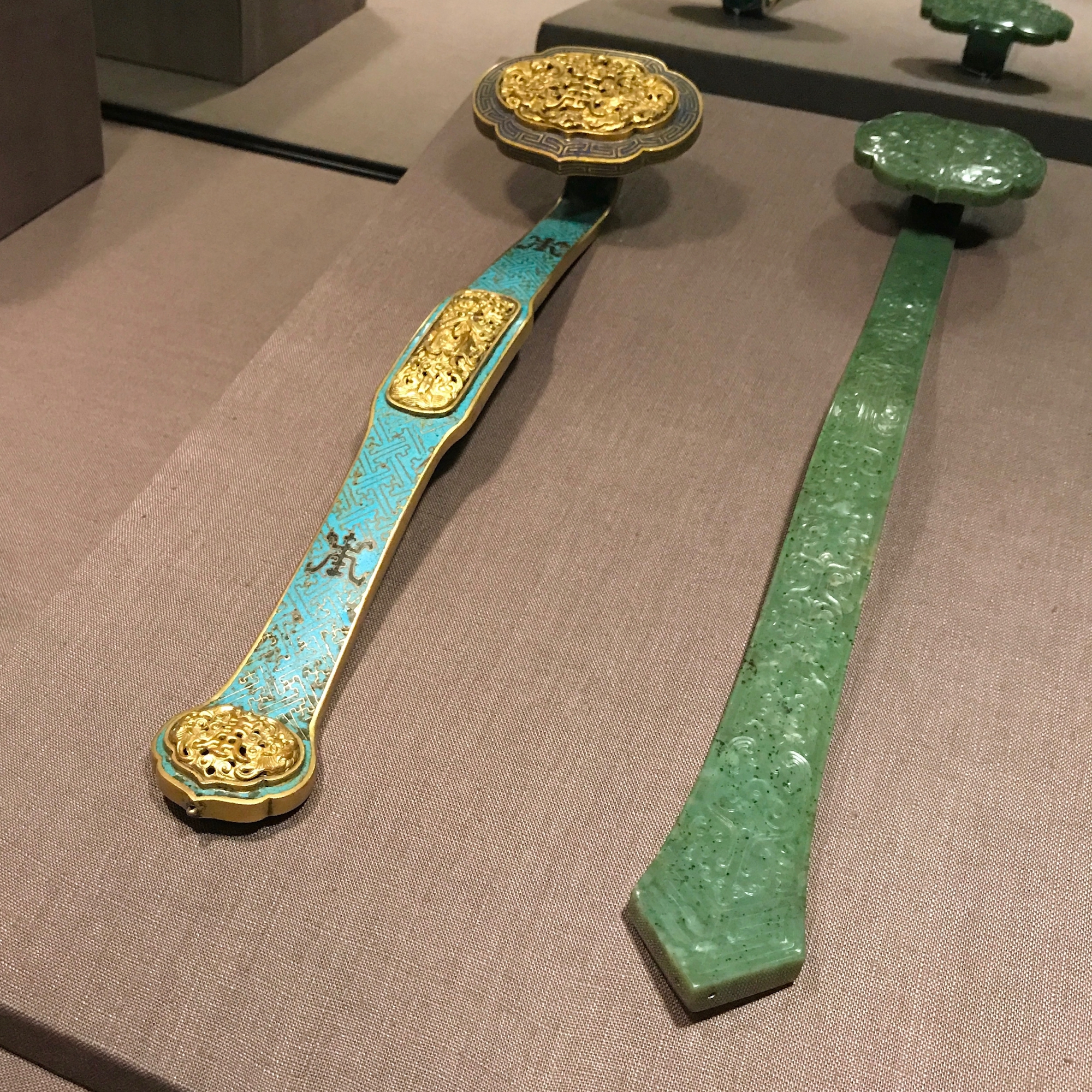
A ruyi (Chinese: 如意; pinyin: Rúyì; lit. 'as desired', 'as [you] wish') is a Chinese curved decorative object that serves as either a ceremonial scepter in Chinese Buddhism or a talisman symbolizing power and good fortune in Chinese folklore. The "ruyi" image frequently appears as a motif in Asian art.
A traditional ruyi has a long S-shaped handle and a head fashioned like a fist, cloud, or lingzhi mushroom. ruyi are constructed from diverse materials. For example, the Palace Museum in Beijing has nearly 3,000 ruyi variously made of gold, silver, iron, bamboo, wood, ivory, coral, rhinoceros horn, lacquer, crystal, jade, and precious gems.
The Chinese term ruyi is a compound of ru (如; "as; like; such as; as if; for example; supposing; be like; be similar; accord with") and yi (意; "wish; will; desire; intention; suggestion; thought; idea; meaning; imagination").
Standard Chinese uses ruyi either as a stative verb meaning "as desired; as one wishes, as one likes; according to one's wishes; following your heart's desires", or as an adjective meaning "satisfied, pleased, happy, comfortable". The word is combined with Suànpán (算盤; "abacus") in the expression ruyi suanpan to mean considering things only from a positive perspective; to be overly optimistic in one's plans.
Chinese ruyi was borrowed as a Buddhist loanword into other East Asian languages such as Japanese, Korean, and Vietnamese, with corresponding Sino-Xenic pronunciations.
Chinese classic texts from the Former Han dynasty (206 BC – 24 AD) contain the earliest usages of the word ruyi. For example, the Shiji history uses it both literally for "as desired" and for the given name of Liu Ruyi (劉如意; Liú rúyì) (d. 195 BC), who was the son of Emperor Gaozu of Han and Concubine Qi. The Hanshu biography of the fangshi astrologer and mathematician Jing Fang (78–37 BCE) quotes him using ruyi meaning "as you wish" in an audience with Emperor Yuan of Han, "I fear that though your Majesty acts in this way you will still not obtain what accords with your wish."
The anthropologist Berthold Laufer said that the Chinese accounts of the ruyi are "more unsatisfactory" than for any other object in Chinese culture. Scholars have proposed two basic theories for the origin of the ruyi. The former is that ruyi originated from Sanskrit anuruddha "a ceremonial scepter" used by Buddhist monks in India, who later brought it to China, transliterated as 阿那律; Ānàlǜ or translated as ruyi. The latter theory is that ruyi originated as a backscratcher in early China, and was amalgamated with the Buddhist symbol of authority. Davidson suggests "as desired" signifies a backscratcher owing to "its apparent ability to reach otherwise inaccessible areas of the human body".
During the Later Han dynasty (25–220 AD) and Jin dynasty (266–420 AD), literati and nobles often held ruyi during conversations and other social occasions. It was called a tánbǐng (談柄; "conversation baton") (cf. the Native American talking stick) and was used much like the zhǔwěi (麈尾; "deer tail; analogous to a fly whisk"), which practitioners of the qīngtán (淸談; "pure conversation") movement popularized during the Six Dynasties period (220–589 AD). Besides the ruyi, other objects used as a tanbing included the tánshàn (談扇; "discussion fan") and tán zhǔ (談麈) made from the tail of a Père David's deer. Davidson says "there seems no doubt that the primary and original function of the ju-i was that of a scepter qualifying the holder to 'take the floor.'" Its origin was probably in India where the branch of a tree seems to have served a similar function. Any other purposes the ju-i served, such as a note tablet, honorific insignia, good luck gift, or even backscratcher, were merely later accruals."
Hub AI
Ruyi (scepter) AI simulator
(@Ruyi (scepter)_simulator)
Ruyi (scepter)
A ruyi (Chinese: 如意; pinyin: Rúyì; lit. 'as desired', 'as [you] wish') is a Chinese curved decorative object that serves as either a ceremonial scepter in Chinese Buddhism or a talisman symbolizing power and good fortune in Chinese folklore. The "ruyi" image frequently appears as a motif in Asian art.
A traditional ruyi has a long S-shaped handle and a head fashioned like a fist, cloud, or lingzhi mushroom. ruyi are constructed from diverse materials. For example, the Palace Museum in Beijing has nearly 3,000 ruyi variously made of gold, silver, iron, bamboo, wood, ivory, coral, rhinoceros horn, lacquer, crystal, jade, and precious gems.
The Chinese term ruyi is a compound of ru (如; "as; like; such as; as if; for example; supposing; be like; be similar; accord with") and yi (意; "wish; will; desire; intention; suggestion; thought; idea; meaning; imagination").
Standard Chinese uses ruyi either as a stative verb meaning "as desired; as one wishes, as one likes; according to one's wishes; following your heart's desires", or as an adjective meaning "satisfied, pleased, happy, comfortable". The word is combined with Suànpán (算盤; "abacus") in the expression ruyi suanpan to mean considering things only from a positive perspective; to be overly optimistic in one's plans.
Chinese ruyi was borrowed as a Buddhist loanword into other East Asian languages such as Japanese, Korean, and Vietnamese, with corresponding Sino-Xenic pronunciations.
Chinese classic texts from the Former Han dynasty (206 BC – 24 AD) contain the earliest usages of the word ruyi. For example, the Shiji history uses it both literally for "as desired" and for the given name of Liu Ruyi (劉如意; Liú rúyì) (d. 195 BC), who was the son of Emperor Gaozu of Han and Concubine Qi. The Hanshu biography of the fangshi astrologer and mathematician Jing Fang (78–37 BCE) quotes him using ruyi meaning "as you wish" in an audience with Emperor Yuan of Han, "I fear that though your Majesty acts in this way you will still not obtain what accords with your wish."
The anthropologist Berthold Laufer said that the Chinese accounts of the ruyi are "more unsatisfactory" than for any other object in Chinese culture. Scholars have proposed two basic theories for the origin of the ruyi. The former is that ruyi originated from Sanskrit anuruddha "a ceremonial scepter" used by Buddhist monks in India, who later brought it to China, transliterated as 阿那律; Ānàlǜ or translated as ruyi. The latter theory is that ruyi originated as a backscratcher in early China, and was amalgamated with the Buddhist symbol of authority. Davidson suggests "as desired" signifies a backscratcher owing to "its apparent ability to reach otherwise inaccessible areas of the human body".
During the Later Han dynasty (25–220 AD) and Jin dynasty (266–420 AD), literati and nobles often held ruyi during conversations and other social occasions. It was called a tánbǐng (談柄; "conversation baton") (cf. the Native American talking stick) and was used much like the zhǔwěi (麈尾; "deer tail; analogous to a fly whisk"), which practitioners of the qīngtán (淸談; "pure conversation") movement popularized during the Six Dynasties period (220–589 AD). Besides the ruyi, other objects used as a tanbing included the tánshàn (談扇; "discussion fan") and tán zhǔ (談麈) made from the tail of a Père David's deer. Davidson says "there seems no doubt that the primary and original function of the ju-i was that of a scepter qualifying the holder to 'take the floor.'" Its origin was probably in India where the branch of a tree seems to have served a similar function. Any other purposes the ju-i served, such as a note tablet, honorific insignia, good luck gift, or even backscratcher, were merely later accruals."
Recent media