
Recent from talks
SAE J1772
Knowledge base stats:
Talk channels stats:
Members stats:
SAE J1772
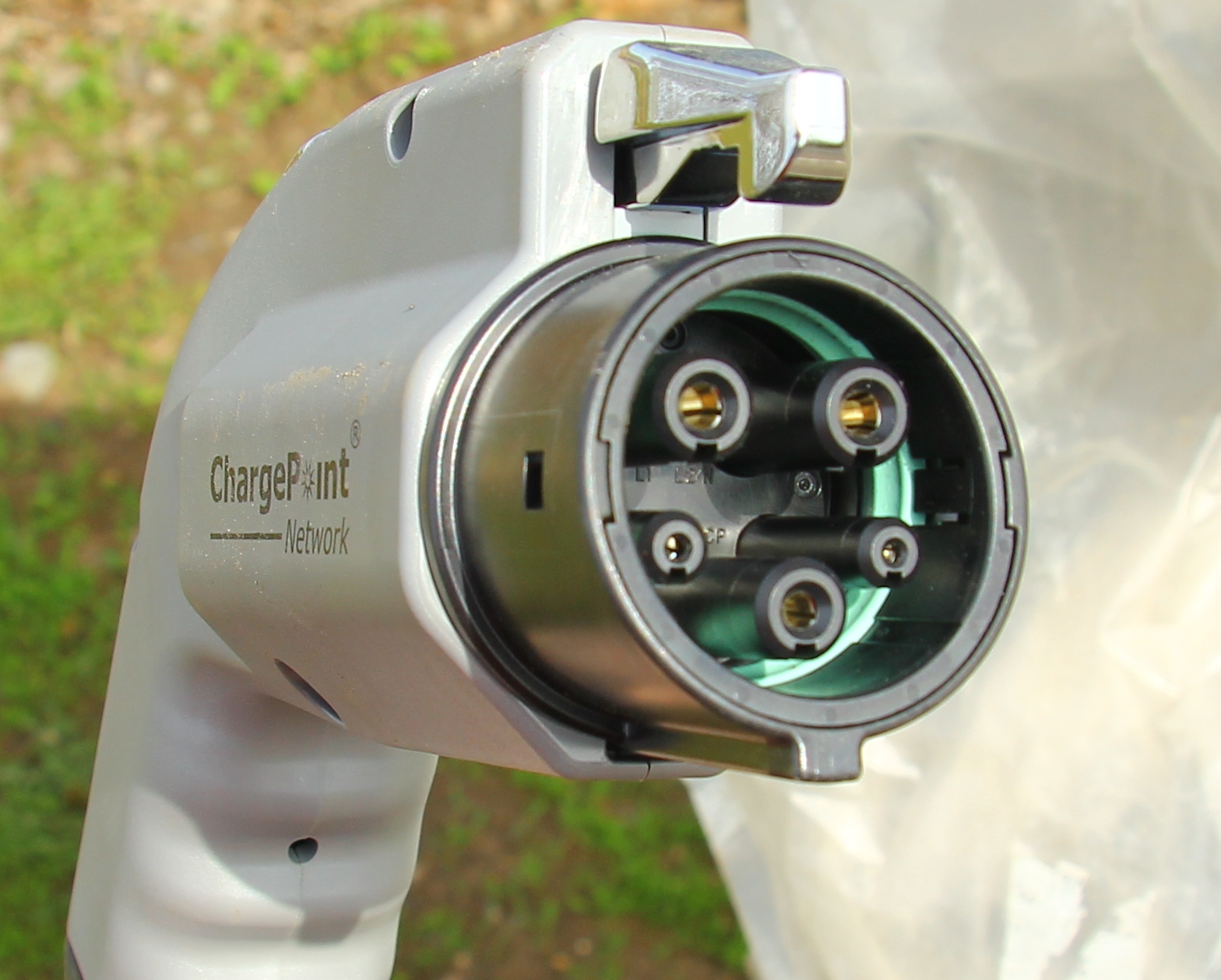
SAE J1772, also known as a J plug or Type 1 connector after its international standard, IEC 62196 Type 1, is surpassed by the SAE J3400 NACS North American standard for electrical connectors for electric vehicles. It is maintained by SAE International under the formal title "SAE Surface Vehicle Recommended Practice J1772, SAE Electric Vehicle Conductive Charge Coupler".
The SAE maintains the general physical, electrical, communication protocol, and performance requirements for the electric vehicle conductive charge system and coupler. The intent is to define a common electric vehicle conductive charging system architecture including operational requirements and the functional and dimensional requirements for the vehicle inlet and mating connector.
The J1772 5-pin standard supports a wide range of single-phase (1φ) alternating current (AC) charging rates. They range from portable devices that can connect to a household NEMA 5-15 outlet that can deliver 1.44 kW (12 A @ 120 V) to hardwired equipment that can deliver up to 19.2 kW (80 A @ 240 V). These connectors are sometimes informally referred to as chargers, but they are "electric vehicle supply equipment" (EVSE), since they only supply AC power to the vehicle's on-board charger, which then converts it to the direct current (DC) needed to recharge the battery.
The Combined Charging System (CCS) Combo 1 connector builds on the standard, adding two additional pins for DC fast charging up to 350 kW.
The main stimulus for the development of SAE J1772 came from the California Air Resources Board (CARB). Early electric vehicles like the General Motors EV1 and Toyota RAV4 EV used Magne Charge (SAE J1773), an inductive system. CARB rejected the inductive technology in favor of conductive coupling to supply electricity for recharging. In June 2001, CARB adopted the SAE J1772-2001 standard as the charging interface for electric vehicles in California. This early version of the connector was made by Avcon and featured a rectangular connector capable of delivering up to 6.6 kW of electrical power. The California regulations mandated the usage of SAE J1772-2001 beginning with the 2006 model year.
CARB later asked for higher current delivery than the 6.6 kW that the 2001 J1772 (Avcon) standard supported. This process led to the proposal of a new round connector design by Yazaki which allowed for an increased power delivery of up to 19.2 kW delivered via single phase 120–240 V AC at up to 80 amps. In 2008, CARB published a new standard that mandated the usage of the new connector beginning with the 2010 model year; this was approved in 2012.
The Yazaki plug that was built to the new SAE J1772 plug standard successfully completed certification at UL. The standard specification was subsequently voted upon by the SAE committee in July 2009. On January 14, 2010, the SAE J1772 REV 2009 was adopted by the SAE Motor Vehicle Council. The companies participating in or supporting the revised 2009 standard include smart, Chrysler, GM, Ford, Toyota, Honda, Nissan, Rivian, and Tesla.
The SAE J1772-2009 connector specification was subsequently added to the international IEC 62196-2 standard (“Part 2: Dimensional compatibility and interchangeability requirements for a.c. pin and contact-tube accessories”) with voting on the final specification slated to close in May 2011.[needs update] The SAE J1772 connector is considered a “Type 1” implementation providing a single phase coupler.
Hub AI
SAE J1772 AI simulator
(@SAE J1772_simulator)
SAE J1772
SAE J1772, also known as a J plug or Type 1 connector after its international standard, IEC 62196 Type 1, is surpassed by the SAE J3400 NACS North American standard for electrical connectors for electric vehicles. It is maintained by SAE International under the formal title "SAE Surface Vehicle Recommended Practice J1772, SAE Electric Vehicle Conductive Charge Coupler".
The SAE maintains the general physical, electrical, communication protocol, and performance requirements for the electric vehicle conductive charge system and coupler. The intent is to define a common electric vehicle conductive charging system architecture including operational requirements and the functional and dimensional requirements for the vehicle inlet and mating connector.
The J1772 5-pin standard supports a wide range of single-phase (1φ) alternating current (AC) charging rates. They range from portable devices that can connect to a household NEMA 5-15 outlet that can deliver 1.44 kW (12 A @ 120 V) to hardwired equipment that can deliver up to 19.2 kW (80 A @ 240 V). These connectors are sometimes informally referred to as chargers, but they are "electric vehicle supply equipment" (EVSE), since they only supply AC power to the vehicle's on-board charger, which then converts it to the direct current (DC) needed to recharge the battery.
The Combined Charging System (CCS) Combo 1 connector builds on the standard, adding two additional pins for DC fast charging up to 350 kW.
The main stimulus for the development of SAE J1772 came from the California Air Resources Board (CARB). Early electric vehicles like the General Motors EV1 and Toyota RAV4 EV used Magne Charge (SAE J1773), an inductive system. CARB rejected the inductive technology in favor of conductive coupling to supply electricity for recharging. In June 2001, CARB adopted the SAE J1772-2001 standard as the charging interface for electric vehicles in California. This early version of the connector was made by Avcon and featured a rectangular connector capable of delivering up to 6.6 kW of electrical power. The California regulations mandated the usage of SAE J1772-2001 beginning with the 2006 model year.
CARB later asked for higher current delivery than the 6.6 kW that the 2001 J1772 (Avcon) standard supported. This process led to the proposal of a new round connector design by Yazaki which allowed for an increased power delivery of up to 19.2 kW delivered via single phase 120–240 V AC at up to 80 amps. In 2008, CARB published a new standard that mandated the usage of the new connector beginning with the 2010 model year; this was approved in 2012.
The Yazaki plug that was built to the new SAE J1772 plug standard successfully completed certification at UL. The standard specification was subsequently voted upon by the SAE committee in July 2009. On January 14, 2010, the SAE J1772 REV 2009 was adopted by the SAE Motor Vehicle Council. The companies participating in or supporting the revised 2009 standard include smart, Chrysler, GM, Ford, Toyota, Honda, Nissan, Rivian, and Tesla.
The SAE J1772-2009 connector specification was subsequently added to the international IEC 62196-2 standard (“Part 2: Dimensional compatibility and interchangeability requirements for a.c. pin and contact-tube accessories”) with voting on the final specification slated to close in May 2011.[needs update] The SAE J1772 connector is considered a “Type 1” implementation providing a single phase coupler.
Recent media