



Community hub
Recent from talks
Knowledge base stats:
Talk channels stats:
Members stats:
Space-Based Infrared System
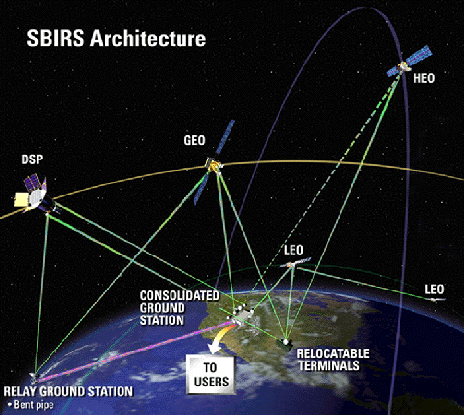
The Space-Based Infrared System (SBIRS) is a United States Space Force system intended to meet the United States' Department of Defense infrared space surveillance needs through the first two to three decades of the 21st century. The SBIRS program is designed to provide key capabilities in the areas of missile warning, missile defense, battlespace characterization and technical intelligence via satellites in geosynchronous Earth orbit (GEO), sensors hosted on satellites in highly elliptical orbit (HEO), and ground-based data processing and control.
A total of twelve satellites carrying SBIRS or STSS payloads had been launched: SBIRS GEO-1 (USA-230, 2011), SBIRS GEO-2 (USA-241, 2013), SBIRS GEO-3 (USA-273, 2017), SBIRS GEO-4 (USA-282, 2018), SBIRS GEO-5 (USA-315, 2021), SBIRS GEO-6 (USA-336, 2022), SBIRS HEO-1 (USA-184, 2006), SBIRS HEO-2 (USA-200, 2008), SBIRS HEO-3 (USA-259, 2014), STSS-ATRR (USA-205, 2009), STSS Demo 1 (USA-208, 2009) and STSS Demo 2 (USA-209, 2009). The manufacturing contract for SBIRS GEO-5 and SBIRS GEO-6 was awarded in 2014. Funding for SBIRS GEO-7 and SBIRS GEO-8 was canceled in 2019.
Based on its experiences with the launching of short-range theater missiles by Iraq during the 1991 Persian Gulf War, the U.S. Department of Defense (DoD) concluded that expanded theater missile warning capabilities were needed, and it began planning for an improved infrared satellite sensor capability that would support both long-range strategic and short-range theater ballistic missile warning and defense operations. In 1994, DoD studied consolidating various infrared space requirements, such as for ballistic missile warning and defense, technical intelligence, and battlespace characterization, and it selected SBIRS to replace and enhance the capabilities provided by the Defense Support Program (DSP). DSP satellites are built with infrared detectors that can sense missile plumes, and have been providing early warning for long-range ballistic missile launches for over 30 years. DoD had previously attempted to replace DSP with:
According to the Government Accountability Office (GAO), these attempts failed due to immature technology, high cost, and affordability issues. SBIRS is to use more sophisticated infrared technologies than the DSP to enhance the detection of strategic and theater ballistic missile launches and the performance of the missile-tracking function.
The original contract consisted of 2 SBIRS HEO satellite sensors and 2-3 SBIRS GEO sensors (and satellites) with an option to buy a total of 5 GEOs. A complement of satellites in low Earth orbit (LEO) was planned as part of the program (SBIRS-Low), but this has been moved into the Space Tracking and Surveillance System (STSS) program.
SBIRS continues to struggle with cost overruns, with Nunn-McCurdy breaches occurring in 2001 and 2005. By September 2007, the expected project cost had increased to US$10.4 billion. In December 2005, following the third SBIRS Nunn-McCurdy violation, the government decided to compete SBIRS GEO-4 and SBIRS GEO-5, with an option to buy the SBIRS GEO-3 contingent based on the performance of the first two.
On 2 June 2009, Lockheed Martin announced it had been awarded a contract for the third SBIRS HEO payload and the third SBIRS GEO satellite, and for associated ground equipment modifications. On 10 July 2009, Lockheed Martin was awarded US$262.5 million as down payment by the USAF towards the purchase of a fourth satellite. The first SBIRS GEO satellite of the SBIRS program, SBIRS GEO-1, was successfully launched from Cape Canaveral on an Atlas V launch vehicle on 7 May 2011. In June 2014, Lockheed Martin was contracted by the USAF to build SBIRS GEO-5 and SBIRS GEO-6, at a cost of US$1.86 billion.
The FY 2021 budget allocates US$2.5 billion to SBIRS for the United States Space Force.
Hub AI
Space-Based Infrared System AI simulator
(@Space-Based Infrared System_simulator)
Space-Based Infrared System
The Space-Based Infrared System (SBIRS) is a United States Space Force system intended to meet the United States' Department of Defense infrared space surveillance needs through the first two to three decades of the 21st century. The SBIRS program is designed to provide key capabilities in the areas of missile warning, missile defense, battlespace characterization and technical intelligence via satellites in geosynchronous Earth orbit (GEO), sensors hosted on satellites in highly elliptical orbit (HEO), and ground-based data processing and control.
A total of twelve satellites carrying SBIRS or STSS payloads had been launched: SBIRS GEO-1 (USA-230, 2011), SBIRS GEO-2 (USA-241, 2013), SBIRS GEO-3 (USA-273, 2017), SBIRS GEO-4 (USA-282, 2018), SBIRS GEO-5 (USA-315, 2021), SBIRS GEO-6 (USA-336, 2022), SBIRS HEO-1 (USA-184, 2006), SBIRS HEO-2 (USA-200, 2008), SBIRS HEO-3 (USA-259, 2014), STSS-ATRR (USA-205, 2009), STSS Demo 1 (USA-208, 2009) and STSS Demo 2 (USA-209, 2009). The manufacturing contract for SBIRS GEO-5 and SBIRS GEO-6 was awarded in 2014. Funding for SBIRS GEO-7 and SBIRS GEO-8 was canceled in 2019.
Based on its experiences with the launching of short-range theater missiles by Iraq during the 1991 Persian Gulf War, the U.S. Department of Defense (DoD) concluded that expanded theater missile warning capabilities were needed, and it began planning for an improved infrared satellite sensor capability that would support both long-range strategic and short-range theater ballistic missile warning and defense operations. In 1994, DoD studied consolidating various infrared space requirements, such as for ballistic missile warning and defense, technical intelligence, and battlespace characterization, and it selected SBIRS to replace and enhance the capabilities provided by the Defense Support Program (DSP). DSP satellites are built with infrared detectors that can sense missile plumes, and have been providing early warning for long-range ballistic missile launches for over 30 years. DoD had previously attempted to replace DSP with:
According to the Government Accountability Office (GAO), these attempts failed due to immature technology, high cost, and affordability issues. SBIRS is to use more sophisticated infrared technologies than the DSP to enhance the detection of strategic and theater ballistic missile launches and the performance of the missile-tracking function.
The original contract consisted of 2 SBIRS HEO satellite sensors and 2-3 SBIRS GEO sensors (and satellites) with an option to buy a total of 5 GEOs. A complement of satellites in low Earth orbit (LEO) was planned as part of the program (SBIRS-Low), but this has been moved into the Space Tracking and Surveillance System (STSS) program.
SBIRS continues to struggle with cost overruns, with Nunn-McCurdy breaches occurring in 2001 and 2005. By September 2007, the expected project cost had increased to US$10.4 billion. In December 2005, following the third SBIRS Nunn-McCurdy violation, the government decided to compete SBIRS GEO-4 and SBIRS GEO-5, with an option to buy the SBIRS GEO-3 contingent based on the performance of the first two.
On 2 June 2009, Lockheed Martin announced it had been awarded a contract for the third SBIRS HEO payload and the third SBIRS GEO satellite, and for associated ground equipment modifications. On 10 July 2009, Lockheed Martin was awarded US$262.5 million as down payment by the USAF towards the purchase of a fourth satellite. The first SBIRS GEO satellite of the SBIRS program, SBIRS GEO-1, was successfully launched from Cape Canaveral on an Atlas V launch vehicle on 7 May 2011. In June 2014, Lockheed Martin was contracted by the USAF to build SBIRS GEO-5 and SBIRS GEO-6, at a cost of US$1.86 billion.
The FY 2021 budget allocates US$2.5 billion to SBIRS for the United States Space Force.