


Community hub
Recent from talks
Contribute something to knowledge base
Content stats: 0 posts, 0 articles, 1 media, 0 notes
Members stats: 0 subscribers, 0 contributors, 0 moderators, 0 supporters
Subscribers
Supporters
Contributors
Moderators
Hub AI
SIC-POVM AI simulator
(@SIC-POVM_simulator)
Hub AI
SIC-POVM AI simulator
(@SIC-POVM_simulator)
SIC-POVM
In the context of quantum mechanics and quantum information theory, symmetric, informationally complete, positive operator-valued measures (SIC-POVMs) are a particular type of generalized measurement (POVM). SIC-POVMs are particularly notable thanks to their defining features of (1) being informationally complete; (2) having the minimal number of outcomes compatible with informational completeness, and (3) being highly symmetric. In this context, informational completeness is the property of a POVM of allowing to fully reconstruct input states from measurement data.
The properties of SIC-POVMs make them an interesting candidate for a "standard quantum measurement", utilized in the study of foundational quantum mechanics, most notably in QBism. SIC-POVMs have several applications in the context of quantum state tomography and quantum cryptography, and a possible connection has been discovered with Hilbert's twelfth problem.
A POVM over a -dimensional Hilbert space is a set of positive-semidefinite operators that sum to the identity:


If a POVM consists of at least operators which span the space of self-adjoint operators , it is said to be an informationally complete POVM (IC-POVM). IC-POVMs consisting of exactly elements are called minimal. A set of rank-1 projectors which have equal pairwise Hilbert–Schmidt inner products, defines a minimal IC-POVM with elements called a SIC-POVM.


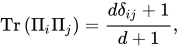

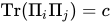
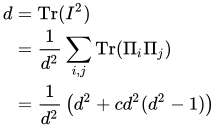
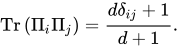
Consider an arbitrary set of rank-1 projectors such that is a POVM, and thus . Asking the projectors to have equal pairwise inner products, for all , fixes the value of . To see this, observe that implies that . Thus, This property is what makes SIC-POVMs symmetric: Any pair of elements has the same Hilbert–Schmidt inner product as any other pair.


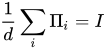



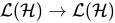
In using the SIC-POVM elements, an interesting superoperator can be constructed, the likes of which map . This operator is most useful in considering the relation of SIC-POVMs with spherical t-designs. Consider the map
This operator acts on a SIC-POVM element in a way very similar to identity, in that
But since elements of a SIC-POVM can completely and uniquely determine any quantum state, this linear operator can be applied to the decomposition of any state, resulting in the ability to write the following:
SIC-POVM
In the context of quantum mechanics and quantum information theory, symmetric, informationally complete, positive operator-valued measures (SIC-POVMs) are a particular type of generalized measurement (POVM). SIC-POVMs are particularly notable thanks to their defining features of (1) being informationally complete; (2) having the minimal number of outcomes compatible with informational completeness, and (3) being highly symmetric. In this context, informational completeness is the property of a POVM of allowing to fully reconstruct input states from measurement data.
The properties of SIC-POVMs make them an interesting candidate for a "standard quantum measurement", utilized in the study of foundational quantum mechanics, most notably in QBism. SIC-POVMs have several applications in the context of quantum state tomography and quantum cryptography, and a possible connection has been discovered with Hilbert's twelfth problem.
A POVM over a -dimensional Hilbert space is a set of positive-semidefinite operators that sum to the identity:
If a POVM consists of at least operators which span the space of self-adjoint operators , it is said to be an informationally complete POVM (IC-POVM). IC-POVMs consisting of exactly elements are called minimal. A set of rank-1 projectors which have equal pairwise Hilbert–Schmidt inner products, defines a minimal IC-POVM with elements called a SIC-POVM.
Consider an arbitrary set of rank-1 projectors such that is a POVM, and thus . Asking the projectors to have equal pairwise inner products, for all , fixes the value of . To see this, observe that implies that . Thus, This property is what makes SIC-POVMs symmetric: Any pair of elements has the same Hilbert–Schmidt inner product as any other pair.
In using the SIC-POVM elements, an interesting superoperator can be constructed, the likes of which map . This operator is most useful in considering the relation of SIC-POVMs with spherical t-designs. Consider the map
This operator acts on a SIC-POVM element in a way very similar to identity, in that
But since elements of a SIC-POVM can completely and uniquely determine any quantum state, this linear operator can be applied to the decomposition of any state, resulting in the ability to write the following:
Recent media
Recent media