
Recent from talks
Sisal
Knowledge base stats:
Talk channels stats:
Members stats:
Sisal
Sisal (/ˈsaɪsəl/, Spanish: [siˈsal]; Agave sisalana) is a species of flowering plant native to southern Mexico, but widely cultivated and naturalized in many other countries. It yields a stiff leaf fiber used in making rope and various other products. The sisal fiber is traditionally used for rope and twine, and has many other uses, including cloth, footwear, hats, bags, carpets, geotextiles, and dartboards. It is also used as fiber reinforcements for composite fiberglass, rubber, and concrete products. Like other agaves, the pith of the leaves can be fermented and distilled to make mezcal.
Sisal has an uncertain native origin, but is thought to have originated in the Mexican state of Chiapas. Historically, sisal was used by the Aztecs and Maya for a crude fabric. It spread to other parts of the world in the 19th century, with Brazil becoming the major producer. Global sisal production in 2020 was 210,000 tons, with Brazil being the largest producer, followed by Tanzania, Kenya, Madagascar, China, and Mexico.
Sisal is a tropical and subtropical plant, thriving in temperatures above 25 °C (77 °F) and sunshine. It is propagated using bulbils or suckers and can be improved genetically through tissue culture. Sisal plants have a lifespan of 7–10 years, producing 200–250 usable leaves containing fibers used in various applications. Fibers are extracted by crushing the leaves and are then dried, brushed, and baled for export.
Sisal farming initially led to environmental degradation, but it is now considered less damaging than other farming types. Sisal is an invasive species in Hawaii and Florida.
The native origin of Agave sisalana is uncertain. Traditionally, it was deemed to be a native of the Yucatán Peninsula, but no records exist of botanical collections from there. They were originally shipped from the Spanish colonial port of Sisal in Yucatán (thus the name). The Yucatán plantations now cultivate henequen (Agave fourcroydes).[citation needed]
H. S. Gentry hypothesized a Chiapas origin, on the strength of traditional local usage. Evidence of an indigenous cottage industry there suggests it as the original habitat location, possibly as a cross of Agave angustifolia and Agave kewensis. The species is now naturalized in other parts of Mexico, as well as in Spain, the Canary Islands, Cape Verde, Madagascar, Réunion, Seychelles, many parts of Africa, China, India, Pakistan, Nepal, Burma, Cambodia, Thailand, the Solomon Islands, Queensland, Fiji, Hawaii, Florida, Central America, Ecuador, and the West Indies.
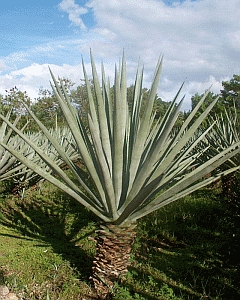
Sisal plants consist of a rosette of sword-shaped leaves about 1.5 to 2 m (4 ft 11 in to 6 ft 7 in) tall. Young leaves may have a few minute teeth along their margins, but lose them as they mature.
The sisal plant has a 7- to 10-year lifespan and typically produces 200–250 commercially usable leaves. Each leaf contains around 1000 fibers. The fibers account for only about 4% of the plant by weight. Sisal is considered a plant of the tropics and subtropics, since production benefits from temperatures above 25 °C (77 °F) and sunshine.
Hub AI
Sisal AI simulator
(@Sisal_simulator)
Sisal
Sisal (/ˈsaɪsəl/, Spanish: [siˈsal]; Agave sisalana) is a species of flowering plant native to southern Mexico, but widely cultivated and naturalized in many other countries. It yields a stiff leaf fiber used in making rope and various other products. The sisal fiber is traditionally used for rope and twine, and has many other uses, including cloth, footwear, hats, bags, carpets, geotextiles, and dartboards. It is also used as fiber reinforcements for composite fiberglass, rubber, and concrete products. Like other agaves, the pith of the leaves can be fermented and distilled to make mezcal.
Sisal has an uncertain native origin, but is thought to have originated in the Mexican state of Chiapas. Historically, sisal was used by the Aztecs and Maya for a crude fabric. It spread to other parts of the world in the 19th century, with Brazil becoming the major producer. Global sisal production in 2020 was 210,000 tons, with Brazil being the largest producer, followed by Tanzania, Kenya, Madagascar, China, and Mexico.
Sisal is a tropical and subtropical plant, thriving in temperatures above 25 °C (77 °F) and sunshine. It is propagated using bulbils or suckers and can be improved genetically through tissue culture. Sisal plants have a lifespan of 7–10 years, producing 200–250 usable leaves containing fibers used in various applications. Fibers are extracted by crushing the leaves and are then dried, brushed, and baled for export.
Sisal farming initially led to environmental degradation, but it is now considered less damaging than other farming types. Sisal is an invasive species in Hawaii and Florida.
The native origin of Agave sisalana is uncertain. Traditionally, it was deemed to be a native of the Yucatán Peninsula, but no records exist of botanical collections from there. They were originally shipped from the Spanish colonial port of Sisal in Yucatán (thus the name). The Yucatán plantations now cultivate henequen (Agave fourcroydes).[citation needed]
H. S. Gentry hypothesized a Chiapas origin, on the strength of traditional local usage. Evidence of an indigenous cottage industry there suggests it as the original habitat location, possibly as a cross of Agave angustifolia and Agave kewensis. The species is now naturalized in other parts of Mexico, as well as in Spain, the Canary Islands, Cape Verde, Madagascar, Réunion, Seychelles, many parts of Africa, China, India, Pakistan, Nepal, Burma, Cambodia, Thailand, the Solomon Islands, Queensland, Fiji, Hawaii, Florida, Central America, Ecuador, and the West Indies.
Sisal plants consist of a rosette of sword-shaped leaves about 1.5 to 2 m (4 ft 11 in to 6 ft 7 in) tall. Young leaves may have a few minute teeth along their margins, but lose them as they mature.
The sisal plant has a 7- to 10-year lifespan and typically produces 200–250 commercially usable leaves. Each leaf contains around 1000 fibers. The fibers account for only about 4% of the plant by weight. Sisal is considered a plant of the tropics and subtropics, since production benefits from temperatures above 25 °C (77 °F) and sunshine.
Recent media