Hubbry Logo
TwineTwineMain
Open search
Twine
Community hub
Twine
logo
8 pages, 0 posts
0 subscribers
Be the first to start a discussion here.
Twine
Twine
from Wikipedia
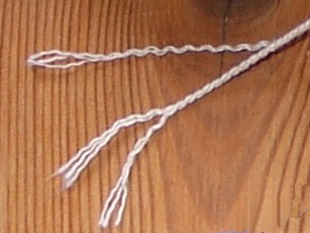
Twine showing component strands

Twine is a strong thread, light string or cord composed of string in which two or more thinner strands are twisted, and then twisted together (plied). The strands are plied in the opposite direction to that of their twist, which adds torsional strength to the cord and keeps it from unravelling. This process is sometimes called reverse wrap.[1] The same technique used for making twine is also used to make thread, which is thinner, yarn, and rope, which is stronger and thicker, generally with three or more strands.

Natural fibres used for making twine include wool, cotton, sisal, jute, hemp, henequen, paper, and coir. A variety of synthetic fibres are also used. Twine is a popular substance used in modern-day crafting.

Prehistoric

[edit]
Men making twine. Japan, 1915

The invention of twine is at least as important as the development of stone tools for early humans.[2] Indeed, Elizabeth Wayland Barber has called the development of twine, which can be made far stronger and longer than its component fibers, "the string revolution."[2] Twine could be used to fasten points and blades to arrows, spears, harpoons and other tools and to make snares, bags, baby slings, fishing and hunting nets and marine tackle, not to mention to secure firewood, haul goods and anchor tents and shelters. Twine is the foundation to both textile and rope making. Twine has been made of animal hair, including human,[3] sinews and plant material, often from the vascular tissue of a plant (known as bast), but also bark and even seed down, e.g. milkweed. However, unlike stone or metal tools, most twine is missing from the archaeological record because it is made of perishable materials that rarely survive over time.[4] In fact, the discovery of ancient beads and the dating of sea travel to at least 60,000 years ago suggests that the "string revolution" might have occurred much earlier than the Upper Paleolithic.[5] Plant twine was used for hafting stone tips by about 58,000 years ago in southern Africa.[6]

Paleolithic cord remnants have been discovered in a few places: Georgia's Dzudzuana Cave (30,000 years old),[7][8] Israel's Ohalo II site (19,000 years old),[9] and France's Lascaux Cave (17,000 years old).[10] In 2016, a carved piece of mammoth ivory with three holes, dated at 40,000 years old, was unearthed at the Hohle Fels site, famous for the discovery of both Paleolithic female figurines and flutes. It has been identified as a tool for twining rope.[11] In the Americas, cordage has been found at the Windover Bog, in Florida, dating to 8000 years ago.[12] A small piece of cord discovered at Abris du Muras, in south-eastern France, has been dated to around 50,000 years ago.[13]

Early depictions of twine are few, but one of the around 200 Venus figurines that have been found across Eurasia is depicted as wearing a "string skirt" (the Venus of Lespugue, dated to 25,000 years ago). Barber notes that not only is each twist in the strings carved in detail, but also "the bottom end of each string [is shown] fraying out into a mass of loose fibers (not possible for e.g. a twisted piece of gut or sinew)."[14][15]

Other evidence for the prehistoric use of twine is provided by impressions on metal or in pottery and other ceramic artifacts.[16] In the Fukui cave, Japan, such impressions date to 13,000 years ago.[17] Imprints of woven material in clay found at Dolni Vestonice I and several other sites in Moravia date to 26,000 years ago.[18] and were found along with needles and tools that were used to sew clothing and make nets for hunting small animals and birds.[19]

Beads, as well as shells and animal teeth with man-made holes, have also been used as indirect evidence of twining, as have net sinkers and tools with the marks of cord wear.[20] Beads have been found with the remnants of thread still trapped inside them.[21]

Historical manufacture

[edit]
Binder twine securing a hay bale

After the technique of making twine by hand was invented, various implements to produce thread for textile production such as spindles, spinning wheels and looms for spinning and weaving and tools for twine and rope-making were developed.

Process

[edit]

The twining process begins with cordage, which can be any form of untwisted, twisted or braided combination of fibers. A cord is formed by the twisting of at least one ply of material or the braiding together of multiple plies. The number of plies and the type of material lends itself to the naming of the type and structure of the cord. A simple ply is one that is made from a single strand or bunch of material that is spun in the same direction whereas a compound ply is created by twisting several strands or bunches of material individually and then spinning those together in opposite directions to one another.[22]

Once twine is produced, it can be used to produce other forms of function, most commonly textiles and basketry. The spun twine is then combined using a process called twining in order to produce both types of object. The primary constituents of this twining process are known as the warp and weft or the foundation and stitch. Objects created with this method using varying techniques may also host unique structural decoration. Systematic passing of the warp can create images or patterned modifications. In accompaniment of warp modifications, dyed or naturally coloured materials may be used to accumulate patterns. Textural differences may be created in twined objects by intentional spacing of strands implemented in the weave. Lastly, other auxiliary materials can be incorporated into the object for further detail such as embroidery, feathers, appliques, etc.[23]

Classifications

[edit]

There are several primary means of classifying objects such as threads, textiles and baskets created with twining. The way that the weft rows are spaced can be defined as open, closed or a combination of the two. These terms identify the closeness of the weft rows to one another and variation in this intentional spacing. The way that the warp and weft are interconnected creates different compositional arrangements. These arrangements can be simple, diagonal or both. The last main categorization comes from the direction that the weft is twisted. This is denoted as S-twist and Z-twist or both. In the S-twist the strands appear to come up as they are twisted left and the Z-twist appears to come up as they are twisted to the right.

Additional classifications that are typically recorded by anthropologists can include the width of the strands, the number of strands being used together to form the warp or weft, the number of warp and weft rows per unit centimeter, and the width of the gaps in the weft rows. Methods of preparation, composition, and creation are also of great importance.[22]

See also

[edit]

References

[edit]
Revisions and contributorsEdit on WikipediaRead on Wikipedia
from Grokipedia
Twine is a strong thread, light string, or cord composed of two or more thinner strands twisted together (plied). The term originates from twinn, meaning "double thread" or "linen," referring to the twisting process used in its production. Twine is made from natural fibers such as , , , or , as well as synthetic materials like , and finds applications in tying, binding, , crafting, and industry.

History

Prehistoric origins

Twine, a form of cordage, consists of two or more strands of fibers twisted together to create a strong, flexible light string or cord, setting it apart from untwisted plant fibers or single-thread materials that lack such structural integrity. This twisting process enhances tensile strength, making twine suitable for practical applications in early human societies. The earliest direct evidence of twine production comes from a fragment of three-ply cord made from twisted bast fibers of coniferous trees, discovered at the Abri du Maras site in southeastern and dated to between 41,000 and 52,000 years ago; microscopic analysis confirms it was crafted by Neanderthals through deliberate manual twisting and plying. Additional fragments of twisted and knotted fibers, indicative of early twine, were found at Dzudzuana Cave in the region of Georgia, preserved in sediment layers and radiocarbon-dated to approximately 30,000 years ago; these remains include evidence of processing wild (Linum usitatissimum) into usable cordage. In the Americas, well-preserved examples of twine and cordage, including two-ply and three-ply constructions from plant materials like palm and yucca, have been recovered from the Windover Archaeological Site in , dating to around 8,000 years ago and demonstrating advanced twisting techniques in a wetland burial context. Indirect evidence for twine or string use extends further back, with impressions of cordage patterns preserved in baked clay artifacts from sites like in the , dated to about 27,000 years ago, revealing details of twist direction and ply structure. Earlier inferences arise from perforated marine shell beads at sites such as in , dated to around 100,000–135,000 years ago, where abrasion marks around the perforations suggest suspension on twisted fiber strings. The emergence of twine marked what archaeologist Elizabeth Wayland Barber has termed the "string revolution," a transformative prehistoric around 25,000–30,000 years ago that facilitated the production of nets for and , woven baskets for storage and , fishing lines, and attachments for and tools, thereby revolutionizing efficiency, hunting success, and long-distance migration patterns among peoples. These advancements relied on basic hand-twisting techniques, where individuals gathered plant fibers from sources like , nettles, and tree bark, moistened them for pliability, and manually rolled or twisted them against the or palm to form cohesive strands without any mechanical aids.

Ancient and historical developments

The development of twine production advanced significantly with the introduction of basic tools that enabled more consistent twisting of fibers, building on earlier prehistoric foundations of manual fiber manipulation. Around 10,000 BCE in the , perforated stones identified as spindle whorls appeared at sites like those in the , facilitating the spinning of plant and animal fibers into stronger, uniform strands by providing rotational weight and momentum to a drop spindle. These tools marked a shift toward specialized cordage creation, with early evidence from contexts in around 6000 BCE showing standardized spindle whorls for systematic fiber twisting, often using clay or stone weights attached to wooden spindles. Concurrently, rudimentary looms emerged in the region by the period, integrating twisted twine as warp elements in textiles and allowing for woven fabrics that incorporated cordage for structural . In from approximately 3000 BCE, twine derived from and fibers played a vital role in maritime and activities, where it was twisted into ropes for sails on vessels and nets for capturing and . , cultivated extensively along the , provided durable cords essential for ships and securing , while strips were beaten and twisted into coarser twine for everyday bindings and marine applications. The Romans, adopting and expanding these practices, relied on cordage for and naval supremacy, twisting fibers into robust ropes for fastenings, equipment, and sails on their galleys, which supported expansive campaigns across the Mediterranean. By the medieval period in , binder twine—often handmade from or —became integral to , used to tie harvested sheaves of grain for storage and transport, reflecting localized adaptations in rural economies. Twine's cultural importance extended beyond utility into basketry, where finely twisted fibers formed the foundational coils and weaves of containers for storage and transport in ancient Near Eastern and Egyptian societies, serving as precursors to more complex rope-making techniques. In trade networks, such as those of the (circa 800–1050 CE), cordage from imported fibers like those akin to sisal analogs (though primarily local and ) facilitated maritime exchanges across and beyond, enabling the binding of goods on long voyages. Early standardization emerged through medieval guilds in , particularly in textile centers like and , where regulations from the onward specified thread counts, twist directions, and fiber qualities for cordage to ensure consistency in production for sails, nets, and bindings. Pre-industrial twine production faced substantial challenges due to its labor-intensive hand methods, requiring skilled workers to manually twist fibers for hours to achieve sufficient strength and length, often limiting output to small-scale operations. Fiber sourcing posed additional constraints, as reliance on regionally available like or was vulnerable to seasonal variations, conditions, and , leading to inconsistencies in quality and availability before broader networks developed. These limitations underscored the artisanal nature of twine-making, where entire communities might dedicate significant time to and twisting, yet production remained inefficient compared to later mechanized eras.

Industrial and modern advancements

The mechanization of twine production began in the early with the of the rope-twisting machine in in 1820, which automated the twisting process and facilitated mass production of uniform ropes and twines on an industrial scale. Later in the century, binder twine emerged as a critical for , enabling the automated baling of hay and grain; this was driven by the development of machines in the 1870s and 1880s, which used lightweight sisal-based twine to secure bundles efficiently during harvesting. In the , twine manufacturing shifted toward synthetic materials following , with the introduction of fibers like and that provided superior strength, rot resistance, and longevity compared to natural alternatives. Automation further advanced during this period through improved twisting and braiding machines, such as Haskell-Dawes rope layers, which enhanced production consistency, speed, and output volumes for both natural and synthetic twines in industrial settings. Recent developments from 2020 to 2025 have emphasized , including the rise of biodegradable twines made from (PLA), which fully decompose in within months and reduce in agricultural applications. Innovations in eco-friendly processing, such as Twine Solutions' waterless digital dyeing systems, eliminate traditional water-intensive dyeing by applying color directly via inkjet technology, cutting water usage by up to 95% and minimizing . These systems, along with methods for reprocessing from used bale twine into new durable products like garden planters, have gained traction to address environmental concerns in twine production. In 2025, Steakholder Foods completed the acquisition of Twine Solutions' technologies on November 4, 2025, to integrate digital dyeing with advanced platforms. Additionally, the EU's proposed Packaging and Packaging Waste Regulation (PPWR), advancing as of 2025, aims to set recycled content targets for products, including twines, to promote . These advancements have driven significant market expansion, with the global cordage and twine industry projected to reach $80.2 billion by 2031, fueled by for durable, UV-resistant variants like twines that withstand prolonged outdoor exposure. Overall impacts include substantial reductions in labor costs via automated machinery, enhanced load-bearing capabilities—such as twines handling agricultural bales up to several hundred pounds—and compliance with environmental regulations to curb marine litter.

Materials

Natural fibers

Natural fibers, derived from plant and animal sources, have long served as the foundational materials for twine production due to their renewability and inherent strength. These fibers are primarily extracted from plants such as bast (stem) fibers like and , leaf fibers like , and seed fibers like , offering a biodegradable alternative to more modern materials. Among the most common plant-based fibers used in twine are , valued for its exceptional strength and durability, making it ideal for ropes and heavy-duty applications; and , which provide coarse, biodegradable options suited for agricultural tying and packaging; , prized for its softness and absorbency in lighter crafts and bindings; and (also known as ), which offers fine, strong strands suitable for textiles and finer twines. fibers, sourced from the plant, exhibit high tensile strength, typically around 500 MPa, enabling robust twine resistant to abrasion. , extracted from the leaves of the plant native to and , and from the plant in , are coarser with tensile strengths of approximately 200-400 MPa, emphasizing their role in disposable, eco-friendly uses. fibers, harvested from plants, have lower tensile strength around 300 MPa but excel in flexibility, while from provides a balance of fineness and strength up to 500 MPa for versatile twine. Processing these fibers begins with harvesting and extraction through methods like , where plant stalks are soaked in water or dew to break down and separate fibers from woody parts, followed by , a mechanical beating to remove impurities and align the strands for spinning into twine. These steps preserve the natural composition while enhancing usability, though variations in climate and soil affect fiber quality. Environmentally, natural fibers are highly renewable, requiring minimal synthetic inputs and decomposing fully without persistent pollutants, which supports ; however, they are susceptible to rot and microbial degradation when exposed to moisture, limiting longevity in wet conditions. Historically, natural fibers dominated twine production until the mid-20th century, driven by their widespread availability and suitability for manual processing; for instance, in 19th-century farming, binder twine made from (abaca fiber from Musa textilis in the ) revolutionized mechanized harvesting by securely bundling crops like . This reliance stemmed from the fibers' accessibility in agrarian societies, where and were cultivated globally for cordage needs. Today, natural fibers hold a niche but growing role in eco-friendly products, capturing approximately 20% of the twine market in 2025, particularly in sustainable applications like and biodegradable packaging, amid a broader shift toward synthetics for enhanced durability.

Synthetic fibers

Synthetic fibers for twine represent a class of man-made materials engineered from polymers, offering enhanced durability and performance over traditional natural alternatives. Developed primarily after the , these fibers emerged from advancements in , with patented in 1937 and commercialized in 1939 by , introduced in Britain in 1941 and the U.S. in 1953 by , and invented in 1951 by Phillips Petroleum. These innovations addressed limitations of natural fibers like susceptibility to moisture and rot, enabling synthetic twines to achieve superior tensile strength—such as approximately 900 MPa for drawn fibers—and extended longevity through resistance to chemicals, abrasion, and weathering. Among the primary synthetic fibers used in twine production, stands out for its lightweight construction, water resistance, and stability under (UV) exposure, making it ideal for outdoor agricultural applications like twine. provides high elasticity and exceptional abrasion resistance, allowing twines to absorb shocks without breaking, which is advantageous in dynamic uses such as securing. , known for its mold resistance and high strength in wet conditions, excels in marine environments where twines must withstand prolonged exposure to saltwater without degrading. These properties collectively outperform natural fibers in demanding industrial settings, though synthetics have largely supplanted them due to engineered consistency. The production of synthetic twine fibers begins with to form the base , followed by melt through a —a plate with tiny holes—to draw continuous filaments that are then cooled, stretched, and wound into twine. This process allows for customization, such as adding pigments for colored baler twine, enhancing visibility in farming operations. By 2025, synthetic fibers, particularly , are projected to dominate approximately 80% of the global twine market, driven by their cost-efficiency—often 20-30% lower production costs than naturals—and scalability for high-volume applications. Environmental considerations for synthetic twine include the release of during degradation, which can persist in and waterways, posing risks to ecosystems as highlighted in global assessments predicting doubled oceanic microplastic levels by 2030. However, advancements since 2020 have introduced recyclable variants, such as reprocessed from , enabling closed-loop systems that reduce contributions and promote in twine manufacturing.

Manufacturing Processes

Traditional techniques

Traditional techniques for creating twine relied on manual processes to twist natural fibers into strong, functional cords, primarily through hand-rolling or basic tools like drop spindles. The core process involved twisting fibers into 2 plies, often using a motion to form individual strands, followed by counter-twisting the plies together for cohesion and strength; braiding multiple strands could further enhance durability for applications like binding or netting. These methods evolved from prehistoric practices of simple twisting, dating back thousands of years. The production steps began with fiber preparation, which included combing to align the s and them—often by hand or soaking—to reduce and facilitate twisting without breakage. Next, prepared fibers were bundled and twisted into plies using techniques such as reverse-wrap twisting, where one set of fibers wrapped around stationary ones, or diagonal twisting for more structured forms. Twist direction was critical: an S-twist (counterclockwise) or Z-twist (clockwise) was applied to single plies, with plies then combined in the opposite direction to balance tension and prevent unravelling. Tools were rudimentary, starting with prehistoric hand methods where fibers were rolled between palms or on the to impart twist, progressing to drop spindles in related spinning traditions—a weighted stick rotated by hand to continuously spin fibers into cord. By the (16th century onward), mechanical aids like treadle wheels emerged, allowing foot-powered rotation of a spindle to produce twine more efficiently for small-scale items such as fishing nets. These variations supported localized production, with hand-rolling suited for coarse, short cords and spindles enabling finer, longer lengths. Despite their effectiveness, traditional techniques had limitations, including inconsistent strength due to variable quality and manual application, as well as high labor intensity that restricted output to pre-industrial scales suitable only for or needs.

Modern production methods

Modern twine production has evolved into highly industrialized processes that emphasize , precision, and to meet global demands for consistent quality and . For synthetic twines, the process begins with fiber extrusion, where raw polymers such as are melted and forced through spinnerets to form continuous monofilaments or multifilaments, which are then cooled, stretched, and wound into yarns. In contrast, twines start with , where raw materials like , , or are cleaned, aligned, and combed into slivers to prepare them for spinning. These prepared fibers or filaments are then fed into automated twisting machines, which have been in use since the early , featuring multiple spindles to ply strands together into balanced, high-strength twine through controlled rotation and tension. For more intricate designs, braiding looms interlace multiple strands in complex patterns, enabling the production of durable, flexible twines suitable for specialized applications. Recent advancements have integrated digital technologies to enhance efficiency and environmental performance, including compliance with standards like the Global Recycled Standard (GRS) for sustainable materials. Computer-controlled systems now regulate tension during twisting, ensuring uniform twist levels across large batches and minimizing defects like uneven ply or breakage. Post-2020 innovations include AI for color prediction in dyeing processes and digital waterless dyeing technologies that can reduce water and chemical usage by up to 95%, alongside waste reprocessing techniques that recycle end-of-life twine into new fibers, promoting principles. These build upon foundational traditional hand-twisting methods by scaling them for industrial volumes while addressing ecological concerns, with emerging bio-based synthetic twines as of 2025. Quality control in modern production involves rigorous testing, particularly for break strength, where baler twine is evaluated for typical knot strengths of 100-300 pounds under tensile stress to ensure reliability in high-demand scenarios. Finished twine is typically packaged in coils or spools optimized for agricultural machinery, facilitating easy integration into automated baling systems. Globally, twine and cordage output reached an estimated value of $11.3 billion in 2024, with production focused on energy-efficient machinery and compliance with eco-standards like reduced emissions and recyclable materials to support sustainable supply chains.

Classifications and Types

By construction and twist

Twine is classified by its construction methods, which determine its physical properties and suitability for various structural demands. involves simple plying of fibers or yarns in a helical manner, providing flexibility and ease of handling due to the loose alignment of components that allows without excessive stress. Braided construction, by contrast, interweaves multiple strands in an over-under pattern around a central axis, resulting in a smoother surface and enhanced strength through even distribution of tension across the structure. Twist direction further refines classification, with S-twist denoting a left-handed, counterclockwise orientation where strands slant like the lower part of the letter "S" when viewed vertically, and Z-twist indicating a right-handed, slant resembling the letter "Z." Balanced plies achieve stability by combining singles twisted in (typically Z) with an opposite ply twist (S), counteracting torsional forces to prevent unraveling and maintain structural integrity under load. In anthropological contexts, twined textiles exhibit metrics such as open or closed weft spacing, where open spacing features broadly separated wefts (e.g., 10–20 mm apart) connecting stationary warps to form porous structures, while closed spacing packs wefts tightly for denser fabrics. Warp-weft arrangements vary from simple alignments, where wefts twist half-turns around adjacent warps, to diagonal configurations that elements for added complexity and potential in prehistoric artifacts like American Desert West robes. These construction and twist features influence performance, with braided twine excelling in heavy-load scenarios such as trawls due to its high tensile strength and resistance to deformation under stress. Twist direction impacts grip and wear by altering load distribution; unbalanced or excessive twist leads to uneven strand tension, accelerating abrasion on over-stressed elements and reducing overall durability. properties can briefly influence twist viability, as certain fibers better accommodate high twists without fracturing.

By material and application

Twine is categorized by its material composition, which directly influences its strength, durability, and suitability for specific applications. twines, derived from plant sources such as , , , and , are valued for their biodegradability and traditional uses in and . For instance, garden twine typically exhibits a tensile strength of around 210 to 240 pounds, making it suitable for light to moderate tying tasks like securing plants or bundling lightweight materials. In contrast, synthetic twines, primarily made from or , offer higher resistance to moisture, UV exposure, and abrasion, often achieving greater tensile strengths for demanding industrial needs. baler twine, for example, commonly provides a tensile strength of 110 to 170 pounds or more, enabling it to handle heavy loads in hay baling without breaking. Application-specific subtypes further refine these material-based categories to match functional requirements. Binder twine, predominantly used in for tying bales of hay or , is typically 2 to 4 millimeters in diameter and available in both natural (with about 130 pounds tensile strength) and synthetic variants for efficient mechanized baling. Mason's twine, designed for precise construction tasks like laying bricks or marking straight lines, is a fine, low-stretch product often made from or , with diameters under 2 millimeters and tensile strengths around 160 pounds to ensure taut, accurate alignments without sagging. Upholstery twine, employed in furniture assembly for securing springs or decorative cording, is usually waxed or coated like or , with typical tensile strengths of 75 to 200 pounds while resisting moisture and adding aesthetic appeal. Industry standards, such as ISO 2062, govern the measurement of tensile strength and elongation for twines, ensuring consistent performance across materials by specifying test methods for breaking force and percentage elongation at break. Post-2020 developments have introduced eco-classifications emphasizing , distinguishing biodegradable natural twines (e.g., or , which decompose in 1-2 years) from recyclable synthetics like , with initiatives promoting compostable twine to reduce . Recent developments as of 2025 include bio-based synthetic twines that combine durability with faster decomposition, supporting agricultural initiatives. Twine variations also include diameter grades tailored to load-bearing needs, with fine grades under 2 millimeters (e.g., 0.8 to 1.5 millimeters for delicate tasks like crafting or ) offering precision and minimal bulk, while coarse grades over 5 millimeters provide enhanced grip and strength for heavy-duty applications like bundling or hauling.

Uses and Applications

Creative and literary uses

Twine has been widely adopted in and hypertext literature since its release, allowing authors to create branching narratives that explore nonlinear storytelling without requiring advanced programming skills. Early applications focused on personal and experimental works, such as choose-your-own-adventure style stories shared online, building on traditions of text-based adventures from the 1970s and 1980s. Notable examples include "" (2013) by Zoe Quinn, which uses Twine's structure to simulate experiences of depression and raised awareness about in gaming communities. Twine also facilitated the prototyping of Netflix's ": " (2018), where creator utilized the tool to map complex narrative paths before full production. In literary contexts, Twine supports elements like embedded images, audio, and variables for dynamic content, enabling poets and writers to blend text with . Works by authors like Porpentine (e.g., "With Those We Love Alive," 2014) demonstrate Twine's capacity for intimate, emotional interactive experiences that challenge traditional prose forms. These creative uses have fostered a of "walking sims" and narrative-driven games, often distributed for free on platforms like , where thousands of Twine-created titles are available as of November 2025.

Educational and professional applications

Twine is extensively used in education to teach narrative design, , and introductory programming concepts, particularly in and classrooms. Its visual interface helps students visualize story structures, making it ideal for assignments in , , and —such as simulating historical events through interactive timelines or ethical dilemmas in courses. For instance, educators have employed Twine to create branching scenarios for training in fields like and drone piloting, enhancing engagement and decision-making skills without overwhelming technical barriers. In professional settings, Twine aids independent game developers in prototyping interactive experiences, supporting formats like SugarCube for advanced macros and integration. It has been applied in research for building explorable explanations and in therapy contexts for personalized tools. The tool's open-source nature and active community, including forums and a server, provide resources like the Twine Cookbook for collaborative development. As of November 2025, Twine's ecosystem continues to grow, with ongoing updates to story formats and integration with web technologies, empowering non-programmers in .

References

Add your contribution
Related Hubs
User Avatar
No comments yet.