


Community hub
Recent from talks
Contribute something to knowledge base
Content stats: 0 posts, 0 articles, 1 media, 0 notes
Members stats: 0 subscribers, 0 contributors, 0 moderators, 0 supporters
Subscribers
Supporters
Contributors
Moderators
Hub AI
SM-64 Navaho AI simulator
(@SM-64 Navaho_simulator)
Hub AI
SM-64 Navaho AI simulator
(@SM-64 Navaho_simulator)
SM-64 Navaho
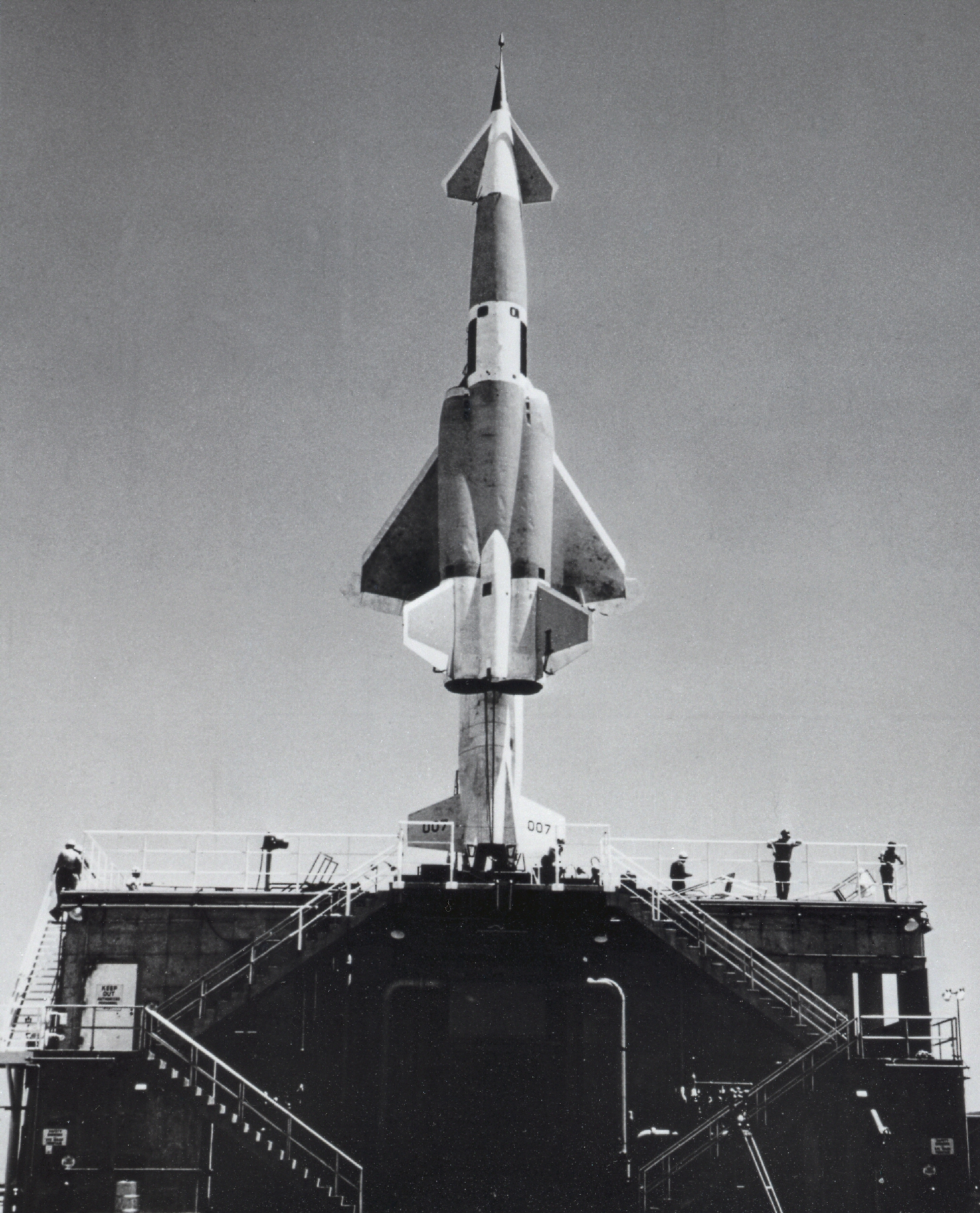
The North American SM-64 Navaho was a supersonic intercontinental cruise missile project built by North American Aviation (NAA). The final design was capable of delivering a nuclear weapon to the USSR from bases within the US, while cruising at Mach 3 (3,700 km/h; 2,300 mph) at 60,000 feet (18,000 m) altitude. The missile was named after the Navajo Nation, starting with "NA" for North American, it is sometimes stated to also be an acronym for North American Vehicle, Alcohol, Hydrogen peroxide, Oxygen, referring to the missile's propellants.
The original 1946 project called for a relatively short-range system, a boost-glide weapon based on a winged V-2 rocket design. Over time the requirements were repeatedly extended, both due to the US Air Force's desire for longer ranged systems, as well as competition from similar weapons that successfully filled the shorter-range niche. This led to a new design based on a ramjet powered cruise missile, which also developed into a series of ever-larger versions, along with the booster rockets to launch them up to speed.
Through this period the US Air Force was developing the SM-65 Atlas, based on rocket technology developed for Navaho. Atlas filled the same performance goals but could do so with total flight times measured in minutes rather than hours, and flying at speeds and altitudes which made them immune to interception, as opposed to merely very difficult to intercept as in the case of Navaho. With the launch of Sputnik 1 in 1957 and the ensuing fears of a missile gap, Atlas received the highest development authority. Navaho continued as a backup, before being canceled in 1958 when Atlas successfully matured.
Although Navaho did not enter service, its development provided useful research in a number of fields. A version of the Navaho airframe powered by a single turbojet became the AGM-28 Hound Dog, which was carried towards its targets on the Boeing B-52 Stratofortress and then flew the rest of the way at about Mach 2. The guidance system was used to guide the first Polaris submarines. The booster engine design, spun off to NAA's new Rocketdyne subsidiary, was used in various versions of the Atlas, PGM-11 Redstone, PGM-17 Thor, PGM-19 Jupiter, Mercury-Redstone, and the Juno series; it is therefore the direct ancestor of the engines used to launch the Saturn I and Saturn V Moon rockets.
The Germans had introduced a number of new "wonder weapons" during the war that were of great interest to all the allied forces. Jet engines were already widely used after their introduction in the UK, but the V-1 flying bomb and V-2 rocket represented technologies that had not been developed elsewhere. In German use these weapons had relatively little strategic effect and had to be fired in the thousands to cause any real damage. But if armed with a nuclear weapon, even a single such weapon would cause damage equivalent to thousands of conventionally armed versions, and this line of research was quickly taken up by the US Army Air Force (USAAF) in late 1944.
Vannevar Bush of the USAAF's Scientific Advisory Board was convinced that manned or automated aircraft like the V-1 were the only possible solution for long range roles. A ballistic missile capable of carrying even the smallest warhead was "at least ten years away", and when asked directly about the topic, noted:
In my opinion, such a thing is impossible. I don't think anybody in the world knows how to do such a thing and I feel confident it will not be done for a very long time to come.
Army planners began planning for a wide variety of post-war missile systems that varied from short-range ballistic missiles to long range flying bombs. After considerable internal debate among Army branches, in August 1945 these were codified in a classified document outlining many such systems, among them a variety of cruise missiles, essentially V-1s with extended range and the greater payload needed to carry a nuclear warhead. There were three broad outlines depending on range, one for a missile flying 175 to 500 miles (282–805 km), another 500 to 1,500 miles (800–2,410 km), and finally one for 1,500 to 5,000 miles (2,400–8,000 km). Both subsonic and supersonic designs would be considered.
SM-64 Navaho
The North American SM-64 Navaho was a supersonic intercontinental cruise missile project built by North American Aviation (NAA). The final design was capable of delivering a nuclear weapon to the USSR from bases within the US, while cruising at Mach 3 (3,700 km/h; 2,300 mph) at 60,000 feet (18,000 m) altitude. The missile was named after the Navajo Nation, starting with "NA" for North American, it is sometimes stated to also be an acronym for North American Vehicle, Alcohol, Hydrogen peroxide, Oxygen, referring to the missile's propellants.
The original 1946 project called for a relatively short-range system, a boost-glide weapon based on a winged V-2 rocket design. Over time the requirements were repeatedly extended, both due to the US Air Force's desire for longer ranged systems, as well as competition from similar weapons that successfully filled the shorter-range niche. This led to a new design based on a ramjet powered cruise missile, which also developed into a series of ever-larger versions, along with the booster rockets to launch them up to speed.
Through this period the US Air Force was developing the SM-65 Atlas, based on rocket technology developed for Navaho. Atlas filled the same performance goals but could do so with total flight times measured in minutes rather than hours, and flying at speeds and altitudes which made them immune to interception, as opposed to merely very difficult to intercept as in the case of Navaho. With the launch of Sputnik 1 in 1957 and the ensuing fears of a missile gap, Atlas received the highest development authority. Navaho continued as a backup, before being canceled in 1958 when Atlas successfully matured.
Although Navaho did not enter service, its development provided useful research in a number of fields. A version of the Navaho airframe powered by a single turbojet became the AGM-28 Hound Dog, which was carried towards its targets on the Boeing B-52 Stratofortress and then flew the rest of the way at about Mach 2. The guidance system was used to guide the first Polaris submarines. The booster engine design, spun off to NAA's new Rocketdyne subsidiary, was used in various versions of the Atlas, PGM-11 Redstone, PGM-17 Thor, PGM-19 Jupiter, Mercury-Redstone, and the Juno series; it is therefore the direct ancestor of the engines used to launch the Saturn I and Saturn V Moon rockets.
The Germans had introduced a number of new "wonder weapons" during the war that were of great interest to all the allied forces. Jet engines were already widely used after their introduction in the UK, but the V-1 flying bomb and V-2 rocket represented technologies that had not been developed elsewhere. In German use these weapons had relatively little strategic effect and had to be fired in the thousands to cause any real damage. But if armed with a nuclear weapon, even a single such weapon would cause damage equivalent to thousands of conventionally armed versions, and this line of research was quickly taken up by the US Army Air Force (USAAF) in late 1944.
Vannevar Bush of the USAAF's Scientific Advisory Board was convinced that manned or automated aircraft like the V-1 were the only possible solution for long range roles. A ballistic missile capable of carrying even the smallest warhead was "at least ten years away", and when asked directly about the topic, noted:
In my opinion, such a thing is impossible. I don't think anybody in the world knows how to do such a thing and I feel confident it will not be done for a very long time to come.
Army planners began planning for a wide variety of post-war missile systems that varied from short-range ballistic missiles to long range flying bombs. After considerable internal debate among Army branches, in August 1945 these were codified in a classified document outlining many such systems, among them a variety of cruise missiles, essentially V-1s with extended range and the greater payload needed to carry a nuclear warhead. There were three broad outlines depending on range, one for a missile flying 175 to 500 miles (282–805 km), another 500 to 1,500 miles (800–2,410 km), and finally one for 1,500 to 5,000 miles (2,400–8,000 km). Both subsonic and supersonic designs would be considered.
Recent media
Recent media