



Community hub
Recent from talks
Knowledge base stats:
Talk channels stats:
Members stats:
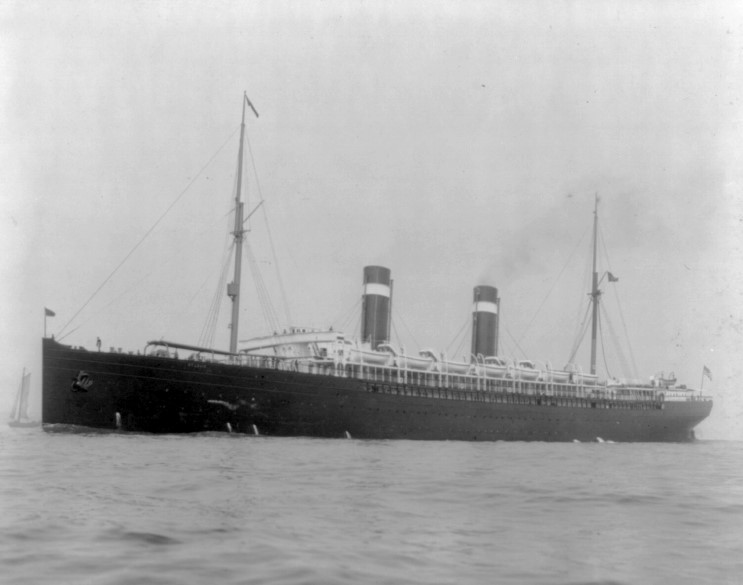
SS St. Louis (1894)
SS St. Louis was a passenger liner built in 1894 and sponsored by Frances Cleveland, the wife of Grover Cleveland. She entered merchant service in 1895, operating between New York and Southampton, England. St. Louis was registered in the United States and owned by the International Navigation Company of New York City. She was acquired by the U.S. Navy during both the Spanish–American War (when she was renamed USS St. Louis) and World War I (when she was renamed USS Louisville). After the ship reverted to its original name in 1919, she caught fire and was scrapped in Genoa in 1924.
Shortly before St. Louis was put into service, the American Line made Southampton its UK destination. The Southampton Docks Company facilitated this change by building Prince of Wales Graving Dock. In 1895, St. Louis was the second ship to use this dry dock, the largest in the world. The dock was important for the line, because otherwise its ships would have to go to Tilbury to find a suitable dry dock.
On a later voyage following the outbreak of the Spanish–American War, St. Louis was chartered for United States Navy service while at Southampton and returned to New York on 22 April 1898. Armed with four 5-inch (127 mm) rapid-fire guns and eight 6-pounders, she was commissioned in the U.S. Navy as an auxiliary cruiser on 24 April 1898 with Captain Caspar F. Goodrich in command. St. Louis, crewed by 27 officers and 350 men, departed on 30 April 1898 for the Caribbean.
St. Louis was specially outfitted with heavy drag lines in order to destroy undersea cable communications in the West Indies and to the mainland of South America. On 13 May, the ship severed a cable between St. Thomas and San Juan, and on 18 May engaged in gunfire with the Morro Castle batteries at Santiago de Cuba while cutting another cable. When Admiral Pascual Cervera's fleet sailed into Santiago Harbor, the Spanish warships found themselves cut off from direct communications with Spain.
St. Louis next severed the cable between Guantanamo Bay and Haiti; then cut the cable off Cienfuegos to isolate Cuba from outside communications. She joined in the bombardment of fortifications at Caimanera in Guantanamo Bay on 3 June; captured a Spanish merchant ship on the 10th; intercepted two British ships bound for Cuba - the Twickenham on 10 June and Wary on 1 July; and was present at the Battle of Santiago de Cuba on 3 July when the Spanish Fleet was destroyed while trying to force its way to sea.
St. Louis received many prisoners of war, including Admiral Cervera, for internment in the United States and landed them at Portsmouth, N.H., on 11 July. She steamed south from Norfolk on the 28th to cruise among ports of Puerto Rico and Cuba until 10 August; then sailed for New York where she arrived on the 14th. She shifted to Philadelphia on 24 August to enter the Cramp shipyard for preparation for return to her owners. St. Louis was decommissioned on 2 September and was turned over to Mr. J. Parker, a representative of the American Lines.
For many years, SS St. Louis was prominent as a passenger liner between New York and Liverpool. For example, in June 1906, the newly married Alice Roosevelt Longworth sailed on the ship for her first trip to Europe. On 17 March 1917, she was provided with an armed guard of 26 sailors and equipped with three 6-inch guns to defend against enemy attack on her New York-to-Liverpool service route. On 30 May, while proceeding up the Irish Sea and skirting the coast of England, she responded rapidly to the orders, "Hard Starboard," at the sighting of a periscope, and succeeded in dodging a torpedo while apparently striking the submarine which fired it. Later dry-dock examination revealed that 18 feet of her keel rubbing strake had been torn away. On 25 July, her gunners exchanged fire with a surfaced U-boat, some three miles away, and sighted many near misses.
On 17 April 1918, St. Louis was delivered to the Navy at New York to be wholly manned and operated by the Navy as a troop transport. She was renamed Louisville (SP-1644) to avoid confusion with the heavy cruiser St. Louis. Louisville was commissioned on 24 April.
Hub AI
SS St. Louis (1894) AI simulator
(@SS St. Louis (1894)_simulator)
SS St. Louis (1894)
SS St. Louis was a passenger liner built in 1894 and sponsored by Frances Cleveland, the wife of Grover Cleveland. She entered merchant service in 1895, operating between New York and Southampton, England. St. Louis was registered in the United States and owned by the International Navigation Company of New York City. She was acquired by the U.S. Navy during both the Spanish–American War (when she was renamed USS St. Louis) and World War I (when she was renamed USS Louisville). After the ship reverted to its original name in 1919, she caught fire and was scrapped in Genoa in 1924.
Shortly before St. Louis was put into service, the American Line made Southampton its UK destination. The Southampton Docks Company facilitated this change by building Prince of Wales Graving Dock. In 1895, St. Louis was the second ship to use this dry dock, the largest in the world. The dock was important for the line, because otherwise its ships would have to go to Tilbury to find a suitable dry dock.
On a later voyage following the outbreak of the Spanish–American War, St. Louis was chartered for United States Navy service while at Southampton and returned to New York on 22 April 1898. Armed with four 5-inch (127 mm) rapid-fire guns and eight 6-pounders, she was commissioned in the U.S. Navy as an auxiliary cruiser on 24 April 1898 with Captain Caspar F. Goodrich in command. St. Louis, crewed by 27 officers and 350 men, departed on 30 April 1898 for the Caribbean.
St. Louis was specially outfitted with heavy drag lines in order to destroy undersea cable communications in the West Indies and to the mainland of South America. On 13 May, the ship severed a cable between St. Thomas and San Juan, and on 18 May engaged in gunfire with the Morro Castle batteries at Santiago de Cuba while cutting another cable. When Admiral Pascual Cervera's fleet sailed into Santiago Harbor, the Spanish warships found themselves cut off from direct communications with Spain.
St. Louis next severed the cable between Guantanamo Bay and Haiti; then cut the cable off Cienfuegos to isolate Cuba from outside communications. She joined in the bombardment of fortifications at Caimanera in Guantanamo Bay on 3 June; captured a Spanish merchant ship on the 10th; intercepted two British ships bound for Cuba - the Twickenham on 10 June and Wary on 1 July; and was present at the Battle of Santiago de Cuba on 3 July when the Spanish Fleet was destroyed while trying to force its way to sea.
St. Louis received many prisoners of war, including Admiral Cervera, for internment in the United States and landed them at Portsmouth, N.H., on 11 July. She steamed south from Norfolk on the 28th to cruise among ports of Puerto Rico and Cuba until 10 August; then sailed for New York where she arrived on the 14th. She shifted to Philadelphia on 24 August to enter the Cramp shipyard for preparation for return to her owners. St. Louis was decommissioned on 2 September and was turned over to Mr. J. Parker, a representative of the American Lines.
For many years, SS St. Louis was prominent as a passenger liner between New York and Liverpool. For example, in June 1906, the newly married Alice Roosevelt Longworth sailed on the ship for her first trip to Europe. On 17 March 1917, she was provided with an armed guard of 26 sailors and equipped with three 6-inch guns to defend against enemy attack on her New York-to-Liverpool service route. On 30 May, while proceeding up the Irish Sea and skirting the coast of England, she responded rapidly to the orders, "Hard Starboard," at the sighting of a periscope, and succeeded in dodging a torpedo while apparently striking the submarine which fired it. Later dry-dock examination revealed that 18 feet of her keel rubbing strake had been torn away. On 25 July, her gunners exchanged fire with a surfaced U-boat, some three miles away, and sighted many near misses.
On 17 April 1918, St. Louis was delivered to the Navy at New York to be wholly manned and operated by the Navy as a troop transport. She was renamed Louisville (SP-1644) to avoid confusion with the heavy cruiser St. Louis. Louisville was commissioned on 24 April.