
Recent from talks
SU-76
Knowledge base stats:
Talk channels stats:
Members stats:
SU-76
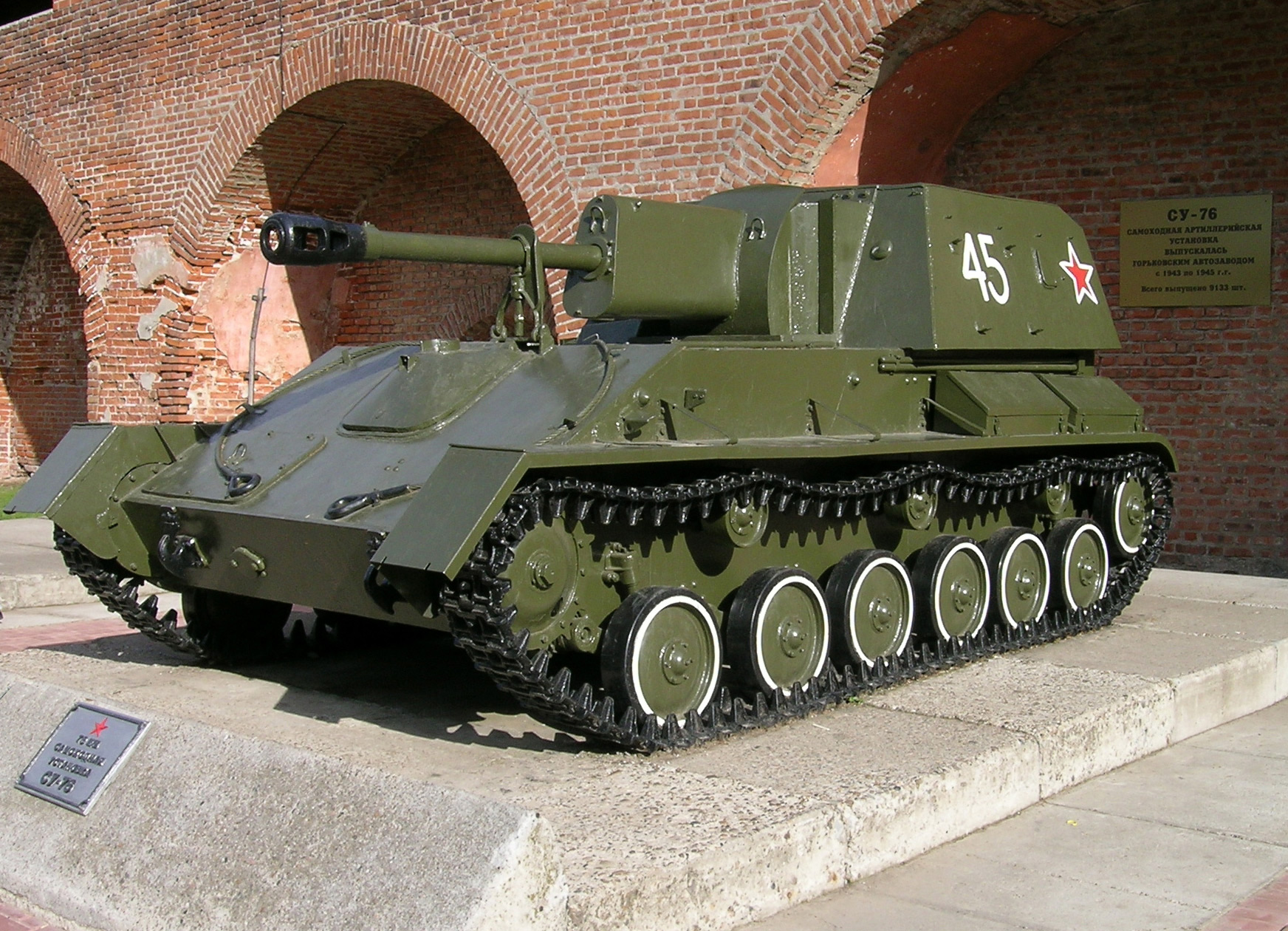
The SU-76 (Samokhodnaya Ustanovka 76) was a Soviet light self-propelled gun used during and after World War II. The SU-76 was based on a lengthened version of the T-70 light tank chassis and armed with the ZIS-3 mod. 1942 76-mm divisional field gun. Developed under the leadership of chief designer S.A. Ginzburg (1900–1943). Its quite simple construction and multipurpose combat role made it the second most produced Soviet armored fighting vehicle of World War II, after the T-34 medium tank.
Design of the SU-76 began in June 1942, when the State Defense Committee (GKO) ordered the construction of infantry support self-propelled guns armed with the ZIS-3 76-mm divisional field gun and the M-30 122-mm howitzer. The T-70 light tank chassis was chosen by chief designer S.A. Ginzburg for mounting the ZIS-3 gun, and basic tank's hull was lengthened, adding one road wheel per side, to facilitate better gun mounting. The gun was installed in the embrasure of the front armored plate of the fixed fully closed armored casemate above the rear of the hull. The power plant consisted of two engines connected in parallel with the transmission. The units of the latter were also paralleled and connected at the level of the main gears. The mechanic-driver sat in the bow of the vehicle, and the gun crew of three men including the commander (usually junior lieutenant) was located in the casemate. The SU-76 (factory designation SU-12) was put into service by a GKO decree of December 2, 1942.
The first batch of SU-76s (25 units) was manufactured by January 1, 1943, and sent to the self-propelled artillery training center. At the end of January, the first two self-propelled artillery regiments of a mixed organization (1433rd and 1434th) were sent to the Volkhov Front to participate in breaking the siege of Leningrad. In March 1943, two more regiments were formed - the 1485th and 1487th, which participated in battles on the Western Front (Soviet Union).
However, already after 10 days of military operation, most of the SU-76s were out of order due to breakdowns in gearboxes and main shafts. An attempt to correct the situation by strengthening the shafts did not lead to anything. Moreover, such vehicles failed even more often. It became obvious that the transmission of the SU-76 had a fundamental design flaw, which was the parallel installation of two twin engines that worked on a common shaft. Such transmission scheme led to the occurrence of resonant torsional vibrations on the shafts. Moreover, the maximum value of the resonant frequency accounted for the most intense mode of operation of the engines (driving in 2nd gear off-road), which led to their rapid failure. Elimination of this defect required time, therefore, on March 21, 1943, the production of the SU-76 was suspended. A total of 560 units were built at Plant No. 38 in Kirov. During the investigation that followed the mass failure of SPGs in the winter of 1943, a commission chaired by I.M. Zaltsman defined that the main culprit was the head of the Department of the Chief Designer of the People's Commissariat of the Tank Industry S.A. Ginzburg, who was removed from his position and sent to the front as the head of the repair service of the 32nd tank brigade belonged to the 29th tank corps. Stalin, having learned about this, did not approve of such a hasty decision, and ordered the talented tank designer to be recalled from the front, but it was too late - Ginzburg was killed in action.
A more reliable vehicle, the SU-15, appeared as a result of a competition announced by the management of the People's Commissariat of the Tank Industry for a light assault SPG armed with a 76-mm divisional gun. GAZ and Plant No. 38 took part in the competition. Tests of the new self-propelled guns took place at the Gorokhovets artillery training ground in July 1943, at the height of the Battle of Kursk. The SU-15 enjoyed the greatest success with the military, and it was recommended for mass production after some improvements. It was necessary to lighten the vehicle, which was done by removing the armored roof over the casemate, at the same time this solved all problems with its ventilation, and also facilitated the boarding and disembarkation of the crew as well as the gun maintenance. In July 1943, the SU-15 under the army designation SU-76M was adopted by the Red Army.
After production of the light SPGs resumed, GAZ and Plant No. 40 in Mytishchi near Moscow joined it in autumn 1943 (the same time the production of T-70 light tanks was fully finished), and as a result 13,732 SU-76Ms were built. More than 9,000 of these SPGs were built solely by Gorky Automobile Plant (GAZ), which became the main plant for the production of the SU-76M from January 1, 1944. The SU-76M became the second most produced Soviet armored fighting vehicle of World War II, after the T-34 medium tank. Under the leadership of the chief designer N.A. Astrov, since the autumn of 1943, work had been going on at GAZ to improve the SPG and adapt its design to mass production conditions. Changes were made to the design of the SU-76M. Vehicles of later series received a higher rear armor plate of the fighting compartment with two firing ports and a larger door, a tube welded to the right and left sides at the back of a casemate appeared to mount a machine gun for anti-aircraft defense. Firing ports of a new shape began to be used, more adapted for firing from a machine gun, etc. Mass production of the SU-76M ceased in October 1945. In contemporary accounts SU-76Ms are often referred to in texts, public radio and TV broadcasting as SU-76s with the "M" omitted, due to their ubiquity in comparison with the original SU-76s.
The layout of the SU-76M and its chassis remained unchanged compared to the SU-76. But the SU-76M had an armored casemate open at the top and partly behind. Two chief designers at the GAZ, N.A. Astrov and A.A. Lipgart, changed the power plant arrangement to that of the T-70 light tank - two GAZ-202 engines were connected in series and installed on the right hand side of the vehicle. The transmission consisted of a two-disk main clutch of dry friction, a four-speed gearbox of the ZIS-5 type, a main drive, side clutches and side drives.
The SU-76M had a clearance 0.3 m (1 ft 0 in). The SPG could climb a slope of 28o, overcame a 1.6 m (5 ft 3 in) wide trench, a 0.6 m (2 ft 0 in) high wall and a 0.9 m (2 ft 11 in) deep ford.
Hub AI
SU-76 AI simulator
(@SU-76_simulator)
SU-76
The SU-76 (Samokhodnaya Ustanovka 76) was a Soviet light self-propelled gun used during and after World War II. The SU-76 was based on a lengthened version of the T-70 light tank chassis and armed with the ZIS-3 mod. 1942 76-mm divisional field gun. Developed under the leadership of chief designer S.A. Ginzburg (1900–1943). Its quite simple construction and multipurpose combat role made it the second most produced Soviet armored fighting vehicle of World War II, after the T-34 medium tank.
Design of the SU-76 began in June 1942, when the State Defense Committee (GKO) ordered the construction of infantry support self-propelled guns armed with the ZIS-3 76-mm divisional field gun and the M-30 122-mm howitzer. The T-70 light tank chassis was chosen by chief designer S.A. Ginzburg for mounting the ZIS-3 gun, and basic tank's hull was lengthened, adding one road wheel per side, to facilitate better gun mounting. The gun was installed in the embrasure of the front armored plate of the fixed fully closed armored casemate above the rear of the hull. The power plant consisted of two engines connected in parallel with the transmission. The units of the latter were also paralleled and connected at the level of the main gears. The mechanic-driver sat in the bow of the vehicle, and the gun crew of three men including the commander (usually junior lieutenant) was located in the casemate. The SU-76 (factory designation SU-12) was put into service by a GKO decree of December 2, 1942.
The first batch of SU-76s (25 units) was manufactured by January 1, 1943, and sent to the self-propelled artillery training center. At the end of January, the first two self-propelled artillery regiments of a mixed organization (1433rd and 1434th) were sent to the Volkhov Front to participate in breaking the siege of Leningrad. In March 1943, two more regiments were formed - the 1485th and 1487th, which participated in battles on the Western Front (Soviet Union).
However, already after 10 days of military operation, most of the SU-76s were out of order due to breakdowns in gearboxes and main shafts. An attempt to correct the situation by strengthening the shafts did not lead to anything. Moreover, such vehicles failed even more often. It became obvious that the transmission of the SU-76 had a fundamental design flaw, which was the parallel installation of two twin engines that worked on a common shaft. Such transmission scheme led to the occurrence of resonant torsional vibrations on the shafts. Moreover, the maximum value of the resonant frequency accounted for the most intense mode of operation of the engines (driving in 2nd gear off-road), which led to their rapid failure. Elimination of this defect required time, therefore, on March 21, 1943, the production of the SU-76 was suspended. A total of 560 units were built at Plant No. 38 in Kirov. During the investigation that followed the mass failure of SPGs in the winter of 1943, a commission chaired by I.M. Zaltsman defined that the main culprit was the head of the Department of the Chief Designer of the People's Commissariat of the Tank Industry S.A. Ginzburg, who was removed from his position and sent to the front as the head of the repair service of the 32nd tank brigade belonged to the 29th tank corps. Stalin, having learned about this, did not approve of such a hasty decision, and ordered the talented tank designer to be recalled from the front, but it was too late - Ginzburg was killed in action.
A more reliable vehicle, the SU-15, appeared as a result of a competition announced by the management of the People's Commissariat of the Tank Industry for a light assault SPG armed with a 76-mm divisional gun. GAZ and Plant No. 38 took part in the competition. Tests of the new self-propelled guns took place at the Gorokhovets artillery training ground in July 1943, at the height of the Battle of Kursk. The SU-15 enjoyed the greatest success with the military, and it was recommended for mass production after some improvements. It was necessary to lighten the vehicle, which was done by removing the armored roof over the casemate, at the same time this solved all problems with its ventilation, and also facilitated the boarding and disembarkation of the crew as well as the gun maintenance. In July 1943, the SU-15 under the army designation SU-76M was adopted by the Red Army.
After production of the light SPGs resumed, GAZ and Plant No. 40 in Mytishchi near Moscow joined it in autumn 1943 (the same time the production of T-70 light tanks was fully finished), and as a result 13,732 SU-76Ms were built. More than 9,000 of these SPGs were built solely by Gorky Automobile Plant (GAZ), which became the main plant for the production of the SU-76M from January 1, 1944. The SU-76M became the second most produced Soviet armored fighting vehicle of World War II, after the T-34 medium tank. Under the leadership of the chief designer N.A. Astrov, since the autumn of 1943, work had been going on at GAZ to improve the SPG and adapt its design to mass production conditions. Changes were made to the design of the SU-76M. Vehicles of later series received a higher rear armor plate of the fighting compartment with two firing ports and a larger door, a tube welded to the right and left sides at the back of a casemate appeared to mount a machine gun for anti-aircraft defense. Firing ports of a new shape began to be used, more adapted for firing from a machine gun, etc. Mass production of the SU-76M ceased in October 1945. In contemporary accounts SU-76Ms are often referred to in texts, public radio and TV broadcasting as SU-76s with the "M" omitted, due to their ubiquity in comparison with the original SU-76s.
The layout of the SU-76M and its chassis remained unchanged compared to the SU-76. But the SU-76M had an armored casemate open at the top and partly behind. Two chief designers at the GAZ, N.A. Astrov and A.A. Lipgart, changed the power plant arrangement to that of the T-70 light tank - two GAZ-202 engines were connected in series and installed on the right hand side of the vehicle. The transmission consisted of a two-disk main clutch of dry friction, a four-speed gearbox of the ZIS-5 type, a main drive, side clutches and side drives.
The SU-76M had a clearance 0.3 m (1 ft 0 in). The SPG could climb a slope of 28o, overcame a 1.6 m (5 ft 3 in) wide trench, a 0.6 m (2 ft 0 in) high wall and a 0.9 m (2 ft 11 in) deep ford.