
Recent from talks
Saadanius
Knowledge base stats:
Talk channels stats:
Members stats:
Saadanius
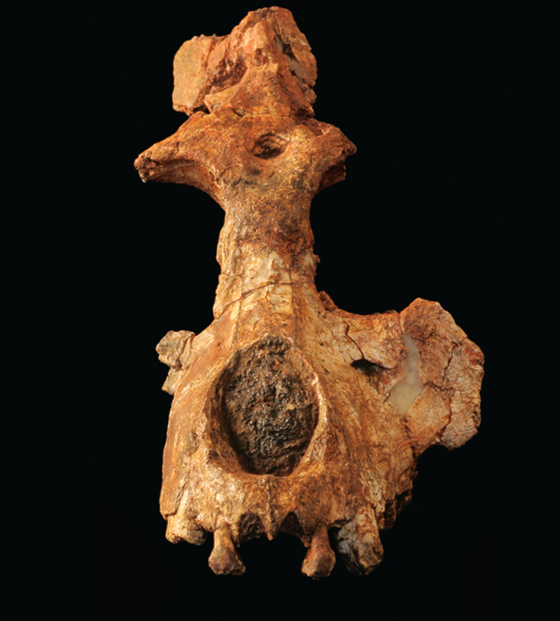
Saadanius is a genus of fossil primates dating to the Oligocene that is closely related to the common ancestor of the Old World monkeys and apes, collectively known as catarrhines. It is represented by a single species, Saadanius hijazensis, which is known only from a single partial skull tentatively dated between 29 and 28 million years ago. It was discovered in 2009 in western Saudi Arabia near Mecca and was first described in 2010 after comparison with both living and fossil catarrhines.
Saadanius had a longer face than living catarrhines and lacked the advanced frontal sinus found in living catarrhines. However, it had a bony ectotympanic and teeth comparable to those of living catarrhines. Its discovery provided new information about the early evolution of catarrhines.
Saadanius is known from a single specimen, the holotype, named "SGS-UM 2009-002", stored in Jeddah, Saudi Arabia, at the Paleontology Unit of the Saudi Geological Survey (SGS). The specimen was discovered in southwestern Saudi Arabia in February 2009 by paleontologist Iyad Zalmout, who had traveled to the region to search for ancient whale and dinosaur fossils. While looking for dinosaur fossils in an area that, according to the maps he was working from, contained rock layers that dated to the Cretaceous, Zalmout found the jawbone of an anthracotheriid, which dated to the Eocene or Oligocene. This indicated that the rock layers were much younger than what was dated on the maps. The following day, he noticed fossil teeth, which he immediately recognized as those of a primate. Zalmout emailed a photo of the teeth to paleontologist Philip D. Gingerich, with whom he was working as a postdoctoral fellow. Gingerich, an expert on ancient primates and whales, confirmed that it was indeed a primate. Due to a tight schedule, Zalmout had to leave the exposed fossil embedded in the rock for the next few days because collecting it would require days of work. The fossil was soon recovered by a joint expedition involving the SGS and the University of Michigan.
The fossil was formally described in 2010 when its discovery was announced in the journal Nature. The genus name, Saadanius, comes from the Arabic word, saadan (Arabic: سَعدان), which is the collective term for apes and monkeys. The species name, hijazensis, is a reference to the al Hijaz region, in which it was discovered.
The only known fossil of Saadanius is a partial skull, preserving much of the face and palate and many of the teeth. Two bite marks, one of which may have been fatal, are visible on the skull. Its enlarged, deep-rooted canine teeth, the diastema between its canine teeth and second incisors, and its sagittal crest suggest that the specimen was a male. These features are shared among male Old World monkeys.
Saadanius had a longer face than living catarrhines, more closely resembling New World monkeys in appearance, although it was larger, similar in size to the siamang. It most closely resembles the older fossil Aegyptopithecus, but it also shares some similarities with later catarrhines. For example, it lacks the advanced frontal sinus found in living hominoids, but it does possess a tube-shaped ectotympanic, found in living catarrhines. Propliopithecoids, the oldest stem group of catarrhines, which date back 35 to 30 mya, lacked a fully developed ectotympanic.
The upper molars were relatively wide, with prominent well-separated cusps. The third upper molar (M3) was larger than the second (M2). The canines were relatively smaller than in some later taxa like Proconsul, with an approximately oval cross-section. The nasal aperture is relatively large, though unlike in Dendropithecus it does not extend between the roots of the first incisors. The nasals are long and narrow and do not touch the premaxillae.
Comparative anatomy and cladistic analysis performed when the fossil was discovered indicate that Saadanius is more closely related to the last common ancestor of crown catarrhines than any other known fossil catarrhines, placing the common ancestry of Catarrhini in Arabia and Africa. Other stem catarrhines include propliopithecoids, such as Aegyptopithecus, and pliopithecoids, such as Pliopithecus. The closer similarities between Saadanius and crown catarrhines, particularly its ectotympanic, suggest Saadanius of all known fossil primates most closely resembled the last common ancestor of living catarrhines. Some later studies instead found Saadanius to be more closely related to Old World monkeys than to hominoids, placing it among crown catarrhines.
Hub AI
Saadanius AI simulator
(@Saadanius_simulator)
Saadanius
Saadanius is a genus of fossil primates dating to the Oligocene that is closely related to the common ancestor of the Old World monkeys and apes, collectively known as catarrhines. It is represented by a single species, Saadanius hijazensis, which is known only from a single partial skull tentatively dated between 29 and 28 million years ago. It was discovered in 2009 in western Saudi Arabia near Mecca and was first described in 2010 after comparison with both living and fossil catarrhines.
Saadanius had a longer face than living catarrhines and lacked the advanced frontal sinus found in living catarrhines. However, it had a bony ectotympanic and teeth comparable to those of living catarrhines. Its discovery provided new information about the early evolution of catarrhines.
Saadanius is known from a single specimen, the holotype, named "SGS-UM 2009-002", stored in Jeddah, Saudi Arabia, at the Paleontology Unit of the Saudi Geological Survey (SGS). The specimen was discovered in southwestern Saudi Arabia in February 2009 by paleontologist Iyad Zalmout, who had traveled to the region to search for ancient whale and dinosaur fossils. While looking for dinosaur fossils in an area that, according to the maps he was working from, contained rock layers that dated to the Cretaceous, Zalmout found the jawbone of an anthracotheriid, which dated to the Eocene or Oligocene. This indicated that the rock layers were much younger than what was dated on the maps. The following day, he noticed fossil teeth, which he immediately recognized as those of a primate. Zalmout emailed a photo of the teeth to paleontologist Philip D. Gingerich, with whom he was working as a postdoctoral fellow. Gingerich, an expert on ancient primates and whales, confirmed that it was indeed a primate. Due to a tight schedule, Zalmout had to leave the exposed fossil embedded in the rock for the next few days because collecting it would require days of work. The fossil was soon recovered by a joint expedition involving the SGS and the University of Michigan.
The fossil was formally described in 2010 when its discovery was announced in the journal Nature. The genus name, Saadanius, comes from the Arabic word, saadan (Arabic: سَعدان), which is the collective term for apes and monkeys. The species name, hijazensis, is a reference to the al Hijaz region, in which it was discovered.
The only known fossil of Saadanius is a partial skull, preserving much of the face and palate and many of the teeth. Two bite marks, one of which may have been fatal, are visible on the skull. Its enlarged, deep-rooted canine teeth, the diastema between its canine teeth and second incisors, and its sagittal crest suggest that the specimen was a male. These features are shared among male Old World monkeys.
Saadanius had a longer face than living catarrhines, more closely resembling New World monkeys in appearance, although it was larger, similar in size to the siamang. It most closely resembles the older fossil Aegyptopithecus, but it also shares some similarities with later catarrhines. For example, it lacks the advanced frontal sinus found in living hominoids, but it does possess a tube-shaped ectotympanic, found in living catarrhines. Propliopithecoids, the oldest stem group of catarrhines, which date back 35 to 30 mya, lacked a fully developed ectotympanic.
The upper molars were relatively wide, with prominent well-separated cusps. The third upper molar (M3) was larger than the second (M2). The canines were relatively smaller than in some later taxa like Proconsul, with an approximately oval cross-section. The nasal aperture is relatively large, though unlike in Dendropithecus it does not extend between the roots of the first incisors. The nasals are long and narrow and do not touch the premaxillae.
Comparative anatomy and cladistic analysis performed when the fossil was discovered indicate that Saadanius is more closely related to the last common ancestor of crown catarrhines than any other known fossil catarrhines, placing the common ancestry of Catarrhini in Arabia and Africa. Other stem catarrhines include propliopithecoids, such as Aegyptopithecus, and pliopithecoids, such as Pliopithecus. The closer similarities between Saadanius and crown catarrhines, particularly its ectotympanic, suggest Saadanius of all known fossil primates most closely resembled the last common ancestor of living catarrhines. Some later studies instead found Saadanius to be more closely related to Old World monkeys than to hominoids, placing it among crown catarrhines.
Recent media