
Recent from talks
Sachertorte
Knowledge base stats:
Talk channels stats:
Members stats:
Sachertorte
Sachertorte is a sponge cake that combines chocolate sponge, apricot jam, and a chocolate glaze. It was invented by the Austrian confectioner Franz Sacher in the mid-19th century.
In Vienna, the Hotel Sacher and Demel pastry shop dominate the market for Sachertorte. In the 20th century, they fought over the cake's ownership, trademark, and how many layers of sponge the original contained, with Hotel Sacher favouring two and Demel one. The cakes themselves had the same basic ingredients—butter, chocolate, eggs, flour, and sugar—but exact recipes were kept secret. In 2007, it was reported that Hotel Sacher made approximately 360,000 Sachertorte a year. It sells its cakes worldwide.
The reputation of Sachertorte varies by geography. In Austria and other German-speaking countries, the cake is common and typically regarded positively, with its elements seen as well-balanced. In other areas, the cake has a different reputation: in France it is often regarded as being too sweet and lacking in chocolate flavour, while in the US many people consider it dry and not sweet enough.
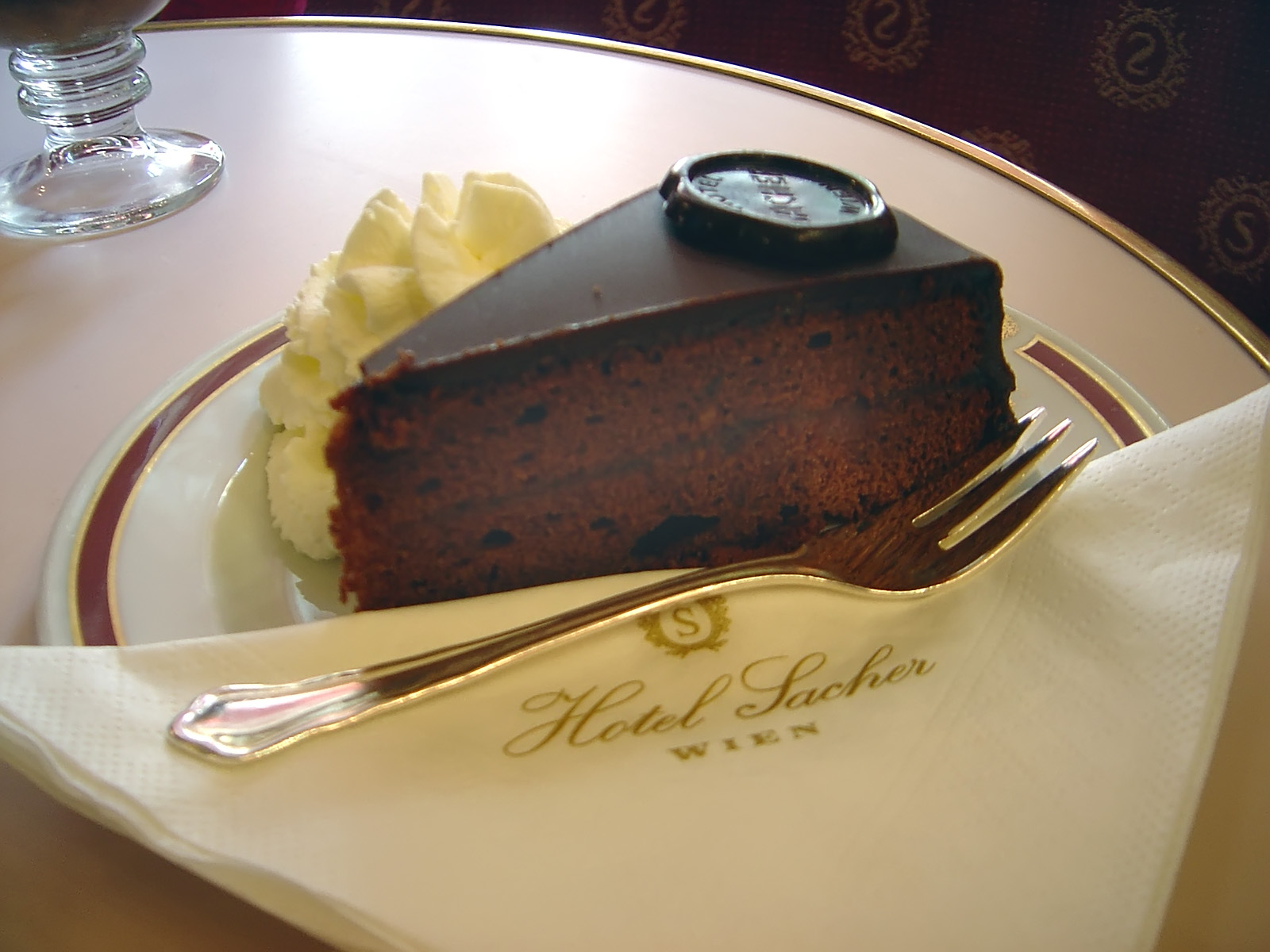
Sachertorte is a chocolate sponge cake, distinguished by layers of apricot jam and chocolate glaze. Its name is regulated in Austria by the Austrian food codex (Latin: Codex Alimentarius Austriacus), which defines Sachertorte as made from a batter of butter, flour, eggs, sugar, and at least 15% chocolate by weight. It permits flavourings such as salt, vanilla, and rum; it also allows almonds, hazelnuts, and walnuts if reflected in the name. Apricot jam is also a key component. The Hotel Sacher website gives one method of making Sachertorte with these ingredients, combining melted chocolate, egg yolks, butter, vanilla, and icing sugar into a batter, with flour and a meringue of egg whites and sugar folded in before baking; the creaming introduces air into the batter. As a result, characteristic bubbles appear throughout the final cake, occasionally breaking the surface.
Sachertorte is made with one or more sponge layers: at Demel, a bakery in Vienna, it has historically been made with only one, while at Hotel Sacher it is made with two. Apricot jam is spread over the top of the sponge, and also between the layers in multi-layer versions. While versions using strawberry, raspberry, and peach exist in Vienna, they cannot be called Sachertorte. The Codex also specifies the glaze, which is poured over the cake and sets to a fudge-like consistency. To produce a smooth surface, some bakers use tins with rounded edges that allow the glaze to flow evenly over the sides.
In Austria, the word Sacher is often written across the top of the cake, and at Demel and Hotel Sacher the cake is finished with a chocolate seal—triangular and circular respectively. Sachertorte is served in Austria with a dollop of unsweetened whipped cream on the side; Elisabeth Gürtler, the former director of Hotel Sacher, also recommends pairing the cake with champagne. The high butter content means Sachertorte can be kept without refrigeration.
The word Sachertorte combines the name of its creator, Franz Sacher, and torte, a German word for a filled layer cake. The spelling varies: Hotel Sacher favours Sacher-Torte, while Sachertorte remains the generic form in Austria, though the spaced form Sacher torte is also common. The word Sachertorte entered English in the early 20th century.
Critical opinion is highly favourable, such as in Germany, where it is known as "sweet, delicate, and with a flawless surface", and in Austria, where the author Franz Maier-Bruck writes that Sachertorte is "delicate and mild" (zart und mild), opining that the cake is not too soft, sweet, dry, or gritty. To Maier-Bruck, a good Sachertorte comes from the balance of its ingredients, the baking process, and the smoothness of the glaze. Outside of those regions, Sachertorte is often considered dry and too simple, with the culinary writer Jane Grigson writing in the 1980s that while she considers the cake to be one of the most famous in Europe, she does not consider it to be the best. Criticisms range by geography; Krondl writes that in the US, the cake is perceived as being dry and insufficiently sweet, while in France, it is considered too sweet.
Hub AI
Sachertorte AI simulator
(@Sachertorte_simulator)
Sachertorte
Sachertorte is a sponge cake that combines chocolate sponge, apricot jam, and a chocolate glaze. It was invented by the Austrian confectioner Franz Sacher in the mid-19th century.
In Vienna, the Hotel Sacher and Demel pastry shop dominate the market for Sachertorte. In the 20th century, they fought over the cake's ownership, trademark, and how many layers of sponge the original contained, with Hotel Sacher favouring two and Demel one. The cakes themselves had the same basic ingredients—butter, chocolate, eggs, flour, and sugar—but exact recipes were kept secret. In 2007, it was reported that Hotel Sacher made approximately 360,000 Sachertorte a year. It sells its cakes worldwide.
The reputation of Sachertorte varies by geography. In Austria and other German-speaking countries, the cake is common and typically regarded positively, with its elements seen as well-balanced. In other areas, the cake has a different reputation: in France it is often regarded as being too sweet and lacking in chocolate flavour, while in the US many people consider it dry and not sweet enough.
Sachertorte is a chocolate sponge cake, distinguished by layers of apricot jam and chocolate glaze. Its name is regulated in Austria by the Austrian food codex (Latin: Codex Alimentarius Austriacus), which defines Sachertorte as made from a batter of butter, flour, eggs, sugar, and at least 15% chocolate by weight. It permits flavourings such as salt, vanilla, and rum; it also allows almonds, hazelnuts, and walnuts if reflected in the name. Apricot jam is also a key component. The Hotel Sacher website gives one method of making Sachertorte with these ingredients, combining melted chocolate, egg yolks, butter, vanilla, and icing sugar into a batter, with flour and a meringue of egg whites and sugar folded in before baking; the creaming introduces air into the batter. As a result, characteristic bubbles appear throughout the final cake, occasionally breaking the surface.
Sachertorte is made with one or more sponge layers: at Demel, a bakery in Vienna, it has historically been made with only one, while at Hotel Sacher it is made with two. Apricot jam is spread over the top of the sponge, and also between the layers in multi-layer versions. While versions using strawberry, raspberry, and peach exist in Vienna, they cannot be called Sachertorte. The Codex also specifies the glaze, which is poured over the cake and sets to a fudge-like consistency. To produce a smooth surface, some bakers use tins with rounded edges that allow the glaze to flow evenly over the sides.
In Austria, the word Sacher is often written across the top of the cake, and at Demel and Hotel Sacher the cake is finished with a chocolate seal—triangular and circular respectively. Sachertorte is served in Austria with a dollop of unsweetened whipped cream on the side; Elisabeth Gürtler, the former director of Hotel Sacher, also recommends pairing the cake with champagne. The high butter content means Sachertorte can be kept without refrigeration.
The word Sachertorte combines the name of its creator, Franz Sacher, and torte, a German word for a filled layer cake. The spelling varies: Hotel Sacher favours Sacher-Torte, while Sachertorte remains the generic form in Austria, though the spaced form Sacher torte is also common. The word Sachertorte entered English in the early 20th century.
Critical opinion is highly favourable, such as in Germany, where it is known as "sweet, delicate, and with a flawless surface", and in Austria, where the author Franz Maier-Bruck writes that Sachertorte is "delicate and mild" (zart und mild), opining that the cake is not too soft, sweet, dry, or gritty. To Maier-Bruck, a good Sachertorte comes from the balance of its ingredients, the baking process, and the smoothness of the glaze. Outside of those regions, Sachertorte is often considered dry and too simple, with the culinary writer Jane Grigson writing in the 1980s that while she considers the cake to be one of the most famous in Europe, she does not consider it to be the best. Criticisms range by geography; Krondl writes that in the US, the cake is perceived as being dry and insufficiently sweet, while in France, it is considered too sweet.
Recent media