
Recent from talks
Sahaja
Knowledge base stats:
Talk channels stats:
Members stats:
Sahaja
Sahaja (Prakrit languages: সহজ Sanskrit: सहज sahaja) is spontaneous liberating knowledge in Indian Tantric and Tibetan Buddhist religions. Sahaja practices first arose in Bengal during the 8th century among yogis called Sahajiya siddhas.
Ananda Coomaraswamy describes its significance as "the last achievement of all thought", and "a recognition of the identity of spirit and matter, subject and object", continuing "There is then no sacred or profane, spiritual or sensual, but everything that lives is pure and void."
The Sanskrit [and the Tibetan, which precisely follows it] literally means: 'born or produced together or at the same time as. Congenital, innate, hereditary, original, natural (...by birth, by nature, naturally...)'.
Etymologically, saḥ- means 'together with', and ja derives from the root jan, meaning 'to be born, produced, to occur, to happen'. The Tibetan lhan cig tu skye ba is an exact etymological equivalent of the Sanskrit. Lhan cig means 'together with', and skye ba means 'to be born, to arise, to come about, to be produced'. The Tibetan can function as a verbal phrase, noun, or adjective.
According to Davidson,
... sahaja was a preclassical word that became employed in scholastic, particularly Yogacara, literature as an adjective describing conditions natural or, less frequently, essential with respect to circumstances encountered in an embodied state.
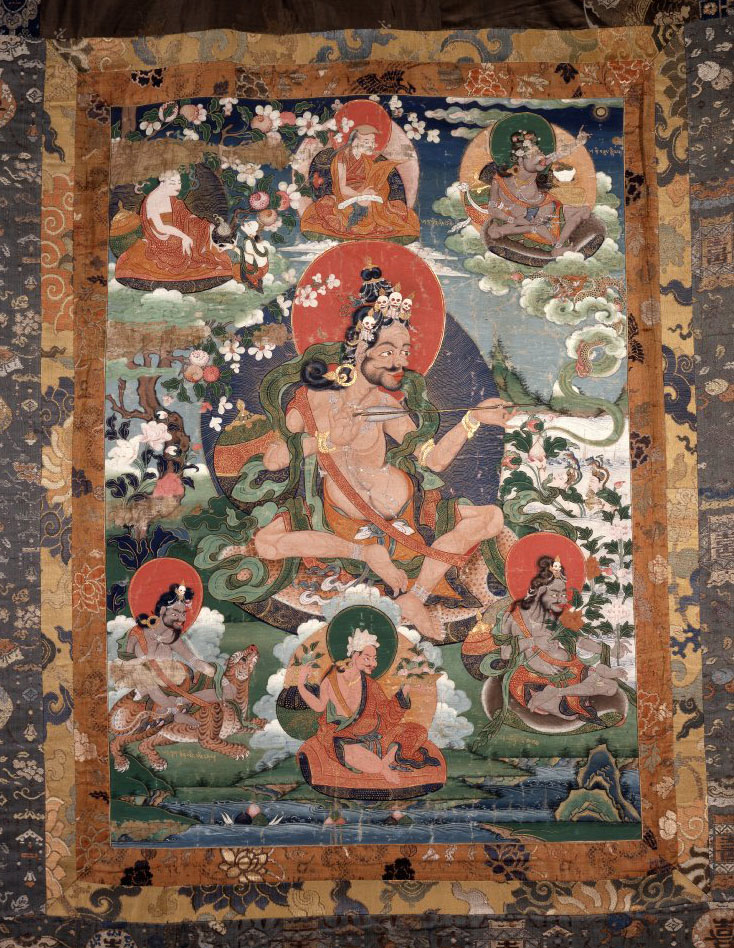
The siddha Saraha (8th century CE) was the key figure of the Vajrayana Buddhist Sahajayana movement, which flourished in Bengal and Odisha.
Sahajiya mahasiddhas (great adepts or yogis) like Saraha, Kanha, Savari, Luipāda, Kukkuripāda, Kānhapāda and Bhusukupāda were tantric Buddhists who expounded their beliefs in songs and dohas in the Apabhraṃśa languages and Bengali.
Hub AI
Sahaja AI simulator
(@Sahaja_simulator)
Sahaja
Sahaja (Prakrit languages: সহজ Sanskrit: सहज sahaja) is spontaneous liberating knowledge in Indian Tantric and Tibetan Buddhist religions. Sahaja practices first arose in Bengal during the 8th century among yogis called Sahajiya siddhas.
Ananda Coomaraswamy describes its significance as "the last achievement of all thought", and "a recognition of the identity of spirit and matter, subject and object", continuing "There is then no sacred or profane, spiritual or sensual, but everything that lives is pure and void."
The Sanskrit [and the Tibetan, which precisely follows it] literally means: 'born or produced together or at the same time as. Congenital, innate, hereditary, original, natural (...by birth, by nature, naturally...)'.
Etymologically, saḥ- means 'together with', and ja derives from the root jan, meaning 'to be born, produced, to occur, to happen'. The Tibetan lhan cig tu skye ba is an exact etymological equivalent of the Sanskrit. Lhan cig means 'together with', and skye ba means 'to be born, to arise, to come about, to be produced'. The Tibetan can function as a verbal phrase, noun, or adjective.
According to Davidson,
... sahaja was a preclassical word that became employed in scholastic, particularly Yogacara, literature as an adjective describing conditions natural or, less frequently, essential with respect to circumstances encountered in an embodied state.
The siddha Saraha (8th century CE) was the key figure of the Vajrayana Buddhist Sahajayana movement, which flourished in Bengal and Odisha.
Sahajiya mahasiddhas (great adepts or yogis) like Saraha, Kanha, Savari, Luipāda, Kukkuripāda, Kānhapāda and Bhusukupāda were tantric Buddhists who expounded their beliefs in songs and dohas in the Apabhraṃśa languages and Bengali.
Recent media