




Community hub
Recent from talks
Contribute something to knowledge base
Content stats: 0 posts, 0 articles, 1 media, 0 notes
Members stats: 0 subscribers, 0 contributors, 0 moderators, 0 supporters
Subscribers
Supporters
Contributors
Moderators
Sai oua
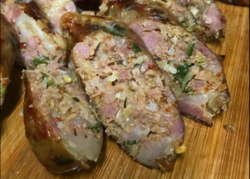
Sai oua, sometimes also known as Laotian sausage (Lao: ໄສ້ອັ່ວ, pronounced [sȁj ʔūa], also sai ua: Thai: ไส้อั่ว, pronounced [sâj ʔùa]; Northern Thai: ไส้อั่ว, pronounced [sa᷇j ʔùa]; Northeastern Thai: ไส้อั่ว, pronounced [sàj ʔúa]), is a popular type of sausage made in Laos, Myanmar, and Thailand, particularly in northern Thailand and northern Laos. It is prepared from coarsely chopped fatty pork seasoned with lemongrass, galangal, kaffir lime leaves, shallots, cilantro, chilies, garlic, salt, sticky rice and fish sauce. "Lao sausage" is a broad term used to describe the local variant of Lao-style sai oua sausages found in Laos, and northern and northeastern Thailand. In Shan State, Myanmar, this sausage is known as sai long phik. In Thailand, it is also known as northern Thai sausage or Chiang Mai sausage. Sai oua is a standard food of Thailand's northern provinces and has become very popular in the rest of Thailand as well.
Sai ua contains minced pork meat, herbs, spices, and kaeng khua red curry paste. It can include coarsely chopped fatty pork seasoned with lemongrass, galangal, kaffir lime leaves, shallots, cilantro, chilies, garlic, salt, sticky rice and fish sauce.
The sausage is either fermented, dried and roasted, or grilled before serving. It is usually eaten with sticky rice or served as a snack or starter. Traditionally sai ua was a homemade sausage, but today it is readily available in shops.[better source needed]
Sai oua is an ancient Lao word for sausage, literally sai (intestine) oua (stuffed).[citation needed]
The spicy sausage originates from Luang Prabang, Laos. Luang Prabang was once the royal capital and seat of power of the Kingdom of Lan Xang (1353–1707). The ancient city of Luang Prabang is considered to be the cradle of Lao culture and cuisine. At the height of its power, Luang Prabang's influence stretches from the borders of Sipsongpanna (China) to Steung Treng (Cambodia), from the eastern border along the Annamite Range with Vietnam to the western border Khorat Plateau (Northeastern Thailand) and its sister kingdom of Lan Na.
Sai ua was listed in a collection of favorite dishes for the former Lao royal family written by Phia Sing (1898–1967), the king's personal chef and master of ceremonies and today is one of several popular traditional Lao dishes.
There are two types of sai oua in Laos:
The traditional recipe for sai oua moo served to Laotian royalties can be found in a collection of hand written recipes from Phia Sing (1898–1967), the king's personal chef and master of ceremonies. Phia Sing's hand written recipes were compiled and published for the first time in 1981.
Sai oua
Sai oua, sometimes also known as Laotian sausage (Lao: ໄສ້ອັ່ວ, pronounced [sȁj ʔūa], also sai ua: Thai: ไส้อั่ว, pronounced [sâj ʔùa]; Northern Thai: ไส้อั่ว, pronounced [sa᷇j ʔùa]; Northeastern Thai: ไส้อั่ว, pronounced [sàj ʔúa]), is a popular type of sausage made in Laos, Myanmar, and Thailand, particularly in northern Thailand and northern Laos. It is prepared from coarsely chopped fatty pork seasoned with lemongrass, galangal, kaffir lime leaves, shallots, cilantro, chilies, garlic, salt, sticky rice and fish sauce. "Lao sausage" is a broad term used to describe the local variant of Lao-style sai oua sausages found in Laos, and northern and northeastern Thailand. In Shan State, Myanmar, this sausage is known as sai long phik. In Thailand, it is also known as northern Thai sausage or Chiang Mai sausage. Sai oua is a standard food of Thailand's northern provinces and has become very popular in the rest of Thailand as well.
Sai ua contains minced pork meat, herbs, spices, and kaeng khua red curry paste. It can include coarsely chopped fatty pork seasoned with lemongrass, galangal, kaffir lime leaves, shallots, cilantro, chilies, garlic, salt, sticky rice and fish sauce.
The sausage is either fermented, dried and roasted, or grilled before serving. It is usually eaten with sticky rice or served as a snack or starter. Traditionally sai ua was a homemade sausage, but today it is readily available in shops.[better source needed]
Sai oua is an ancient Lao word for sausage, literally sai (intestine) oua (stuffed).[citation needed]
The spicy sausage originates from Luang Prabang, Laos. Luang Prabang was once the royal capital and seat of power of the Kingdom of Lan Xang (1353–1707). The ancient city of Luang Prabang is considered to be the cradle of Lao culture and cuisine. At the height of its power, Luang Prabang's influence stretches from the borders of Sipsongpanna (China) to Steung Treng (Cambodia), from the eastern border along the Annamite Range with Vietnam to the western border Khorat Plateau (Northeastern Thailand) and its sister kingdom of Lan Na.
Sai ua was listed in a collection of favorite dishes for the former Lao royal family written by Phia Sing (1898–1967), the king's personal chef and master of ceremonies and today is one of several popular traditional Lao dishes.
There are two types of sai oua in Laos:
The traditional recipe for sai oua moo served to Laotian royalties can be found in a collection of hand written recipes from Phia Sing (1898–1967), the king's personal chef and master of ceremonies. Phia Sing's hand written recipes were compiled and published for the first time in 1981.
Recent media
Recent media