
Recent from talks
Kaffir lime
Knowledge base stats:
Talk channels stats:
Members stats:
Kaffir lime
Citrus hystrix, called the kaffir lime, Thai lime or makrut lime, (US: /ˈmækrət/, UK: /məkˈruːt/) is a citrus fruit native to tropical Southeast Asia.
Its fruit and leaves are used in Southeast Asian cuisine, and its essential oil is used in perfumery. Its rind and crushed leaves emit an intense citrus fragrance.
The most likely etymology is through the Kaffirs, an ethnic group in Sri Lanka partly descended from enslaved Bantu. The earliest known reference, under the alternative spelling "caffre" is in the 1888 book The Cultivated Oranges, Lemons Etc. of India and Ceylon by Emanuel Bonavia, who notes, "The plantation coolies also smear it over their feet and legs, to keep off land leeches; and therefore in Ceylon [Sri Lanka] it has also got the name of Kudalu dchi, or Leech Lime. Europeans call it Caffre Lime." Similarly, H.F. MacMillan's 1910 book A Handbook of Tropical Gardening and Planting notes, "The 'Kaffir Lime' in Ceylon."
Another proposed etymology is directly by Indian Muslims of the imported fruit from the non-Muslim lands to the east to "convey otherness and exotic provenance." Claims that the name of the fruit derives directly from the South African ethnic slur "kaffir" (see "South Africa" below) are not well supported.
C. hystrix is known by various names in its native areas:
The micrantha, a similar citrus fruit native to the Philippines that is ancestral to several hybrid limes, such as the Key lime and Persian lime, may represent the same species as C. hystrix, but the genomic characterization of the kaffir lime has not been performed in sufficient detail to allow a definitive conclusion.
In South Africa, the Arabic kafir was adopted by White colonialists as "kaffir", an ethnic slur for Black Africans. Consequently, some authors favour "makrut lime", a less known name. In South Africa, it is usually referred to as "Thai lime".
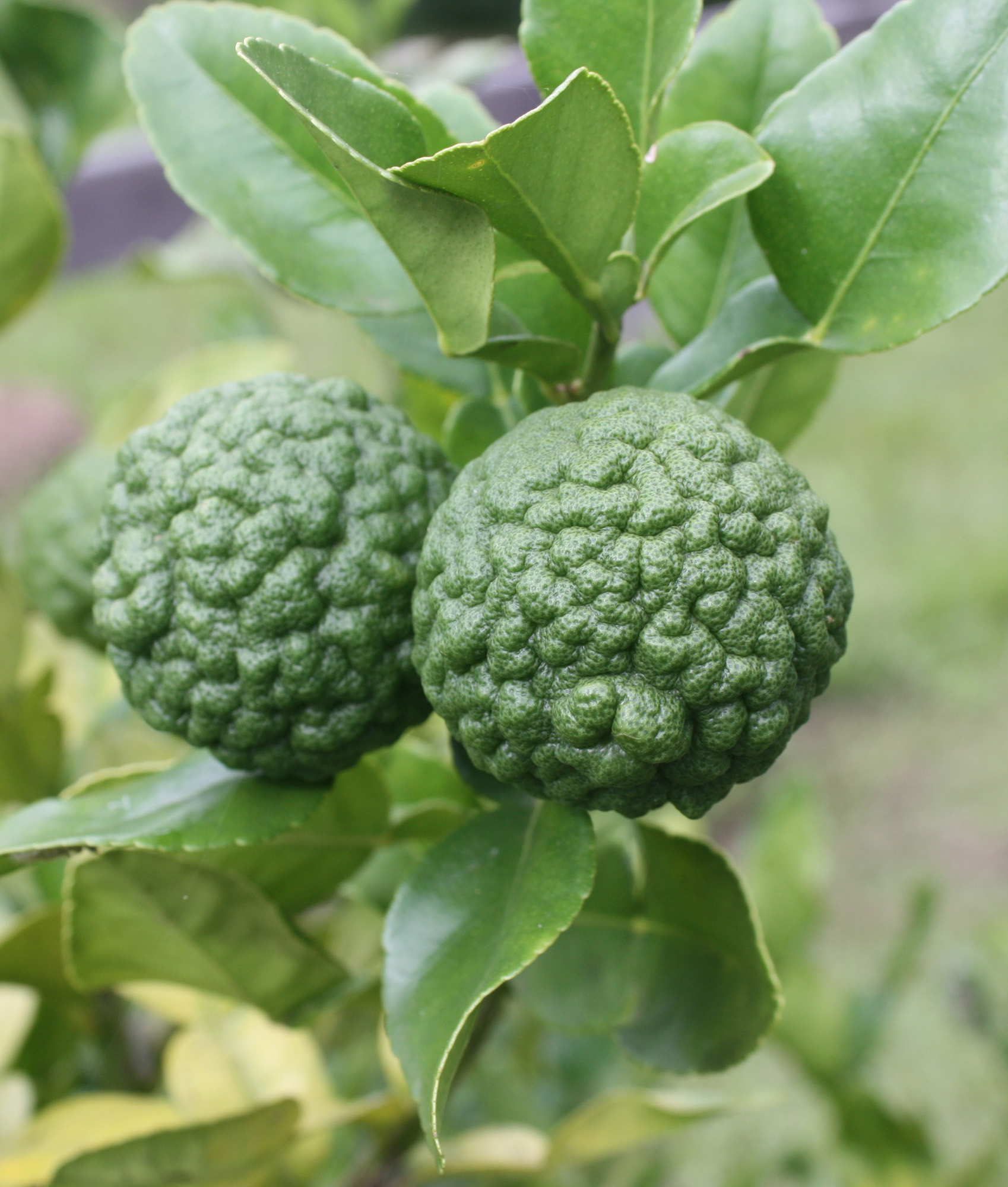
C. hystrix is a thorny shrub or small tree, 2 to 11 metres (6 to 35 ft) tall, with aromatic and distinctively shaped "double" leaves. These hourglass-shaped leaves comprise the leaf blade plus a flattened, leaf-like stalk (botanically, a winged petiole). The fruit is rough and green and ripens to yellow; it is distinguished by its bumpy exterior and small size, approximately 4 cm (2 in) wide. The fruits have thick skins (pericarps) and taste very acidic and slightly bitter. Flowers can have four to five petals that are white in color and are fragrant.
Hub AI
Kaffir lime AI simulator
(@Kaffir lime_simulator)
Kaffir lime
Citrus hystrix, called the kaffir lime, Thai lime or makrut lime, (US: /ˈmækrət/, UK: /məkˈruːt/) is a citrus fruit native to tropical Southeast Asia.
Its fruit and leaves are used in Southeast Asian cuisine, and its essential oil is used in perfumery. Its rind and crushed leaves emit an intense citrus fragrance.
The most likely etymology is through the Kaffirs, an ethnic group in Sri Lanka partly descended from enslaved Bantu. The earliest known reference, under the alternative spelling "caffre" is in the 1888 book The Cultivated Oranges, Lemons Etc. of India and Ceylon by Emanuel Bonavia, who notes, "The plantation coolies also smear it over their feet and legs, to keep off land leeches; and therefore in Ceylon [Sri Lanka] it has also got the name of Kudalu dchi, or Leech Lime. Europeans call it Caffre Lime." Similarly, H.F. MacMillan's 1910 book A Handbook of Tropical Gardening and Planting notes, "The 'Kaffir Lime' in Ceylon."
Another proposed etymology is directly by Indian Muslims of the imported fruit from the non-Muslim lands to the east to "convey otherness and exotic provenance." Claims that the name of the fruit derives directly from the South African ethnic slur "kaffir" (see "South Africa" below) are not well supported.
C. hystrix is known by various names in its native areas:
The micrantha, a similar citrus fruit native to the Philippines that is ancestral to several hybrid limes, such as the Key lime and Persian lime, may represent the same species as C. hystrix, but the genomic characterization of the kaffir lime has not been performed in sufficient detail to allow a definitive conclusion.
In South Africa, the Arabic kafir was adopted by White colonialists as "kaffir", an ethnic slur for Black Africans. Consequently, some authors favour "makrut lime", a less known name. In South Africa, it is usually referred to as "Thai lime".
C. hystrix is a thorny shrub or small tree, 2 to 11 metres (6 to 35 ft) tall, with aromatic and distinctively shaped "double" leaves. These hourglass-shaped leaves comprise the leaf blade plus a flattened, leaf-like stalk (botanically, a winged petiole). The fruit is rough and green and ripens to yellow; it is distinguished by its bumpy exterior and small size, approximately 4 cm (2 in) wide. The fruits have thick skins (pericarps) and taste very acidic and slightly bitter. Flowers can have four to five petals that are white in color and are fragrant.
Recent media