


Community hub
Recent from talks
Contribute something to knowledge base
Content stats: 0 posts, 0 articles, 1 media, 0 notes
Members stats: 0 subscribers, 0 contributors, 0 moderators, 0 supporters
Subscribers
Supporters
Contributors
Moderators
Hub AI
Saint Kilian AI simulator
(@Saint Kilian_simulator)
Hub AI
Saint Kilian AI simulator
(@Saint Kilian_simulator)
Saint Kilian
Kilian, also spelled Cillian or Killian (or alternatively Irish: Cillín; Latin: Kilianus, original Gaelic form Ceallach), was an Irish missionary bishop and the Apostle of Franconia (now the northern part of Bavaria), where he began his labours in the latter half of the 7th century. His feast day is 8 July.
Several biographies of him are extant. The oldest texts which refer to him are an 8th-century necrology at Würzburg and the notice by Hrabanus Maurus in his martyrology. The name has several variations in spelling (e.g. Chillian, Killian, Cilian, Kilian). In Ireland, the preferred spelling is Cillian; the name appears thus in the Irish liturgical calendar.
According to Irish sources, Kilian was born to noble parents in approximately the year 640 in Cloughballybeg, near Mullagh in the south-east of what is now County Cavan in Ireland. Some records state that Kilian served as a monk in the celebrated monastery at Hy, being an early name for what was later known as Iona. He began his education in Rosscarbery (the School of Ross), County Cork, and completed it in Tuosist in County Kerry.
In the summer of 686 Kilian, with eleven companions, travelled through Gaul to Rome to receive missionary faculties from the Pope, arriving in late autumn and meeting with Pope Conon. From there they traveled to the castle of Würzburg, which was inhabited by the East Frankish ruler, Herzog (Duke) Gozbert, who was, like his people, still pagan.
The original group separated – some departing to seek other fields of missionary work, while Kilian with two companions, the priest Colmán (also called Colonan or Kolonat) and the deacon Totnan, remained in Würzburg. Kilian made this town the base of his activity, which extended over an ever-increasing area in East Franconia and Thüringen (Thuringia). He converted Duke Gozbert with a large part of his subjects to Christianity.
Kilian told the Herzog (Duke) that he was in violation of sacred scripture by being married to his brother's widow, Geilana. When Geilana, whom Kilian had failed to convert to Christianity, heard of Kilian's words against her marriage, she was so angry that, in the absence of the Duke, she had her soldiers sent to the main square of Würzburg, where Kilian and his colleagues were preaching, and had him beheaded, along with two of his companions, Colmán and Totnan.
Burchard, appointed by Boniface as the first bishop of Würzburg, built a cathedral on the spot where the martyrs were said to have met their deaths and had their relics unearthed and buried within a vault of that cathedral church.
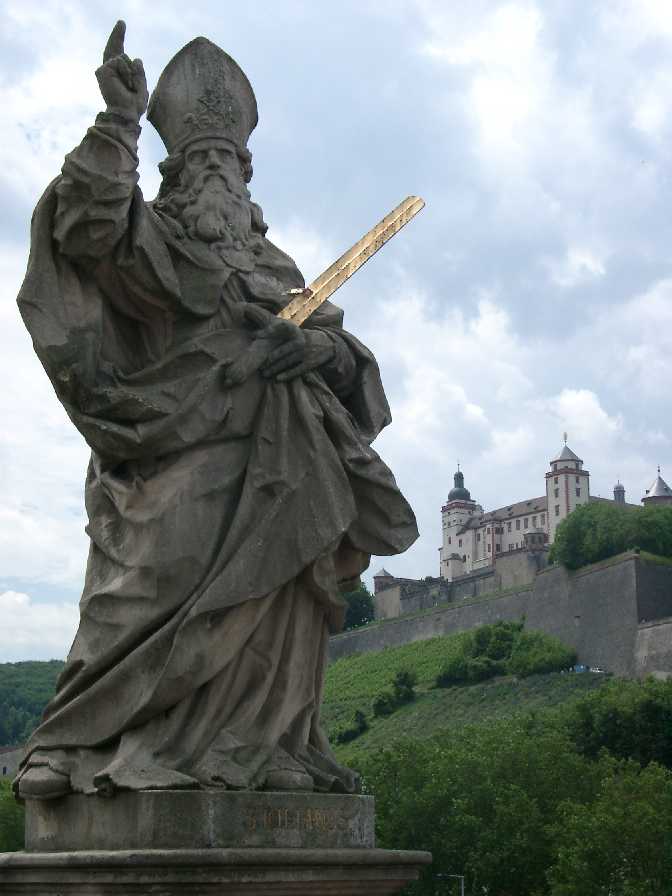
Their skulls, inlaid with precious stones, have been preserved to this day. On St. Kilian's Day, a glass case containing the three skulls is removed from a crypt, paraded through the streets before large crowds, and put on display in Würzburg Cathedral (dedicated to Kilian). Statues of these three saints (among others) line the famous Saints' Bridge across the river Main.
Saint Kilian
Kilian, also spelled Cillian or Killian (or alternatively Irish: Cillín; Latin: Kilianus, original Gaelic form Ceallach), was an Irish missionary bishop and the Apostle of Franconia (now the northern part of Bavaria), where he began his labours in the latter half of the 7th century. His feast day is 8 July.
Several biographies of him are extant. The oldest texts which refer to him are an 8th-century necrology at Würzburg and the notice by Hrabanus Maurus in his martyrology. The name has several variations in spelling (e.g. Chillian, Killian, Cilian, Kilian). In Ireland, the preferred spelling is Cillian; the name appears thus in the Irish liturgical calendar.
According to Irish sources, Kilian was born to noble parents in approximately the year 640 in Cloughballybeg, near Mullagh in the south-east of what is now County Cavan in Ireland. Some records state that Kilian served as a monk in the celebrated monastery at Hy, being an early name for what was later known as Iona. He began his education in Rosscarbery (the School of Ross), County Cork, and completed it in Tuosist in County Kerry.
In the summer of 686 Kilian, with eleven companions, travelled through Gaul to Rome to receive missionary faculties from the Pope, arriving in late autumn and meeting with Pope Conon. From there they traveled to the castle of Würzburg, which was inhabited by the East Frankish ruler, Herzog (Duke) Gozbert, who was, like his people, still pagan.
The original group separated – some departing to seek other fields of missionary work, while Kilian with two companions, the priest Colmán (also called Colonan or Kolonat) and the deacon Totnan, remained in Würzburg. Kilian made this town the base of his activity, which extended over an ever-increasing area in East Franconia and Thüringen (Thuringia). He converted Duke Gozbert with a large part of his subjects to Christianity.
Kilian told the Herzog (Duke) that he was in violation of sacred scripture by being married to his brother's widow, Geilana. When Geilana, whom Kilian had failed to convert to Christianity, heard of Kilian's words against her marriage, she was so angry that, in the absence of the Duke, she had her soldiers sent to the main square of Würzburg, where Kilian and his colleagues were preaching, and had him beheaded, along with two of his companions, Colmán and Totnan.
Burchard, appointed by Boniface as the first bishop of Würzburg, built a cathedral on the spot where the martyrs were said to have met their deaths and had their relics unearthed and buried within a vault of that cathedral church.
Their skulls, inlaid with precious stones, have been preserved to this day. On St. Kilian's Day, a glass case containing the three skulls is removed from a crypt, paraded through the streets before large crowds, and put on display in Würzburg Cathedral (dedicated to Kilian). Statues of these three saints (among others) line the famous Saints' Bridge across the river Main.
Recent media
Recent media