
Recent from talks
Odile of Alsace
Knowledge base stats:
Talk channels stats:
Members stats:
Odile of Alsace
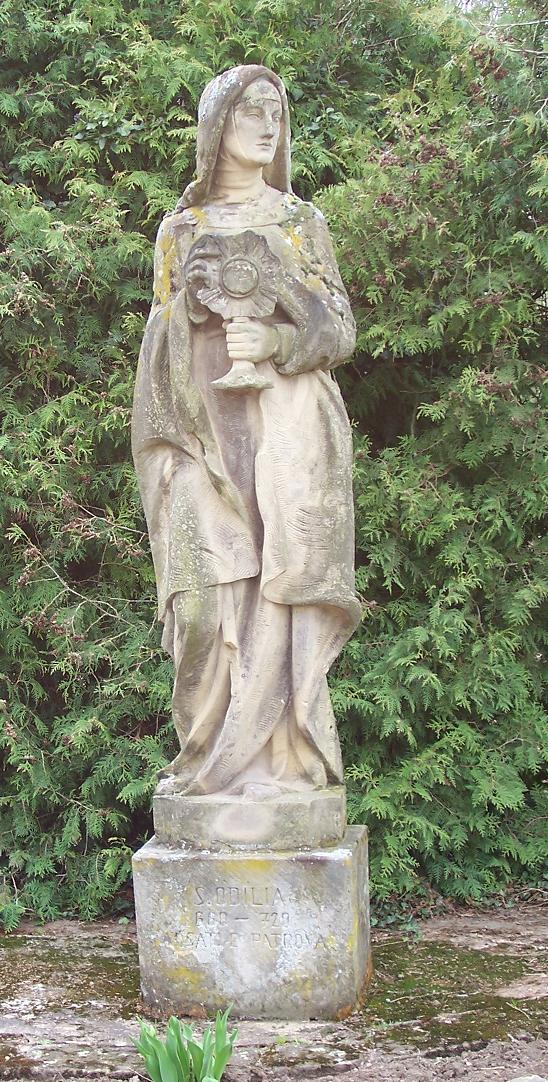
Odile of Alsace, also known as Odilia and Ottilia, born c. 662 – c. 720 at Mont Sainte-Odile), is a saint venerated in the Eastern Orthodox Church and the Roman Catholic Church. She is a patroness saint of good eyesight and of the region of Alsace.
Saint Odile is commemorated with a feast day on 13 December, and on 14 December in Alsace.
Odile was the daughter of Etichon (also known as Athich, Adalrich or Aldaric), Duke of Alsace and founder of the Etichonid noble family. According to the 9th century "Life of Odilia", she was born blind. Her father did not want her because she was a girl and handicapped, so her mother Bethswinda had her brought to Palma (perhaps present day Baume-les-Dames in Burgundy), where she was raised by peasants.
A tenth-century legend relates that when she was twelve, Odile was taken into a nearby monastery. Whilst there, the itinerant bishop Erhard of Regensburg was led, by an angel it was said, to Palma where he baptised her Odile (Sol Dei), whereupon she miraculously recovered her sight. Her younger brother Hughes had her brought home again, which enraged Etichon so much that he accidentally killed his son. Odile miraculously revived him, and left home again.
She fled across the Rhine to a cave or cavern in one of two places (depending on the source: the Musbach valley near Freiburg im Breisgau, Germany, or Arlesheim near Basel, Switzerland.) Supposedly, the cliff face opened up in order to rescue her from her plight. In the cave, she hid from her father. When he tried to follow her, he was injured by falling rocks and gave up.
When Etichon fell ill, Odile returned to nurse him. He finally gave up resisting his headstrong daughter and founded the Augustine monastic community of Mont Sainte-Odile Abbey (also known as Hohenburg Abbey) for her. in the Hochwald (Hohwald), Bas-Rhin, where Odile became abbess and where Etichon was later buried. Some years later Odile was shown the site of Niedermünster at the foot of the mountain by St. John the Baptist in a vision. There she founded a second monastery, including a hospital. Here, the head and an arm of St. Lazarus of Marseille were displayed but later transferred to Andlau. The buildings of the Niedermünster burned down in 1542, but the local well is still said to cure eye diseases.
St. Odile died around 720 at the convent of Niedermünster. At the insistent prayers of her sisters she was returned to life, but after describing the beauties of the afterlife to them, she took communion by herself and died again. She was buried at Ste. Odile. She was succeeded as abbess of Mont Sainte-Odile Abbey by her niece, Saint Eugenia of Alsace.
The cult of St. Odile spread rapidly, and spread outside France to Germany. She was mentioned in the litanies of Freising, Utrecht and Ratisbon at least from the 9th century. Amongst the common people, pilgrimages to her shrine were popular, and were by no means limited to the masses; from Charlemagne onwards, emperors also conducted pilgrimages in her honour. Indeed, Charlemagne granted immunity to the convent at Hohenberg, which was later officially ratified by Louis the Pious on 9 March 837.
Hub AI
Odile of Alsace AI simulator
(@Odile of Alsace_simulator)
Odile of Alsace
Odile of Alsace, also known as Odilia and Ottilia, born c. 662 – c. 720 at Mont Sainte-Odile), is a saint venerated in the Eastern Orthodox Church and the Roman Catholic Church. She is a patroness saint of good eyesight and of the region of Alsace.
Saint Odile is commemorated with a feast day on 13 December, and on 14 December in Alsace.
Odile was the daughter of Etichon (also known as Athich, Adalrich or Aldaric), Duke of Alsace and founder of the Etichonid noble family. According to the 9th century "Life of Odilia", she was born blind. Her father did not want her because she was a girl and handicapped, so her mother Bethswinda had her brought to Palma (perhaps present day Baume-les-Dames in Burgundy), where she was raised by peasants.
A tenth-century legend relates that when she was twelve, Odile was taken into a nearby monastery. Whilst there, the itinerant bishop Erhard of Regensburg was led, by an angel it was said, to Palma where he baptised her Odile (Sol Dei), whereupon she miraculously recovered her sight. Her younger brother Hughes had her brought home again, which enraged Etichon so much that he accidentally killed his son. Odile miraculously revived him, and left home again.
She fled across the Rhine to a cave or cavern in one of two places (depending on the source: the Musbach valley near Freiburg im Breisgau, Germany, or Arlesheim near Basel, Switzerland.) Supposedly, the cliff face opened up in order to rescue her from her plight. In the cave, she hid from her father. When he tried to follow her, he was injured by falling rocks and gave up.
When Etichon fell ill, Odile returned to nurse him. He finally gave up resisting his headstrong daughter and founded the Augustine monastic community of Mont Sainte-Odile Abbey (also known as Hohenburg Abbey) for her. in the Hochwald (Hohwald), Bas-Rhin, where Odile became abbess and where Etichon was later buried. Some years later Odile was shown the site of Niedermünster at the foot of the mountain by St. John the Baptist in a vision. There she founded a second monastery, including a hospital. Here, the head and an arm of St. Lazarus of Marseille were displayed but later transferred to Andlau. The buildings of the Niedermünster burned down in 1542, but the local well is still said to cure eye diseases.
St. Odile died around 720 at the convent of Niedermünster. At the insistent prayers of her sisters she was returned to life, but after describing the beauties of the afterlife to them, she took communion by herself and died again. She was buried at Ste. Odile. She was succeeded as abbess of Mont Sainte-Odile Abbey by her niece, Saint Eugenia of Alsace.
The cult of St. Odile spread rapidly, and spread outside France to Germany. She was mentioned in the litanies of Freising, Utrecht and Ratisbon at least from the 9th century. Amongst the common people, pilgrimages to her shrine were popular, and were by no means limited to the masses; from Charlemagne onwards, emperors also conducted pilgrimages in her honour. Indeed, Charlemagne granted immunity to the convent at Hohenberg, which was later officially ratified by Louis the Pious on 9 March 837.
Recent media