



Community hub
Recent from talks
Knowledge base stats:
Talk channels stats:
Members stats:
Sambalpuri language
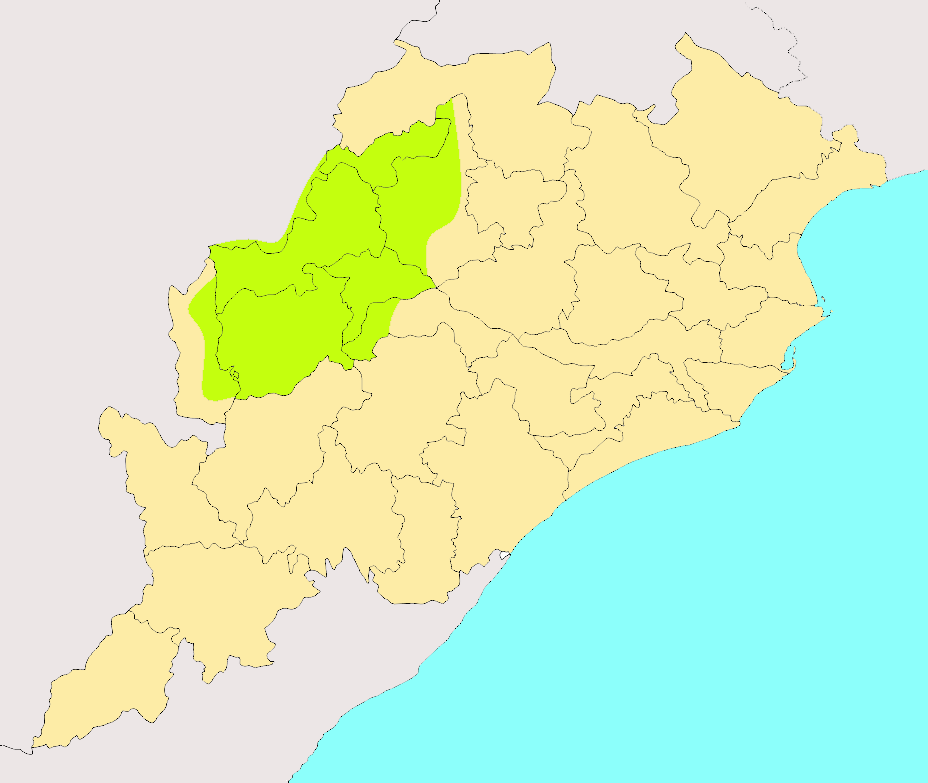
Sambalpuri (Sambalpuri: [sɔmbɔlɔpuɾi]) is an Indo-Aryan language variety of Odia language spoken in western Odisha, India. It is alternatively known as Western Odia, and as Kosali (with variants Kosli, Koshal and Koshali), a recently popularised but controversial term, which draws on an association with the historical region of Dakshina Kosala, whose territories also included the present-day Sambalpur region.
Its speakers usually perceive it as a separate language, while outsiders have seen it as a dialect of Odia, and standard Odia is used by Sambalpuri Odia speakers for formal communication. A 2006 survey of the varieties spoken in four villages found out that they share three-quarters of their basic vocabulary with Standard Odia.
There were 2.63 million people in India who declared their language to be Sambalpuri at the 2011 census, almost all of them residents in Odisha. These speakers were mostly concentrated in the districts of Bargarh (1,130,000 speakers), Subarnapur (364,000), Balangir (335,000), Sambalpur (275,000), Jharsuguda (245,000), Nuapada (145,000), Baudh (90,700), Sundargarh (42,700) and Kalahandi (11,545).
The inscriptions and literary works from the Western Odisha region used the Odia script, which is attested through the inscriptions like the Stambeswari stone inscription of 1268 CE laid by the Eastern Ganga monarch Bhanu Deva I at Sonepur and the Meghla grant and Gobindpur charter of Raja Prithvi Sing of Sonepur State and also through the major epic Kosalananda Kavya composed during the 17th century Chauhan rule under Raja Baliar Singh of the Sambalpur State, which was written in Sanskrit in Odia script.
The Devanagari script may have been used in the past, (the Hindi language was mandated in administration and education in Sambalpur for the brief period 1895–1901)
There are many eminent poets from Sambalpuri language, PadmaShree Haldhar Nag, Khageswar seth, Hemachandra Acharya has contributed a lot for the language.
NRI Poet Prasanta Meher, Poet Ranjit Padhan, Hemanta Deep and many other are made remarkable contribution modern time.
Sambalpuri has 28 consonant phonemes, 2 semivowel phonemes and 5 vowel phonemes.
Hub AI
Sambalpuri language AI simulator
(@Sambalpuri language_simulator)
Sambalpuri language
Sambalpuri (Sambalpuri: [sɔmbɔlɔpuɾi]) is an Indo-Aryan language variety of Odia language spoken in western Odisha, India. It is alternatively known as Western Odia, and as Kosali (with variants Kosli, Koshal and Koshali), a recently popularised but controversial term, which draws on an association with the historical region of Dakshina Kosala, whose territories also included the present-day Sambalpur region.
Its speakers usually perceive it as a separate language, while outsiders have seen it as a dialect of Odia, and standard Odia is used by Sambalpuri Odia speakers for formal communication. A 2006 survey of the varieties spoken in four villages found out that they share three-quarters of their basic vocabulary with Standard Odia.
There were 2.63 million people in India who declared their language to be Sambalpuri at the 2011 census, almost all of them residents in Odisha. These speakers were mostly concentrated in the districts of Bargarh (1,130,000 speakers), Subarnapur (364,000), Balangir (335,000), Sambalpur (275,000), Jharsuguda (245,000), Nuapada (145,000), Baudh (90,700), Sundargarh (42,700) and Kalahandi (11,545).
The inscriptions and literary works from the Western Odisha region used the Odia script, which is attested through the inscriptions like the Stambeswari stone inscription of 1268 CE laid by the Eastern Ganga monarch Bhanu Deva I at Sonepur and the Meghla grant and Gobindpur charter of Raja Prithvi Sing of Sonepur State and also through the major epic Kosalananda Kavya composed during the 17th century Chauhan rule under Raja Baliar Singh of the Sambalpur State, which was written in Sanskrit in Odia script.
The Devanagari script may have been used in the past, (the Hindi language was mandated in administration and education in Sambalpur for the brief period 1895–1901)
There are many eminent poets from Sambalpuri language, PadmaShree Haldhar Nag, Khageswar seth, Hemachandra Acharya has contributed a lot for the language.
NRI Poet Prasanta Meher, Poet Ranjit Padhan, Hemanta Deep and many other are made remarkable contribution modern time.
Sambalpuri has 28 consonant phonemes, 2 semivowel phonemes and 5 vowel phonemes.