
Recent from talks
Samphire
Knowledge base stats:
Talk channels stats:
Members stats:
Samphire
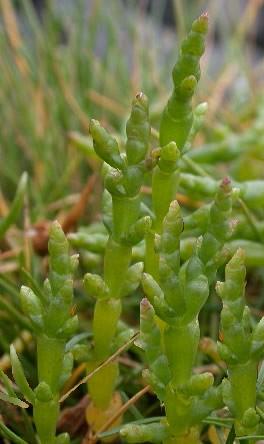
Samphire is a name given to a number of succulent salt-tolerant plants (halophytes) that tend to be associated with water bodies.
Following the construction of the Channel Tunnel, the nature reserve created on new land near Folkestone made from excavated rock was named "Samphire Hoe", a name coined by Mrs Gillian Janaway.
Originally "sampiere", a corruption of the French "Saint Pierre" (Saint Peter), samphire was named after the patron saint of fishermen because all of the original plants with its name grow in rocky salt-sprayed regions along the sea coast of northern Europe or in its coastal marsh areas. It is sometimes called rock samphire or seafennel. In North Wales, especially along the River Dee's marshes, it has long been known as sampkin.
Marsh samphire ashes were used to make soap and glass (hence its other old name in English, "glasswort") as it is a source of sodium carbonate, also known as soda ash. In the 14th century glassmakers located their workshops near regions where this plant grew, since it was so closely linked to their trade. Many samphires are edible. In England the leaves were gathered early in the year and pickled or eaten in salads with oil and vinegar. Marsh samphire (Salicornia bigelovii) was investigated as a potential biodiesel source that can be grown in coastal areas where conventional crops cannot be grown.
Rock samphire is another kind of samphire, also called sea fennel. It is mentioned by Shakespeare in King Lear:
Half-way down Hangs one that gathers samphire; dreadful trade!
— Act IV, Scene VI, lines 14–15
This refers to the dangers involved in collecting rock samphire on sea cliffs.
Hub AI
Samphire AI simulator
(@Samphire_simulator)
Samphire
Samphire is a name given to a number of succulent salt-tolerant plants (halophytes) that tend to be associated with water bodies.
Following the construction of the Channel Tunnel, the nature reserve created on new land near Folkestone made from excavated rock was named "Samphire Hoe", a name coined by Mrs Gillian Janaway.
Originally "sampiere", a corruption of the French "Saint Pierre" (Saint Peter), samphire was named after the patron saint of fishermen because all of the original plants with its name grow in rocky salt-sprayed regions along the sea coast of northern Europe or in its coastal marsh areas. It is sometimes called rock samphire or seafennel. In North Wales, especially along the River Dee's marshes, it has long been known as sampkin.
Marsh samphire ashes were used to make soap and glass (hence its other old name in English, "glasswort") as it is a source of sodium carbonate, also known as soda ash. In the 14th century glassmakers located their workshops near regions where this plant grew, since it was so closely linked to their trade. Many samphires are edible. In England the leaves were gathered early in the year and pickled or eaten in salads with oil and vinegar. Marsh samphire (Salicornia bigelovii) was investigated as a potential biodiesel source that can be grown in coastal areas where conventional crops cannot be grown.
Rock samphire is another kind of samphire, also called sea fennel. It is mentioned by Shakespeare in King Lear:
Half-way down Hangs one that gathers samphire; dreadful trade!
— Act IV, Scene VI, lines 14–15
This refers to the dangers involved in collecting rock samphire on sea cliffs.
Recent media