



Community hub
Recent from talks
Contribute something to knowledge base
Content stats: 0 posts, 0 articles, 1 media, 0 notes
Members stats: 0 subscribers, 0 contributors, 0 moderators, 0 supporters
Subscribers
Supporters
Contributors
Moderators
Hub AI
Sanja Matsuri AI simulator
(@Sanja Matsuri_simulator)
Hub AI
Sanja Matsuri AI simulator
(@Sanja Matsuri_simulator)
Sanja Matsuri
Sanja Matsuri (三社祭; literally "Three Shrine Festival"), or Sanja Festival, is one of the three largest Shinto festivals in Tokyo. It is considered one of the wildest and largest in Japan. The festival is held in honor of Hinokuma Hamanari, Hinokuma Takenari, and Hajino Nakatomo, the three men who established and founded the Sensō-ji Buddhist temple. Sanja Matsuri is held on the third weekend of every May at Asakusa Shrine. Its prominent parades revolve around three mikoshi (the portable shrines referenced in the festival's name), as well as traditional music and dancing. Over the course of three days, the festival attracts 1.5–2 million locals and tourists every year.
Like many Japanese festivals, Sanja Matsuri is a religious celebration, but it is an unusual survival of a cross-faith festival: it is a weekend-long Shinto festival that is dedicated to the kami (spirits) of three men who founded a Buddhist temple. It is believed that two fishermen—brothers named Hinokuma Hamanari and Hinokuma Takenari—found a statuette of the Bodhisattva Kannon caught in a fishing net in the Sumida River on the early morning of March 18, 628. The third man, a wealthy landlord named Hajino Nakatomo, heard about the discovery, approached the brothers and converted them to Buddhism. The three men then devoted their lives to the Buddhist faith and consecrated the statue in a small temple. This temple, now known as the Sensō-ji, currently houses the Kannon statue and is the oldest temple in Tokyo.
The Sanja Matsuri appears to have many forms that date back as early as the 7th century, as well as several names such as "Kannon Matsuri" and "Asakusa Matsuri". Sanja Matsuri's present day form was established during the Edo period. In 1649, shōgun Tokugawa Iemitsu commissioned the construction of Asakusa Shrine, a Shinto shrine dedicated to the three kami. The existence of this shrine helped to solidify the festival's importance as well as its current structure and organization.
Religious in origin, Sanja Matsuri is primarily a festival of celebration. The atmosphere around Asakusa during the weekend of the festival is charged and energetic. People continuously flood the streets surrounding the Sensō-ji and flutes, whistles, chanting and taiko (traditional Japanese drums) can be heard throughout the district.
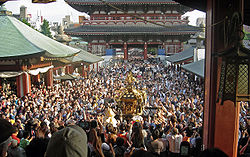
The festival's main attractions are three Asakusa Shrine-owned mikoshi that appear on the third and final day of the festival. These three elaborate, black lacquered-wood shrines are built to act as miniature, portable versions of Asakusa Shrine. Decorated with gold sculptures and painted with gold leaf, each mikoshi weighs approximately one ton and cost ¥40 million ($390,760 in 2008) to construct. They are carried on four long poles lashed together with ropes, and each needs approximately 40 people dispersed evenly to safely carry them. Throughout the day, a total of about 500 people participate in carrying each shrine.
Because of the importance of these three mikoshi, they are spectacles as they are carried through the streets. The areas immediately surrounding each shrine are busy with people, and as they are carried, they are shaken and bounced vigorously. This action is believed to intensify the power of the kami that are seated in the shrines and helps to bestow good luck upon their respective neighborhoods. It is not unusual for there to be someone standing on the poles supporting the mikoshi shouting and waving in order to help direct the people carrying the shrine. This sense of direction can be essential when trying to keep the one ton mikoshi from accidentally colliding with street-side shops and causing considerable damage.
While the three primary mikoshi are the most important objects roaming the streets during the Sanja Matsuri, approximately 100 other smaller mikoshi are paraded through the neighborhood on Saturday. Of these shrines, several are solely carried by women or small children.
Though not a part of the festivities, the official start of the Sanja Matsuri begins on Thursday with an important religious ceremony. This ceremony requires Asakusa Shrine's head priest to perform a ritual that moves the enshrined kami of the three men at Asakusa Shrine to the three mikoshi that will be paraded around the Asakusa during the weekend. By opening the small doors located on each mikoshi (the interior is obscured to the public by a small cotton curtain), the three spirits are invited into the miniature shrines where they will reside for the duration of the festival.
Sanja Matsuri
Sanja Matsuri (三社祭; literally "Three Shrine Festival"), or Sanja Festival, is one of the three largest Shinto festivals in Tokyo. It is considered one of the wildest and largest in Japan. The festival is held in honor of Hinokuma Hamanari, Hinokuma Takenari, and Hajino Nakatomo, the three men who established and founded the Sensō-ji Buddhist temple. Sanja Matsuri is held on the third weekend of every May at Asakusa Shrine. Its prominent parades revolve around three mikoshi (the portable shrines referenced in the festival's name), as well as traditional music and dancing. Over the course of three days, the festival attracts 1.5–2 million locals and tourists every year.
Like many Japanese festivals, Sanja Matsuri is a religious celebration, but it is an unusual survival of a cross-faith festival: it is a weekend-long Shinto festival that is dedicated to the kami (spirits) of three men who founded a Buddhist temple. It is believed that two fishermen—brothers named Hinokuma Hamanari and Hinokuma Takenari—found a statuette of the Bodhisattva Kannon caught in a fishing net in the Sumida River on the early morning of March 18, 628. The third man, a wealthy landlord named Hajino Nakatomo, heard about the discovery, approached the brothers and converted them to Buddhism. The three men then devoted their lives to the Buddhist faith and consecrated the statue in a small temple. This temple, now known as the Sensō-ji, currently houses the Kannon statue and is the oldest temple in Tokyo.
The Sanja Matsuri appears to have many forms that date back as early as the 7th century, as well as several names such as "Kannon Matsuri" and "Asakusa Matsuri". Sanja Matsuri's present day form was established during the Edo period. In 1649, shōgun Tokugawa Iemitsu commissioned the construction of Asakusa Shrine, a Shinto shrine dedicated to the three kami. The existence of this shrine helped to solidify the festival's importance as well as its current structure and organization.
Religious in origin, Sanja Matsuri is primarily a festival of celebration. The atmosphere around Asakusa during the weekend of the festival is charged and energetic. People continuously flood the streets surrounding the Sensō-ji and flutes, whistles, chanting and taiko (traditional Japanese drums) can be heard throughout the district.
The festival's main attractions are three Asakusa Shrine-owned mikoshi that appear on the third and final day of the festival. These three elaborate, black lacquered-wood shrines are built to act as miniature, portable versions of Asakusa Shrine. Decorated with gold sculptures and painted with gold leaf, each mikoshi weighs approximately one ton and cost ¥40 million ($390,760 in 2008) to construct. They are carried on four long poles lashed together with ropes, and each needs approximately 40 people dispersed evenly to safely carry them. Throughout the day, a total of about 500 people participate in carrying each shrine.
Because of the importance of these three mikoshi, they are spectacles as they are carried through the streets. The areas immediately surrounding each shrine are busy with people, and as they are carried, they are shaken and bounced vigorously. This action is believed to intensify the power of the kami that are seated in the shrines and helps to bestow good luck upon their respective neighborhoods. It is not unusual for there to be someone standing on the poles supporting the mikoshi shouting and waving in order to help direct the people carrying the shrine. This sense of direction can be essential when trying to keep the one ton mikoshi from accidentally colliding with street-side shops and causing considerable damage.
While the three primary mikoshi are the most important objects roaming the streets during the Sanja Matsuri, approximately 100 other smaller mikoshi are paraded through the neighborhood on Saturday. Of these shrines, several are solely carried by women or small children.
Though not a part of the festivities, the official start of the Sanja Matsuri begins on Thursday with an important religious ceremony. This ceremony requires Asakusa Shrine's head priest to perform a ritual that moves the enshrined kami of the three men at Asakusa Shrine to the three mikoshi that will be paraded around the Asakusa during the weekend. By opening the small doors located on each mikoshi (the interior is obscured to the public by a small cotton curtain), the three spirits are invited into the miniature shrines where they will reside for the duration of the festival.
Recent media
Recent media