
Recent from talks
Santa Fe Trail
Knowledge base stats:
Talk channels stats:
Members stats:
Santa Fe Trail
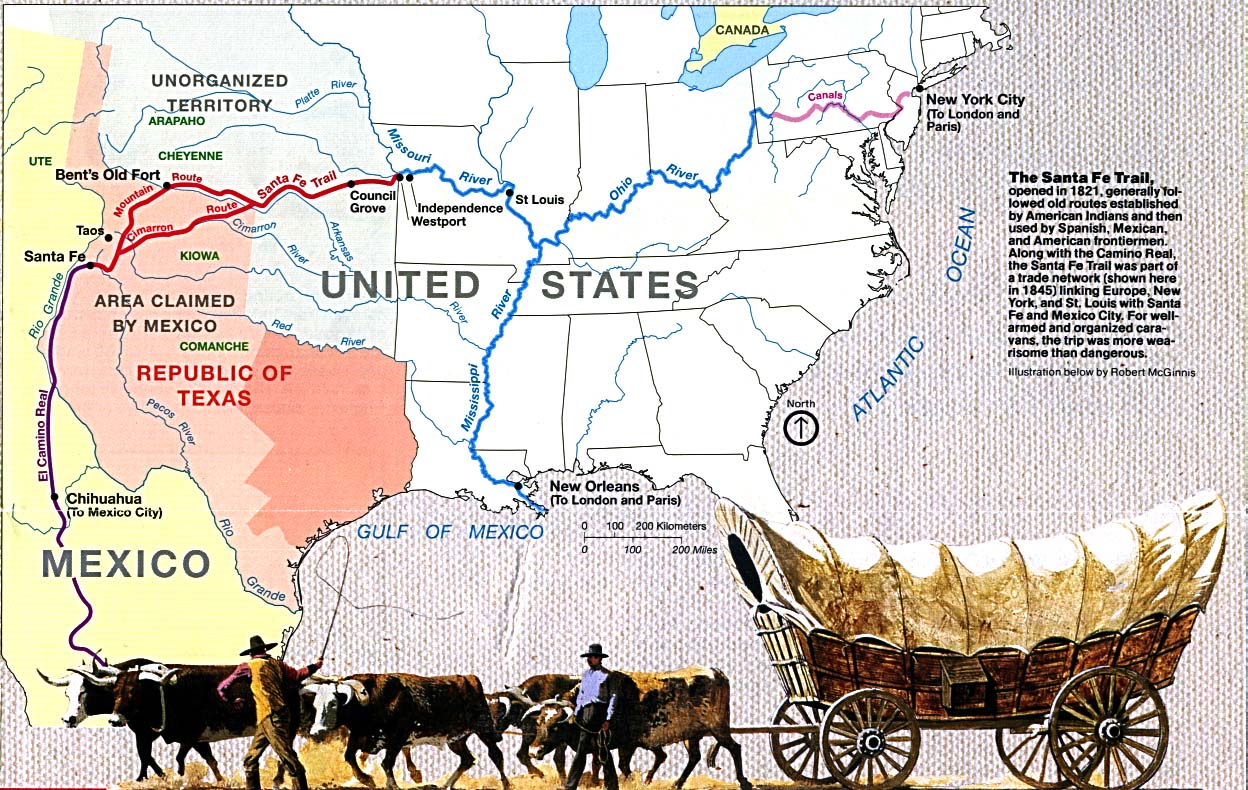
The Santa Fe Trail was a 19th-century route through central North America that connected Franklin, Missouri, with Santa Fe, New Mexico. Pioneered in 1821 by William Becknell, who departed from the Boonslick region along the Missouri River, the trail served as a vital commercial highway until 1880, when the railroad arrived in Santa Fe. Santa Fe was near the end of El Camino Real de Tierra Adentro which carried trade from Mexico City. The trail was later incorporated into parts of the National Old Trails Road and U.S. Route 66.
The route skirted the northern edge and crossed the north-western corner of Comancheria, the territory of the Comanche. Realizing the value, they demanded compensation for granting passage to the trail. American traders envisioned them as another market. Comanche raiding farther south in Mexico isolated New Mexico, making it more dependent on the American trade. They raided to gain a steady supply of horses to sell. By the 1840s, trail traffic through the Arkansas Valley was so numerous that bison herds were cut off from important seasonal grazing land. This habitat disruption, on top of overhunting, contributed to the collapse of the species. Comanche power declined in the region when they lost their most important game.
In 1846, during the Mexican–American War, the United States Army used the Santa Fe Trail to invade New Mexico.
After the U.S. acquisition of the Southwest that ended the war, the trail was integral to the U.S. opening the region to economic development and settlement. It played a vital role in the westward expansion of the U.S. into these new lands. The road route is commemorated today by the National Park Service as the Santa Fe National Historic Trail. A highway route that roughly follows the trail's path, through the entire length of Kansas, the southeast corner of Colorado and northern New Mexico, has been designated as the Santa Fe Trail National Scenic Byway.
The Santa Fe Trail was one of many transportation routes opened by the Indigenous people of North America as well as European trappers and traders in the second half of the 18th century. It was later used extensively by people from the United States in the 19th century after the Louisiana Purchase. Traders and settlers crossed the southwest of North America by the route connecting Independence, Missouri, with Santa Fe, New Mexico. Its major market in Missouri was St. Louis, with its port on the Mississippi River.
In 1719, the French officer Claude Charles Du Tisne was tasked by French authorities to establish a route to trade with the Spanish colony of Santa Fe in New Mexico. This first expedition, which started in Kaskaskia, Illinois, failed, as it was stopped by Indian tribes in Kansas. Then, at the time of the Louisiana regime, under French and then Spanish sovereignty, the French traders Pierre Antoine and Paul Mallet made a first trip in 1739 and 1740, starting also from Kaskaskia, Illinois, reaching Santa Fe and returning. They made other expeditions in 1741 and 1750, which faced various challenges from Indians and Spaniards. Then, the French explorer Pierre Vial made another pioneering trip on the route in 1792, and French traders and trappers from St. Louis gained progressively a fur trading dominance from the Spanish in Santa Fe as well as with the Indian tribes living in this vast region. Other French traders and trappers made trips on the trail from St. Louis, such as Auguste Pierre Chouteau and Jules de Mun in 1815, who were arrested by Spanish authorities in Santa Fe.
After Louisiana was sold to the United States in 1803 (Louisiana Purchase), Americans improved and publicized the Santa Fe Trail beginning in 1822, in order to take advantage of new trade opportunities with Mexico which had just won independence from Spain in the Mexican War of Independence. Manufactured goods were hauled from Missouri to Santa Fe, which was then in the northern Mexican state of Nuevo Mexico.
Settlers seeking the opportunity to hold free land used wagon trains to follow various emigrant trails that branched off to points west. The political philosophy of manifest destiny, the idea that the U.S. should extend from one coast to another, dominated national political discussions. The trail connected interior port cities along the Mississippi and Missouri and their wagon train outfitters to western destinations. The trail was used to carry products from the central plains to the trail head towns St. Joseph and Independence, Missouri.
Hub AI
Santa Fe Trail AI simulator
(@Santa Fe Trail_simulator)
Santa Fe Trail
The Santa Fe Trail was a 19th-century route through central North America that connected Franklin, Missouri, with Santa Fe, New Mexico. Pioneered in 1821 by William Becknell, who departed from the Boonslick region along the Missouri River, the trail served as a vital commercial highway until 1880, when the railroad arrived in Santa Fe. Santa Fe was near the end of El Camino Real de Tierra Adentro which carried trade from Mexico City. The trail was later incorporated into parts of the National Old Trails Road and U.S. Route 66.
The route skirted the northern edge and crossed the north-western corner of Comancheria, the territory of the Comanche. Realizing the value, they demanded compensation for granting passage to the trail. American traders envisioned them as another market. Comanche raiding farther south in Mexico isolated New Mexico, making it more dependent on the American trade. They raided to gain a steady supply of horses to sell. By the 1840s, trail traffic through the Arkansas Valley was so numerous that bison herds were cut off from important seasonal grazing land. This habitat disruption, on top of overhunting, contributed to the collapse of the species. Comanche power declined in the region when they lost their most important game.
In 1846, during the Mexican–American War, the United States Army used the Santa Fe Trail to invade New Mexico.
After the U.S. acquisition of the Southwest that ended the war, the trail was integral to the U.S. opening the region to economic development and settlement. It played a vital role in the westward expansion of the U.S. into these new lands. The road route is commemorated today by the National Park Service as the Santa Fe National Historic Trail. A highway route that roughly follows the trail's path, through the entire length of Kansas, the southeast corner of Colorado and northern New Mexico, has been designated as the Santa Fe Trail National Scenic Byway.
The Santa Fe Trail was one of many transportation routes opened by the Indigenous people of North America as well as European trappers and traders in the second half of the 18th century. It was later used extensively by people from the United States in the 19th century after the Louisiana Purchase. Traders and settlers crossed the southwest of North America by the route connecting Independence, Missouri, with Santa Fe, New Mexico. Its major market in Missouri was St. Louis, with its port on the Mississippi River.
In 1719, the French officer Claude Charles Du Tisne was tasked by French authorities to establish a route to trade with the Spanish colony of Santa Fe in New Mexico. This first expedition, which started in Kaskaskia, Illinois, failed, as it was stopped by Indian tribes in Kansas. Then, at the time of the Louisiana regime, under French and then Spanish sovereignty, the French traders Pierre Antoine and Paul Mallet made a first trip in 1739 and 1740, starting also from Kaskaskia, Illinois, reaching Santa Fe and returning. They made other expeditions in 1741 and 1750, which faced various challenges from Indians and Spaniards. Then, the French explorer Pierre Vial made another pioneering trip on the route in 1792, and French traders and trappers from St. Louis gained progressively a fur trading dominance from the Spanish in Santa Fe as well as with the Indian tribes living in this vast region. Other French traders and trappers made trips on the trail from St. Louis, such as Auguste Pierre Chouteau and Jules de Mun in 1815, who were arrested by Spanish authorities in Santa Fe.
After Louisiana was sold to the United States in 1803 (Louisiana Purchase), Americans improved and publicized the Santa Fe Trail beginning in 1822, in order to take advantage of new trade opportunities with Mexico which had just won independence from Spain in the Mexican War of Independence. Manufactured goods were hauled from Missouri to Santa Fe, which was then in the northern Mexican state of Nuevo Mexico.
Settlers seeking the opportunity to hold free land used wagon trains to follow various emigrant trails that branched off to points west. The political philosophy of manifest destiny, the idea that the U.S. should extend from one coast to another, dominated national political discussions. The trail connected interior port cities along the Mississippi and Missouri and their wagon train outfitters to western destinations. The trail was used to carry products from the central plains to the trail head towns St. Joseph and Independence, Missouri.
Recent media