


Community hub
Recent from talks
Contribute something
Nothing was collected or created yet.
Boonslick
View on WikipediaThe Boonslick, or Boone's Lick Country, is a cultural region of the state of Missouri along the Missouri River that played an important role in the westward expansion of the United States and the development of Missouri's territorial and subsequent statehood in the early 19th century.[1] The Boone's Lick Road, is a longtime historic route paralleling the north bank of the Missouri River from southeast to northwest, between St. Charles and Franklin, Missouri. It was the primary thoroughfare for settlers moving westward from the major river port on the Mississippi River of St. Louis (founded by the French, 1764) and the first capital of the old federal Missouri Territory (1812–1821), in the early 19th century. St. Louis was also a major settlement town since the 17th and 18th century era along with the nearby, across the river upstream to the east, French colonial settlements Kaskaskia and Cahokia in the adjacent Illinois Country of the New France colonial empire of the old Kingdom of France, leading from its capital in Quebec (in future Canada) in the north, and east of the Great Lakes and extending southward through the central Mississippi River Valley down to the lower river port of New Orleans on the Gulf of Mexico and in French Louisiana, the heartland and central watershed of the North American continent. St. Louis was also important because of its proximity to the confluence of the central Mississippi with the Ohio River flowing from the northeast and the Missouri River streaming from the far western Rocky Mountains northwest in the earlier federal Louisiana Territory (1804–1812), organized after the sale of the huge uncharted Louisiana Purchase of 1803, from the Emperor Napoleon I / Napoleon Bonaparte of France (the First French Empire) for $15 million.
The western terminus of the Boone's Lick Road further west in Franklin also marked the eastern end and beginning of the continuing famous Santa Fe Trail, leading further southwestward across the Great Plains to Santa Fe, the Royal Spanish colonial capital of its province of New Mexico in the larger Viceroyalty of New Spain dominions of its Spanish Empire in the twin continents of the Americas (Western Hemisphere). This well-known historical trail, first explored in 1806–1807, by U.S. Army officer Zebulon Pike (1779–1813), and his military expedition eventually became a major conduit for continuing overland American-Spanish trade in the future Southwestern United States. Later it inter-connected with the other heavily used emigrant westward trails, including the Oregon and California Trails, used by pioneers, mountain men/fur trappers, gold-seekers and other early settlers of the American frontier West.[2]
The region takes its name from the local historical landmark a salt spring or referred to as a "lick" (known today as Boone's Lick State Historic Site) in western Howard County, used by brothers Nathan Boone (1780–1856), and Daniel Morgan Boone (1769–1839), sons of famed Western explorer (in Kentucky), settler, and frontiersman Daniel Boone (1734–1820).

Many of Missouri's early leaders came from the Boonslick region. Its early French and Spanish colonial vestiges in old Louisiana were overtaken by settlement of newer European-American migrants moving westward from the Original Thirteen States on the East Coast, down the Ohio River from the Ohio Country, Pittsburgh and the Upland South — largely new states of Kentucky and Tennessee with its connecting tributary rivers from the south of the Tennessee and Cumberland streams, and crossing in the gaps / passes of the Appalachian Mountains chain, from Virginia further east – who brought numerous African-American slaves with them.[3][4] The region's borders often vary in definition but have included the present-day counties of Boone, Callaway, Cooper, Howard, and Saline.[5] Before and after the American Civil War, the area developed as the center of a larger region known as Little Dixie.[6]
Franklin, Missouri, founded in 1816, became a large port on the Missouri River and an early center of settlement and economic activity. There, the Boone's Lick Trail ended and William Becknell (c.1787/88-1856), blazed the Santa Fe Trail further to the southwest to the adjacent Spanish Empire's colonial territories in its province of New Mexico. The Chouteau brothers of St. Louis had previously established a fur trade monopoly with the Spanish in Santa Fe, and the fur trade was the basis of early St. Louis' prosperity and wealth, in addition to river-borne commerce.[citation needed]

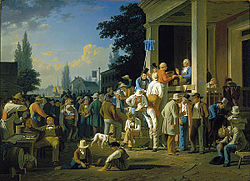
Columbia, Missouri is the largest city in the region and county seat of Boone County; it is the location of the flagship Columbia campus of the University of Missouri system, which was established in 1839. Famed artist George Caleb Bingham (1811–1879), painted in both Franklin and Columbia. His artworks illustrate Western American frontier pioneer, political and river life in the early and mid-19th century. Other early towns were Arrow Rock, Boonville, Fayette, and Rocheport.
In 1827, waterfront Franklin was lost to the powerful devastating floods of the river that year, and the town was re-built higher upon the flanking bluffs as renamed New Franklin. The Smithton Company established the village of Smithton, in the old Missouri Territory in 1818, which would later grow into and be renamed the city of Columbia in 1821.
In the current 21st century, the area is still predominantly rural, with the exception of the city of Columbia. The region is adjacent to the Missouri Rhineland and maintains its own developed vineyards. The Katy Trail State Park runs along the Missouri River, providing recreational access by a conversion of former railroad lines to trails for biking and walking / hiking.
See also
[edit]References
[edit]- ^ "History of region" state of page_id=51 Archived 2013-10-05 at the Wayback Machine, Boonslick Historical Society website
- ^ Barile, Mary. The Santa Fe Trail in Missouri. (Columbia: University of Missouri Press. 2010)
- ^ http://www.mo-river.net/history/boonslick/%7CReflections[permanent dead link] of Change: Death and Cemeteries in the Boonslick Region of Missouri" Maryellen Harshbarger McVicker
- ^ Babcock, Rufus, editor. Forty Years of Pioneer Life: Memoir of John Mason Peck D.D. (Philadelphia: American Baptist Publication Society, 1864)
- ^ U.S. Geological Survey Geographic Names Information System: Boonslick
- ^ "History of Little Dixie". Archived from the original on 2013-06-03. Retrieved 2013-05-17.
External links
[edit]
Boonslick
View on GrokipediaGeography
Location and Boundaries
The Boonslick region occupies central Missouri, centered on the historic Boone's Lick salt works site in Howard County at approximately 39°5′N 92°53′W. This area lies along the Missouri River, which forms a key geographic and historical axis, with the salt works situated roughly halfway between the confluences of the Grand River and Lamine River with the Missouri. The region's core aligns with the path of the early 19th-century Boone's Lick Road, an east-west route extending from the St. Louis area westward to Franklin in Howard County.[4][5] Boundaries of the Boonslick are fluid and historically variable, lacking formal demarcation, but commonly encompass the modern counties of Boone, Howard, and Cooper as the nucleus, reflecting early settlement patterns tied to salt production and river access. Broader interpretations extend to adjacent Missouri River counties including Callaway and Saline, with northern reaches into areas like Chariton and Randolph counties, emphasizing fertile bottomlands suited for agriculture and tobacco cultivation. Eastern limits often follow natural features such as the Loutre River valley near Danville in Montgomery County, while the western edge reaches toward Lafayette County.[3][6] This configuration positions the Boonslick as Missouri's "Little Dixie," a culturally distinct enclave of Southern-origin settlers, isolated southward by the Ozark Plateau and reliant on riverine transport via the Missouri and Mississippi Rivers for economic connectivity. The imprecise extent underscores its evolution from a specific salt-works locale to a broader cultural zone defined by migration routes and shared historical sympathies.[3][7]Physical Features
The Boonslick region encompasses approximately 1,588 square miles of prairie land in central Missouri, characterized by gently rolling hills and flat to undulating plains formed by glacial deposits and loess soils.[8] [9] These soils are deep, well-drained, and highly fertile, supporting extensive agriculture and contributing to the region's historical economic development.[9] [10] Elevations typically range from 500 to 900 feet above sea level, with river bluffs and lowlands providing varied topography along watercourses.[11] The Missouri River serves as the dominant hydrological feature, traversing the region and creating fertile floodplains flanked by wooded bottomlands, while tributaries such as the Lamine, Blackwater, and Petite Saline rivers drain the surrounding prairies.[12] These waterways historically facilitated transportation and settlement, with the river's meandering course shaping alluvial deposits that enhance soil productivity.[1] At the region's core lies the Boone's Lick area, featuring salt springs and a salt creek emerging from karst-influenced limestone terrain, surrounded by dense woodlands that contrast with the open prairie landscape.[1] Originally dominated by tallgrass prairie ecosystems with scattered savannas and riparian forests, the physical environment reflects a transition zone between glaciated northern plains and unglaciated southern prairies, influencing both biodiversity and land use patterns.[9] [13] The loess-capped uplands and river valleys exhibit minimal karst features compared to southern Missouri, but local salt seeps highlight unique mineral-rich outcrops derived from underlying Pennsylvanian bedrock.[14]Settlements
The Boonslick region's early Euro-American settlements coalesced around the productive salt springs and fertile Missouri River floodplain, drawing migrants via the Boonslick Road after 1815. Initial homesteads appeared as early as 1810, when widow Hannah Cole and her family settled in present-day Cooper County, marking one of the first permanent white pioneer claims in the area amid ongoing Native American presence.[15] [16] By 1811, roughly 60 families occupied the vicinity, spurred by salt extraction and land availability following the War of 1812.[17] Franklin, laid out in 1816 on the Missouri River's north bank in Howard County, became the Boonslick's inaugural town and a bustling frontier hub for trade, outfitting, and emigration. It hosted the first newspaper west of the Mississippi, the Missouri Intelligencer and Boonslick Advertiser, starting in 1819, and served as the Santa Fe Trail's eastern origin point, with exports including furs, lead, and salt.[18] [19] However, devastating floods in 1826 and 1828 eroded its site, leading to relocation of residents and its decline into a ghost town by the 1830s, though archaeological remnants persist.[19] [20] Boonville, platted in 1817 on the river's south side in Cooper County, solidified as the region's enduring commercial and administrative center, designated county seat in 1821. It thrived on steamboat traffic, hemp cultivation, and livestock, with lots first sold in 1819 after county organization; by the 1830s, it supported mills, warehouses, and a courthouse.[16] [20] Subsequent settlements reinforced the area's dispersed pattern along river bluffs and tributaries. Arrow Rock, in adjacent Saline County, emerged by 1821 as a key Santa Fe Trail waypoint with taverns and ferries, its bluff providing flood-resistant elevation.[21] In Boone County, Smithton was founded in 1818 as a speculative venture, relocating southward in 1821 to become Columbia due to water scarcity and flooding, evolving into a major inland town.[17] Howard County's Fayette, platted in 1823 as the county seat, and smaller villages like Rocheport (established circa 1818 in Boone County) further dotted the landscape, tied to tobacco, corn, and river commerce.[22] Population surged to over 15,000 across the core Boonslick by 1820, concentrated in these riverine nodes amid township formations like Arrow Rock and Lamine in Cooper County starting 1819.[23] [17] Later 19th-century additions, such as Pilot Grove (1873) and Prairie Home (1874) in Cooper County, extended settlement into uplands but retained the original focus on alluvial soils.[22]History
Pre-Settlement and Native American Presence
The Boonslick region, located along the Missouri River in present-day Boone, Howard, and Cooper counties, featured a landscape of fertile alluvial bottoms, tallgrass prairies, oak-hickory woodlands, and riverine environments that supported abundant wildlife prior to European arrival.[24] This ecology facilitated seasonal migrations and resource exploitation by indigenous groups for thousands of years, with archaeological sites evidencing Woodland period occupations from approximately 500 BCE to 1000 CE and later Oneota culture (ancestral to the Missouri tribe) settlements dating to around AD 1250.[24] By the 17th century, when French explorers first documented Native presence in 1673, the dominant tribes in central Missouri were the Osage and Missouria (also spelled Missouri), both Dhegiha Siouan-speaking peoples.[25] The Osage, estimated at 4,000 to 6,000 individuals before sustained European contact, maintained villages in the Osage River valley (Big Osage subgroup) and exerted control over hunting territories extending into the Boonslick area, practicing semi-nomadic lifeways centered on bison and deer hunting, wild plant gathering, and maize cultivation.[26] [27] The closely related Missouria resided along the Missouri River, including western Saline County adjacent to Boonslick, where they similarly pursued riverine resources and prairie hunts.[25] [28] The Missouri tribe, kin to the Iowa and Otoe, occupied sites about 40 miles northwest of modern Boonville until decimated by smallpox epidemics and raids from the Sauk in the late 18th century.[28] Intertribal conflicts, such as those between the Osage and Iowa over hunting grounds north of the Missouri River, shaped territorial dynamics in the region.[29] Trails used by these groups, including precursors to the Boone's Lick Road, facilitated travel and trade across the prairies and river crossings.[18] Other Algonquian-speaking tribes like the Sac and Fox exerted influence through raids and seasonal incursions, particularly as European trade goods disrupted traditional balances by the early 1800s.[30]Boone's Lick Salt Works Establishment
In 1805, Nathan Boone discovered a saline spring in what is now Howard County, Missouri, prompting him and his brother Daniel Morgan Boone to initiate salt production operations the following year.[1][18] The brothers, sons of frontiersman Daniel Boone, established the works to exploit the natural brine source, which attracted wildlife and held potential for commercial salt extraction vital for food preservation on the frontier.[31][30] Salt production at Boone's Lick involved boiling brine in large iron kettles over stone furnaces, a labor-intensive process requiring six to eight workers initially and yielding up to several bushels daily from a single furnace equipped with around 40 kettles.[32][33] The method relied on evaporating water from the salty spring water to crystallize the salt, with the site's multiple springs enabling sustained output that supported early settlement in the region.[34] This enterprise marked one of the first industrial activities west of the Mississippi, drawing settlers and facilitating trade despite challenges like Osage resistance and logistical difficulties in transporting equipment over 100 miles from St. Charles.[15][3] The salt works' establishment catalyzed regional development, as the Boones' production met demand for salt in a scarcity-driven economy, eventually leading to the area's nomenclature as "Boone's Lick" and influencing migration patterns post-War of 1812.[16][35] Operations expanded with partnerships, such as with the Morrison family, but the foundational efforts by the Boone brothers underscored the site's economic significance in the early 19th-century Missouri Territory.[36][30]Settlement and the Boone's Lick Road
The establishment of Boone's Lick salt works in 1806 by Nathan and Daniel Morgan Boone, sons of Daniel Boone, marked the onset of organized settlement in the Boonslick region of central Missouri. Located on Saline Creek in present-day Howard County, the saline spring yielded salt through evaporation in large kettles, a process that produced up to 150 bushels daily at its peak and supplied a critical preservative for meat in the absence of widespread refrigeration. This economic incentive drew initial pioneers despite the frontier's hazards, including skirmishes with Shawnee and other tribes during the lead-up to the War of 1812.[1][5] The Boone's Lick Road, evolving from a pre-existing Native American trace, connected the salt works to St. Charles on the Missouri River, approximately 150 miles eastward, and served as Missouri's earliest major overland thoroughfare for commerce and migration. Blazed as early as 1804 to transport manufacturing supplies and finished salt eastward, the route was widened for wagons by the early 1810s, enabling bulk shipments via Bryan and Morrison's trading post in St. Charles. This infrastructure catalyzed settlement by providing access to fertile bottomlands along the Missouri River, with the first documented permanent homesteads appearing around 1810, including that of widow Hannah Cole and her nine children near the licks.[18][20][16] Post-War of 1812, the road facilitated a surge in immigration from eastern states, as reduced Native American threats—following treaties and military actions—allowed safer travel. Howard County, organized on January 1, 1816, as the first such entity west of the Mississippi River, encompassed the Boonslick core and saw its population swell from scattered families to organized communities; Franklin was platted in 1816, followed by Boonville in 1817. By 1820, the surrounding counties reported over 10,000 residents, many farming tobacco and hemp on alluvial soils accessible via the road, which extended westward to emerging trails like the Santa Fe. The salt works' output, taxed at $1.50 per bushel under territorial law, generated revenue that funded early infrastructure, underscoring the road's role in transforming the region from isolated outposts to a hub of American expansion.[37][5][38]Role in Westward Expansion and the Santa Fe Trail
The Boone's Lick Road, blazed in the early 1810s from St. Charles westward roughly 150 miles to Franklin in Howard County, functioned as Missouri's premier overland route for pioneers after the 1803 Louisiana Purchase, channeling migrants into the Boonslick region's fertile Missouri River bottomlands and accelerating frontier settlement. By the late 1810s, this path had drawn thousands of families seeking arable land and economic opportunities tied to the salt industry, fostering rapid demographic growth that bolstered Missouri's 1821 admission to the Union as a slave state under the Missouri Compromise. The road's infrastructure—initially rudimentary trails widened by emigrants and salt haulers—supported logistical needs like provisioning with locally produced salt essential for food preservation and livestock during long journeys.[38][5][20] Franklin's position as the Boone's Lick Road's endpoint established it as the launch site for the Santa Fe Trail in 1821, when William Becknell organized the inaugural trading caravan to Santa Fe, New Mexico, exploiting the Adams-Onís Treaty to open commerce with Spanish Mexico. This linkage created a seamless corridor from St. Charles to the Southwest, with Boonslick merchants supplying caravans—up to 80 wagons strong by the 1830s—with salt, bacon, and hardware in exchange for Mexican silver, mules, and furs, generating substantial regional wealth estimated at millions in annual trade value by the 1840s. The trails' convergence at Franklin, alongside the Missouri River route used by Lewis and Clark, positioned Boonslick as a critical nexus for trans-Mississippi expansion, enabling not only Santa Fe commerce but also scouting for later routes like the Oregon and California Trails.[1][39][40] Boonslick's salt works, operational since around 1808, directly aided Santa Fe expeditions by providing a scarce commodity for trade and trail sustenance, with output reaching thousands of bushels annually to outfit wagon trains departing Franklin. This economic synergy drew investment in ferries, warehouses, and mills along the Missouri River, enhancing the area's capacity to sustain westward ventures amid challenges like Osage resistance and seasonal floods. By linking eastern capital to frontier trade, the region exemplified causal drivers of expansion: resource extraction fueling migration and commerce, rather than isolated heroic narratives.[30][18]Antebellum Economy and Slavery
The antebellum economy of the Boonslick region, encompassing counties such as Boone, Callaway, Cooper, and Howard along the Missouri River, centered on agriculture, particularly the production of cash crops like hemp and tobacco, which required intensive manual labor. Hemp, used for rope and bagging in the burgeoning trade networks, became a dominant crop by the 1820s, with exports from river ports like Franklin beginning alongside tobacco shipments as early as 1822. Tobacco cultivation, similarly labor-demanding, complemented hemp on large plantations, forming the backbone of the region's wealth and integrating it into broader Southern market systems. Early salt extraction from the Boone's Lick springs had spurred initial settlement and provided essential preservatives for meat and hides, but by the 1830s, agricultural expansion overshadowed this activity as fertile bottomlands supported plantation-style farming.[41][42][43] Slavery underpinned this economic model, with enslaved African Americans comprising a substantial portion of the population and workforce. In Boone County, slaves numbered 5,034 out of a total population of 19,486 in 1860, equating to 26 percent. Callaway County saw slave percentages rise from 24 percent in 1850 to 28.8 percent by 1860, while the region as a whole ranked among Missouri's top slaveholding areas, exceeding the statewide average of about 10 percent. The typical slaveholder owned around 6.1 slaves, with only 4 percent qualifying as planters holding 20 or more, yet this system enabled commercial-scale production of hemp and tobacco that drove regional prosperity. Settlers from Upper South states like Virginia and Kentucky imported both slaves and the plantation culture, fostering a tolerance for slavery even among non-owners and embedding it deeply in local social and economic structures.[44][45][46] This reliance on slave labor not only facilitated crop processing—such as hemp breaking and tobacco curing—but also extended to ancillary activities like flatboat construction for river exports and livestock management on diversified estates. The Boonslick's position as a gateway for westward trade, including the Santa Fe Trail, amplified demand for these outputs, with hemp products supporting wagon covers and ropes essential for overland commerce. However, the system's dependence on coerced labor made the economy vulnerable to disruptions, foreshadowing challenges during the Civil War, though it generated significant wealth for elite families in the prewar decades.[42][47][7]Civil War and Reconstruction Era
The Boonslick region exhibited pronounced Southern sympathies prior to and during the Civil War, serving as the northernmost concentration of slave-holding interests in the United States and fostering secessionist leanings among many residents. Hemp and tobacco plantations reliant on enslaved labor dominated the local economy, with the area's isolation along the Missouri River exacerbating divisions between pro-Union elements in urban centers like Boonville and rural Confederate strongholds in southern Howard and adjacent counties. Missouri's status as a border state prevented formal secession, but Governor Claiborne Fox Jackson's pro-Confederate Missouri State Guard sought to assert control, drawing the region into early conflict.[3][48][49] The Battle of Boonville on June 17, 1861, marked one of the war's initial significant land engagements west of the Mississippi River, pitting Union forces under General Nathaniel Lyon against the Missouri State Guard led by Governor Jackson and General Sterling Price. Lyon's approximately 2,000 troops routed the larger but poorly organized secessionist force of around 3,500–5,000, capturing Boonville after a brief skirmish and forcing Jackson's retreat southward; Union casualties numbered about 16 killed and 52 wounded, while Confederate losses exceeded 100 killed or wounded and dozens captured. This victory enabled federal dominance over the Missouri River, a vital supply artery, and disrupted early Confederate organizing in central Missouri, though it failed to quell local guerrilla resistance rooted in economic indebtedness and Southern allegiance. Boonville endured three additional clashes during the war, including engagements in 1862 and 1864 amid persistent bushwhacker raids that turned isolated settlements like Danville into lawless zones.[50][16][7][51] Emancipation progressively dismantled the Boonslick's slave-based agriculture as Union advances freed enslaved people, with roughly 10,000 remaining in Missouri by war's end—concentrated disproportionately in this region—and many relocating or integrating into disrupted rural economies post-13th Amendment ratification on December 6, 1865. Confederate irregulars, including figures operating near Perche Creek and southern Howard County, sustained low-level violence through 1864–1865, reflecting unyielding sympathies that claimed civilian lives and property amid retaliatory Union enforcements.[49][48] Reconstruction in the Boonslick unfolded under Missouri's Radical Republican framework, which enacted the 1865 state constitution requiring ironclad loyalty oaths and disfranchising ex-Confederates, thereby sidelining much of the region's planter class from politics and exacerbating postwar economic stagnation in hemp production. Freedmen's integration proved uneven, with former slaves facing sharecropping dependencies and violence in areas of lingering Southern resentment, though federal oversight via the Freedmen's Bureau mitigated some abuses until its Missouri operations wound down by 1868. The era's punitive measures, aimed at suppressing rebel resurgence, gradually yielded to Democratic reclamation by 1870, restoring conservative influence aligned with the Boonslick's prewar heritage.[49][3]Economy
Historical Industries
The Boonslick region's primary early industry centered on salt extraction and production at Boone's Lick, initiated by Nathan and Daniel Morgan Boone in partnership with James and Jesse Morrison starting in 1805. Brine from natural salt springs was pumped into large vats and boiled over wood fires in iron kettles to evaporate water and yield crystallized salt, a process requiring intensive labor often involving enslaved workers. This salt was indispensable for food preservation, animal husbandry, and trade with Osage tribes, supporting frontier settlement and Missouri River commerce until larger-scale operations elsewhere reduced its viability by the 1830s.[52][30] Agriculture rapidly supplanted salt-making as the dominant economic driver, with fertile alluvial soils along the Missouri River enabling large-scale cultivation of cash crops like hemp and tobacco from the 1810s onward. Hemp production, peaking in Boone and Howard counties during the antebellum period, supplied durable fiber for rope, bagging, and cordage essential to outfitting Santa Fe Trail wagons and steamboat rigging, with exports facilitating regional wealth accumulation. Tobacco farming emerged prominently by 1822, when flatboats from Boonslick ports like Boonville began shipping hogsheads downriver to southern markets, complemented by corn, wheat, and livestock rearing that underpinned self-sufficient plantation operations.[53][41] Livestock industries, particularly hog and cattle raising, integrated with crop production to yield pork, beef, lard, and hides for both local use and steamboat exports, bolstering the Boonslick's role as an agricultural entrepôt in the Upper Missouri Valley. These pursuits, reliant on enslaved labor in an area with one of Missouri's highest concentrations of slaveholders, generated commodities stored in riverside warehouses and transported via emerging infrastructure, sustaining economic growth through the Civil War era despite disruptions from conflict and emancipation.[54][55]Modern Economic Development
The Boonslick region's modern economy, primarily encompassing Cooper and Howard counties with spillover effects from adjacent Boone County, has transitioned from heavy reliance on agriculture to a diversified base including manufacturing, logistics, healthcare, and education. This evolution is facilitated by the area's central Missouri location, offering direct access to Interstate 70 for freight movement, mainline rail services, and the mid-state Missouri River port in Boonville, positioning it ideally for distribution and supply chain operations within 500 miles of 43% of the U.S. population.[56] [57] Agriculture remains a cornerstone, particularly in rural Cooper County, where farmland dominates land use and net cash farm income reached $52.2 million in 2022, reflecting a 47% increase from prior years amid rising per-farm product sales values averaging $179,970. Manufacturing has expanded through targeted incentives and infrastructure, with facilities like Boonslick Industries focusing on recycling and employing workers with disabilities, contributing to a broader industrial footprint in plastics and assembly.[58] [59] [60] Economic development organizations, such as the Boonslick Community Development Corporation (serving Cooper and Howard counties since its establishment), emphasize business retention, expansion, and attraction, collaborating with entities like the Howard County Economic Development Council. A May 2025 partnership between these groups aims to streamline services for job creation and investment in underserved manufacturing and logistics sectors. Median household income in Cooper County stood at $67,548 recently, with average wages across private industries at $41,710 in 2024 and unemployment at 4.5% in August 2025, indicating stable but modest growth amid limited natural resources.[6] [61] [62] [63] [64] Proximity to Boone County's urban hub of Columbia, anchored by the University of Missouri, has amplified regional opportunities in high-tech, life sciences, and healthcare, driving spillover employment and commuting. Boone County's real gross domestic product (in chained 2017 dollars) advanced from $9.45 billion in 2020 to $10.27 billion in 2023, underscoring faster diversification compared to the core rural Boonslick counties.[65] [66]Transportation Infrastructure
The Boonslick region's transportation infrastructure historically centered on the Boone's Lick Road, an early 19th-century east-west route originating from St. Charles and extending to the salt works in Howard County, which served as a primary migration and trade path facilitating settlement and commerce before evolving into a precursor for the Santa Fe Trail.[5][20] This trail, initially a Native American trace widened for wagons, supported the transport of salt and goods, underpinning the area's antebellum economy until railroads and highways supplanted it in the late 1800s.[18] Interstate 70 (I-70) forms the backbone of modern highway infrastructure, traversing the region east-west and providing direct access in locations such as Boonville, enabling same-day trucking to Kansas City and St. Louis markets while handling daily traffic volumes of 29,400 to 42,400 vehicles in key segments.[67][68] The corridor, originally aligned near Columbia along the historic Boonslick Road path by 1822, drives economic activity through freight movement and connectivity to intercontinental trade routes, with ongoing expansions aimed at enhancing capacity for goods transport.[69][8] Complementary north-south access via U.S. Highway 63 and regional roads, totaling over 3,905 miles across the Boonslick area, supports local distribution within Missouri's 33,884-mile state network.[67][8] Rail service includes Union Pacific's mainline tracks in Cooper County, offering Class I freight capabilities for bulk commodities, complemented by short-line operations like the Otterville Railway, which integrate with Missouri's 4,800 miles of mainline track handling the state's fourth-highest national freight tonnage.[67][6] These lines facilitate efficient movement of agricultural and manufactured goods, bolstering the region's logistics hub status between the Missouri and Mississippi Rivers.[68] Riverine infrastructure leverages the Missouri River for barge traffic, with port facilities in Howard County poised for expanded multimodal integration via I-70, enhancing export of regional products like grain and enhancing economic resilience through diversified freight options.[70][68] The Boonslick Regional Planning Commission coordinates improvements, including rail overpasses and active transportation plans, to address bottlenecks and promote freight efficiency amid state investments exceeding millions in local projects.[71][72]Demographics and Society
Population Trends
The Boonslick region, encompassing primarily Boone, Howard, Cooper, and Saline counties, experienced rapid population influx in the early 19th century as migrants from Virginia, Kentucky, and other Upper South states settled along the fertile Missouri River bottoms and Boone's Lick Road. By 1820, the area had emerged as Missouri's second-most populous region after St. Louis County, fueled by agricultural opportunities and the salt works' economic pull.[24] Boone County's enumerated population reached 3,692 in 1820, surging 140% to 8,859 by 1830 amid continued immigration and land availability. Growth moderated after the 1830s as frontier expansion shifted westward, with the combined counties' populations expanding steadily through the antebellum era before stabilizing post-Civil War due to economic disruptions and out-migration. Throughout the 20th century, population trends in the rural core counties—Howard, Cooper, and Saline—reflected broader agrarian decline, with minimal net gains offset by urbanization elsewhere in Missouri. Howard County's population hovered around 10,000 from 2000 (10,307) to 2020 (10,151), showing a slight 1.5% decline amid limited job opportunities.[73] Cooper County similarly contracted from 16,850 in 2000 to 16,835 in 2020, a 0.1% drop, while Saline County fell 3% over the same period from 23,877 to 23,177, driven by agricultural consolidation and youth out-migration to urban centers.[74] [75] In contrast, Boone County has driven recent regional expansion, with its population rising from 135,434 in 2000 to 183,310 in 2020—a 35% increase—primarily due to the University of Missouri's growth in Columbia, which attracted students, faculty, and service-sector jobs.[76] From 2010 to 2022, Boone added over 24,000 residents to reach 187,690, outpacing state averages and highlighting urban-rural divergence within the Boonslick.[77] This pattern aligns with Missouri-wide shifts, where metro-adjacent counties like Boone grew at 1-2% annually while non-metro areas stagnated.[78]Cultural Composition
The Boonslick region's cultural composition derives primarily from its early 19th-century settlement by migrants from the Upper South states of Virginia, Kentucky, and Tennessee, who established a distinctly Southern-influenced society characterized by Anglo-American traditions, agrarian lifestyles, and tolerance for slavery. These settlers, often of English and Scots-Irish descent, prioritized hemp and tobacco farming on fertile Missouri River bottomlands, replicating plantation economies from their origins. Enslaved Africans, brought by many families, formed a substantial underclass, contributing to labor-intensive agriculture and domestic service; by 1860, the Boonslick counties held Missouri's highest concentration of slaveholders outside urban areas, with enslaved people comprising up to 20-25% of the population in places like Howard and Cooper Counties.[5][79][7] Religiously, the early Protestant dominance reflected Southern revivalist fervor, with Baptists, Methodists, and Presbyterians competing to organize congregations amid rapid frontier growth; by the 1820s-1830s, camp meetings and circuit riders had planted dozens of churches, emphasizing evangelical piety over formal liturgy. Catholic presence emerged later and minimally, mainly among Irish laborers or German pockets outside the core area, while African Methodist Episcopal churches arose post-emancipation for freed communities. This Protestant base persists, aligning with Missouri's broader 62% Christian affiliation, skewed toward evangelical denominations in the Boonslick's conservative cultural milieu.[80][81] Modern demographics underscore enduring homogeneity, with non-Hispanic Whites forming 85-90% of residents across core counties per 2020 U.S. Census data, descendants of those Southern pioneers. Black or African American populations, tracing to antebellum slaves, hover at 5-9%, concentrated in towns like Boonville and Columbia; Asian (4-5% in urbanized Boone County) and Hispanic (2-3%) shares reflect recent migration tied to education and industry, but remain marginal. Minimal Native American representation stems from early displacement during settlement. This composition fosters a cultural continuity of Southern customs—rural self-reliance, community churches, and family-based traditions—distinct from Missouri's Germanic or Ozark enclaves.[82][83][62]| County | White (Non-Hispanic) % | Black % | Asian % | Hispanic % | Total Population (2020) |
|---|---|---|---|---|---|
| Boone | 76.4 | 9.3 | 4.6 | 3.0 | 183,610[82] |
| Howard | 86.9 | 5.3 | 0.3 | 2.0 | 10,151[83] |
| Cooper | 88.6 | 5.6 | <1 | <2 | 17,103[62] |