



Community hub
Recent from talks
Knowledge base stats:
Talk channels stats:
Members stats:
Santa Maria la Carità
Santa Maria la Carità (Neapolitan: Santa Maria 'a Carità) is a comune (municipality) of 11,617 inhabitants in the Metropolitan City of Naples, in the Italian region of Campania, located about 25 kilometres (16 mi) southeast of Naples. It is situated in the Stabiae-Vesuvian plain, in the Sarno valley.
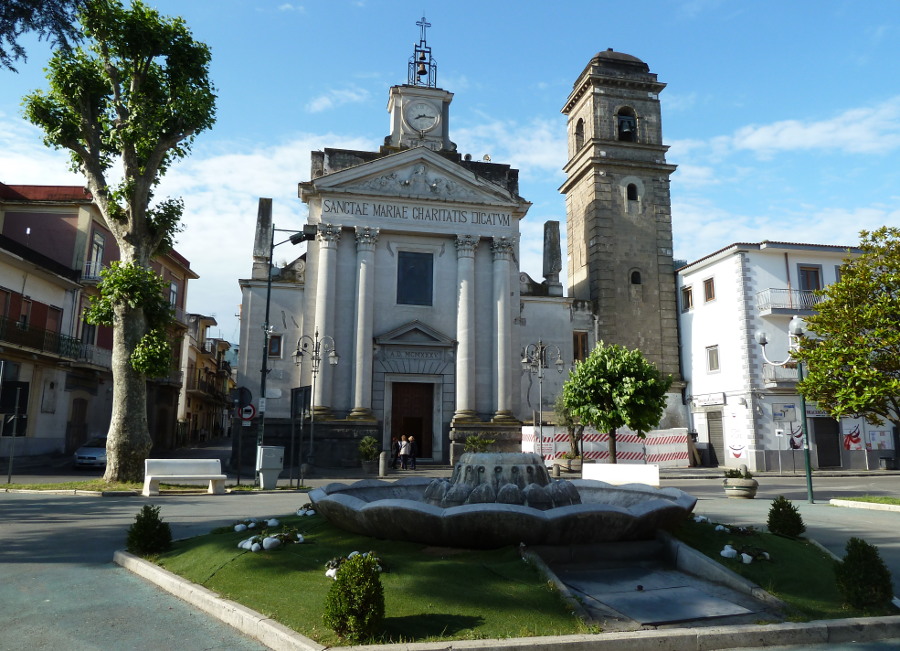
Its urban structure is radial, having its center in Piazza Borrelli, where the main church is located. The name reflects the worship of the patron saint, Santa Maria delle Grazie. The addition of "la Carità" probably serves as a local designation to distinguish it from other places with similar names. This addition also carries connotations of charity and benevolence.
The town boasts historical and cultural landmarks, contributing to its appeal as a tourist destination. Additionally, Santa Maria la Carità enjoys a strategic location, benefiting from proximity to both natural attractions, such as Mount Vesuvius, the Gulf of Naples and the Amalfi Coast, and urban centers, including Naples and Salerno.
The fertile Vesuvian plain, where Santa Maria la Carità is located, was an intensely cultivated and inhabited area already in ancient times. The first news about the town dates back to around 900 BC, when the Oscan people began to settle in the territory. These were rural settlements that arose in an area of intense commercial traffic. Starting from the settlement of the Samnites (around 500 BC) a whole series of bloody wars and battles took place in the area, in which armies of different origins, roaming the Sarno plains, raided the countryside in search of food supplies.
In 340 BC, following the Samnite Wars, the Romans conquered the area. Within the territory of the comune, several villas dating back to the 1st century BC have been discovered, testifying to the constant development of the area, which by this period was surrounded by important towns such as Stabiae and Pompeii. The eruption of Mount Vesuvius in 79 AD abruptly ended this prosperity. The settlements in the comune, like the other well-known surrounding towns, met a tragic fate and the area was abandoned for many decades. Resettlement began before the end of Roman rule, but it occurred on a much smaller scale than before.
After the fall of the Western Roman Empire several peoples settled in the area. Starting from 574 AD, the Lombards invaded Southern Italy, arriving in the Sarno plain. At the end of the first millennium (950 AD), after centuries of relative peace where the area remained mostly rural, the Lombards began to build military watchtowers to defend themselves from the threat posed by the Saracens, who had unsuccessfully tried to reach Amalfi from here. Precisely one of these towers would later become the bell tower of the church of Santa Maria la Carità. Tradition has it that the ancient road connecting the river Sarno to the Lattari Mountains passed under the bell tower: the large openings at the base of the tower, which still exist today, would have had precisely this functional purpose. In 1318 King Robert of Anjou delimits the Cancelleria fiefdom by establishing the church of Santa Maria la Carità as the boundary term.
Starting from around 1450 there were numerous attempts to reclaim the areas of the comune which were marshy and caused numerous deaths from malaria, but only in 1855 King Ferdinand II of Bourbon established the "Amministrazione delle Bonificazioni". During the Bourbon period, the area of Santa Maria la Carità was part of the Kingdom of the Two Sicilies. Urbanization in the area gradually increased with population growth and the development of agricultural activities. During this time, the importance of the local church continued to grow. The last outbreak of war before the Great War arose in 1860 during the Italian Unification, when numerous anti-Garibaldian Sammaritani, after violent clashes, turned to brigandage as they were unable to assert their loyalty to the Bourbon sovereigns in any other way.
The world wars brought a significant number of casualties among the young men of Santa Maria la Carità: Piazza Borrelli, which is the main square of the town, is dedicated to the memory of Ernesto Borrelli, a young decorated pilot who died fighting over the Mediterranean on March 27th, 1943. Starting from the 1950s, Santa Maria la Carità began to develop as an autonomous municipality. Demographic growth and industrialization contributed to the transformation of the urban and social fabric. Despite modernization, agriculture remained an important sector for the local economy. In 1950 the first legislative proposals were born to establish the autonomous municipality of Santa Maria la Carità, but it wasn't until 1978 that the comune obtained total autonomy from the municipality of Gragnano through a referendum.
Hub AI
Santa Maria la Carità AI simulator
(@Santa Maria la Carità_simulator)
Santa Maria la Carità
Santa Maria la Carità (Neapolitan: Santa Maria 'a Carità) is a comune (municipality) of 11,617 inhabitants in the Metropolitan City of Naples, in the Italian region of Campania, located about 25 kilometres (16 mi) southeast of Naples. It is situated in the Stabiae-Vesuvian plain, in the Sarno valley.
Its urban structure is radial, having its center in Piazza Borrelli, where the main church is located. The name reflects the worship of the patron saint, Santa Maria delle Grazie. The addition of "la Carità" probably serves as a local designation to distinguish it from other places with similar names. This addition also carries connotations of charity and benevolence.
The town boasts historical and cultural landmarks, contributing to its appeal as a tourist destination. Additionally, Santa Maria la Carità enjoys a strategic location, benefiting from proximity to both natural attractions, such as Mount Vesuvius, the Gulf of Naples and the Amalfi Coast, and urban centers, including Naples and Salerno.
The fertile Vesuvian plain, where Santa Maria la Carità is located, was an intensely cultivated and inhabited area already in ancient times. The first news about the town dates back to around 900 BC, when the Oscan people began to settle in the territory. These were rural settlements that arose in an area of intense commercial traffic. Starting from the settlement of the Samnites (around 500 BC) a whole series of bloody wars and battles took place in the area, in which armies of different origins, roaming the Sarno plains, raided the countryside in search of food supplies.
In 340 BC, following the Samnite Wars, the Romans conquered the area. Within the territory of the comune, several villas dating back to the 1st century BC have been discovered, testifying to the constant development of the area, which by this period was surrounded by important towns such as Stabiae and Pompeii. The eruption of Mount Vesuvius in 79 AD abruptly ended this prosperity. The settlements in the comune, like the other well-known surrounding towns, met a tragic fate and the area was abandoned for many decades. Resettlement began before the end of Roman rule, but it occurred on a much smaller scale than before.
After the fall of the Western Roman Empire several peoples settled in the area. Starting from 574 AD, the Lombards invaded Southern Italy, arriving in the Sarno plain. At the end of the first millennium (950 AD), after centuries of relative peace where the area remained mostly rural, the Lombards began to build military watchtowers to defend themselves from the threat posed by the Saracens, who had unsuccessfully tried to reach Amalfi from here. Precisely one of these towers would later become the bell tower of the church of Santa Maria la Carità. Tradition has it that the ancient road connecting the river Sarno to the Lattari Mountains passed under the bell tower: the large openings at the base of the tower, which still exist today, would have had precisely this functional purpose. In 1318 King Robert of Anjou delimits the Cancelleria fiefdom by establishing the church of Santa Maria la Carità as the boundary term.
Starting from around 1450 there were numerous attempts to reclaim the areas of the comune which were marshy and caused numerous deaths from malaria, but only in 1855 King Ferdinand II of Bourbon established the "Amministrazione delle Bonificazioni". During the Bourbon period, the area of Santa Maria la Carità was part of the Kingdom of the Two Sicilies. Urbanization in the area gradually increased with population growth and the development of agricultural activities. During this time, the importance of the local church continued to grow. The last outbreak of war before the Great War arose in 1860 during the Italian Unification, when numerous anti-Garibaldian Sammaritani, after violent clashes, turned to brigandage as they were unable to assert their loyalty to the Bourbon sovereigns in any other way.
The world wars brought a significant number of casualties among the young men of Santa Maria la Carità: Piazza Borrelli, which is the main square of the town, is dedicated to the memory of Ernesto Borrelli, a young decorated pilot who died fighting over the Mediterranean on March 27th, 1943. Starting from the 1950s, Santa Maria la Carità began to develop as an autonomous municipality. Demographic growth and industrialization contributed to the transformation of the urban and social fabric. Despite modernization, agriculture remained an important sector for the local economy. In 1950 the first legislative proposals were born to establish the autonomous municipality of Santa Maria la Carità, but it wasn't until 1978 that the comune obtained total autonomy from the municipality of Gragnano through a referendum.