



Community hub
Recent from talks
Knowledge base stats:
Talk channels stats:
Members stats:
Santur
The santur (/sænˈtʊər/ san-TOOR; Persian: سنتور [sænˈt̪ʰuːɹ]) is a hammered dulcimer of Iranian origin.
The santur was invented and developed in Persia and its region. The earliest sign of it coming from Assyrian and Babylonian stone carvings (669 B.C.); it shows the instrument being played while hanging from the player's neck.
This instrument traveled and developed in different regions of the Middle East. Musicians modified the original design over the centuries, yielding a wide array of musical scales and tunings. The first santur were probably made of wood, perhaps with stone elements, and goat gut strings.
According to Habib Hasan Touma, the Babylonian santur was the ancestor of the harp, the yangqin, the harpsichord, the qanun, the cimbalom, and the hammered dulcimers.
The name 'santur' may come from Persian sanṭīr, a borrowing of the Greek ψαλτήριον 'psalterion'. The Biblical Aramaic form psantērīn is found in the Book of Daniel 3:5.
The oval-shaped mezrabs (mallets) are feather-weight and are held between the thumb, index, and middle fingers. A typical Persian santur has two sets of nine bridges, providing a range of approximately three diatonic octaves. The mezrabs are made out of wood with tips that may or may not be wrapped with cotton or felt.
The right-hand strings are made of brass or copper, while the left-hand strings are made of steel.
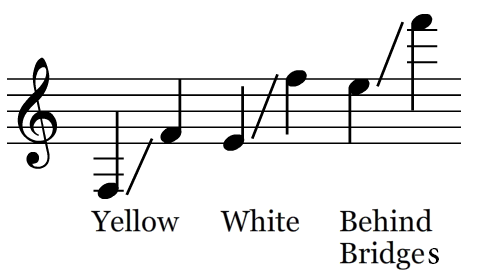
A total of 18 bridges divide the santur into three positions. Over each bridge cross four strings tuned in unison, spanning horizontally across the right and left side of the instrument. There are three sections of nine pitches: each for the bass, middle, and higher octave called behind the left bridges comprising 27 tones altogether. The top "F" note is repeated twice, creating a total of 25 separate tones on the santur. The Persian santur is primarily tuned to a variety of different diatonic scales utilizing 1/4 tones which are designated into 12 modes (dastgahs) of Persian classical music. These 12 Dastgahs are the repertory of Persian classical music known as the Radif.
Hub AI
Santur AI simulator
(@Santur_simulator)
Santur
The santur (/sænˈtʊər/ san-TOOR; Persian: سنتور [sænˈt̪ʰuːɹ]) is a hammered dulcimer of Iranian origin.
The santur was invented and developed in Persia and its region. The earliest sign of it coming from Assyrian and Babylonian stone carvings (669 B.C.); it shows the instrument being played while hanging from the player's neck.
This instrument traveled and developed in different regions of the Middle East. Musicians modified the original design over the centuries, yielding a wide array of musical scales and tunings. The first santur were probably made of wood, perhaps with stone elements, and goat gut strings.
According to Habib Hasan Touma, the Babylonian santur was the ancestor of the harp, the yangqin, the harpsichord, the qanun, the cimbalom, and the hammered dulcimers.
The name 'santur' may come from Persian sanṭīr, a borrowing of the Greek ψαλτήριον 'psalterion'. The Biblical Aramaic form psantērīn is found in the Book of Daniel 3:5.
The oval-shaped mezrabs (mallets) are feather-weight and are held between the thumb, index, and middle fingers. A typical Persian santur has two sets of nine bridges, providing a range of approximately three diatonic octaves. The mezrabs are made out of wood with tips that may or may not be wrapped with cotton or felt.
The right-hand strings are made of brass or copper, while the left-hand strings are made of steel.
A total of 18 bridges divide the santur into three positions. Over each bridge cross four strings tuned in unison, spanning horizontally across the right and left side of the instrument. There are three sections of nine pitches: each for the bass, middle, and higher octave called behind the left bridges comprising 27 tones altogether. The top "F" note is repeated twice, creating a total of 25 separate tones on the santur. The Persian santur is primarily tuned to a variety of different diatonic scales utilizing 1/4 tones which are designated into 12 modes (dastgahs) of Persian classical music. These 12 Dastgahs are the repertory of Persian classical music known as the Radif.