



Community hub
Recent from talks
Knowledge base stats:
Talk channels stats:
Members stats:
Sardana
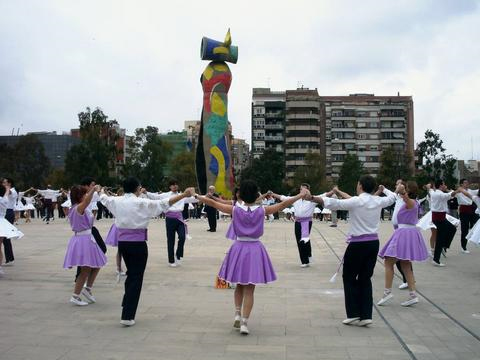
The sardana (Catalan pronunciation: [səɾˈðanə]; plural sardanes in Catalan) is a Catalan musical genre typical of Catalan culture and danced in circle following a set of steps. The dance was originally from the Empordà region, but started gaining popularity throughout Catalonia from the late 19th century to beginning of the 20th century after the modernisation done by Josep Maria Ventura i Casas.
Men and women join together in a circle by holding hands and facing inwards to dance either the historical sardana curta (with an approximate duration of 5 minutes) or the present-day sardana llarga (with a duration of approximately 12–13 minutes). Other more unusual sardanes are the sardana de lluïment and the sardana revessa.
The steps are meticulously counted as two- or three-step movements taken sideways within the circle. The direction of the steps is alternated. The hands stay on the hip or shoulder level depending on the step structure. The pattern of the choreography has jumping intervals changing with the music. Usually there is more than one circle with varying tempo and levels of dance knowledge.
The participants are called sardanistes. Professional dancers organise themselves in colles sardanistes, colla meaning group or club. All colles are united under the Confederació Sardanista de Catalunya.
Sardana is mainly danced during festivities and on weekends. Sardanes danced during a festival are termed aplecs. Brief public dances are known as ballades. The accompanying orchestra of 11 people, a cobla, includes 10 wind instruments and a bass. One person plays the flabiol (a flute) and the tambori (a small hand drum). Since the 1980s female musicians are also allowed in the cobles.
This dance stands out from others because it allows people to join a public dance circle at any time, for anyone of any age and background who is familiar with the sardana can drop their coat and bag in the centre of the circle and join in. It is emphasised by sardanistes as the specialty of the sardana.
The origin of the Sardana is unknown. The oldest found reference to the word Sardana is from 1552. From the 16th century to the 19th century a folk dance known as sardana propagated around the territory of the present province of Girona. The sardana was a popular dance in Empordà, Rosselló and Garrotxa at the middle of the 19th century. Sardana llarga fits the prototype of invented traditions common in the Industrial Revolution. It is believed that the invented traditions are a way to stabilize cultural anchors in a time of rapid socioeconomic or political change. The modern sardana was created in the context of the Renaixença period, in which some people wanted to relate the Sardana with dances of Ancient Greek origin, with the purpose of linking Classical antiquity with old Empúries while taking advantage of the rising popularity of the modern sardana in Empordà. This imagined account is the legendary origin of the dance. The invention served to symbolize the distinct Catalan ethos promoted by the then-newborn Catalan nationalism. In fact, today Catalans are known for their musicality throughout Spain and much of Western Europe; sardana has emerged as a major source of personal and social identity.
Ignoring the myth, the creation of sardana llarga or its evolution was driven by three people: Andreu Toron, Miquel Pardàs, and Josep Maria Ventura (Pep Ventura). Andreu Toron was responsible for introducing a type of oboe-tenor known in Catalonia as the tenora. This happened in 1849 at Perpignan. In parallel, influences to the music composition of sardana llarga include the popular Italian and German operas of the time as well as Contrapàs, a Catalan dance which in religious celebrations preceded sardana curta. These influences evolved into sardanes (plural of sardana) of different lengths. As a consequence, people started counting steps in order to finish at the same time. Shorter choreographies could be accommodated in longer melodies. The new melodies which progressively were made popular required new instruments, increasing the size of the cobla. Similar to what happened with the Catalan language when in 1891 Pompeu Fabra published his grammar, the different sardanes were standardised into what today is known as sardana llarga. Choreography was updated with slight differences from the original North-Catalan dance. Pep Ventura is credited for stabilizing the different variants around a clear 6
8 rhythm[citation needed] and making the instrumental ensemble of a fixed size. He included the today's standard long steps (els llargs) and the eleven player cobla band. Though some Iberian and Mediterranean circle dances follow similar patterns, instrumental music for the sardana has achieved a complexity of its own.[citation needed]
Hub AI
Sardana AI simulator
(@Sardana_simulator)
Sardana
The sardana (Catalan pronunciation: [səɾˈðanə]; plural sardanes in Catalan) is a Catalan musical genre typical of Catalan culture and danced in circle following a set of steps. The dance was originally from the Empordà region, but started gaining popularity throughout Catalonia from the late 19th century to beginning of the 20th century after the modernisation done by Josep Maria Ventura i Casas.
Men and women join together in a circle by holding hands and facing inwards to dance either the historical sardana curta (with an approximate duration of 5 minutes) or the present-day sardana llarga (with a duration of approximately 12–13 minutes). Other more unusual sardanes are the sardana de lluïment and the sardana revessa.
The steps are meticulously counted as two- or three-step movements taken sideways within the circle. The direction of the steps is alternated. The hands stay on the hip or shoulder level depending on the step structure. The pattern of the choreography has jumping intervals changing with the music. Usually there is more than one circle with varying tempo and levels of dance knowledge.
The participants are called sardanistes. Professional dancers organise themselves in colles sardanistes, colla meaning group or club. All colles are united under the Confederació Sardanista de Catalunya.
Sardana is mainly danced during festivities and on weekends. Sardanes danced during a festival are termed aplecs. Brief public dances are known as ballades. The accompanying orchestra of 11 people, a cobla, includes 10 wind instruments and a bass. One person plays the flabiol (a flute) and the tambori (a small hand drum). Since the 1980s female musicians are also allowed in the cobles.
This dance stands out from others because it allows people to join a public dance circle at any time, for anyone of any age and background who is familiar with the sardana can drop their coat and bag in the centre of the circle and join in. It is emphasised by sardanistes as the specialty of the sardana.
The origin of the Sardana is unknown. The oldest found reference to the word Sardana is from 1552. From the 16th century to the 19th century a folk dance known as sardana propagated around the territory of the present province of Girona. The sardana was a popular dance in Empordà, Rosselló and Garrotxa at the middle of the 19th century. Sardana llarga fits the prototype of invented traditions common in the Industrial Revolution. It is believed that the invented traditions are a way to stabilize cultural anchors in a time of rapid socioeconomic or political change. The modern sardana was created in the context of the Renaixença period, in which some people wanted to relate the Sardana with dances of Ancient Greek origin, with the purpose of linking Classical antiquity with old Empúries while taking advantage of the rising popularity of the modern sardana in Empordà. This imagined account is the legendary origin of the dance. The invention served to symbolize the distinct Catalan ethos promoted by the then-newborn Catalan nationalism. In fact, today Catalans are known for their musicality throughout Spain and much of Western Europe; sardana has emerged as a major source of personal and social identity.
Ignoring the myth, the creation of sardana llarga or its evolution was driven by three people: Andreu Toron, Miquel Pardàs, and Josep Maria Ventura (Pep Ventura). Andreu Toron was responsible for introducing a type of oboe-tenor known in Catalonia as the tenora. This happened in 1849 at Perpignan. In parallel, influences to the music composition of sardana llarga include the popular Italian and German operas of the time as well as Contrapàs, a Catalan dance which in religious celebrations preceded sardana curta. These influences evolved into sardanes (plural of sardana) of different lengths. As a consequence, people started counting steps in order to finish at the same time. Shorter choreographies could be accommodated in longer melodies. The new melodies which progressively were made popular required new instruments, increasing the size of the cobla. Similar to what happened with the Catalan language when in 1891 Pompeu Fabra published his grammar, the different sardanes were standardised into what today is known as sardana llarga. Choreography was updated with slight differences from the original North-Catalan dance. Pep Ventura is credited for stabilizing the different variants around a clear 6
8 rhythm[citation needed] and making the instrumental ensemble of a fixed size. He included the today's standard long steps (els llargs) and the eleven player cobla band. Though some Iberian and Mediterranean circle dances follow similar patterns, instrumental music for the sardana has achieved a complexity of its own.[citation needed]