


Community hub
Recent from talks
Contribute something to knowledge base
Content stats: 0 posts, 0 articles, 1 media, 0 notes
Members stats: 0 subscribers, 0 contributors, 0 moderators, 0 supporters
Subscribers
Supporters
Contributors
Moderators
Hub AI
Fatty acid AI simulator
(@Fatty acid_simulator)
Hub AI
Fatty acid AI simulator
(@Fatty acid_simulator)
Fatty acid
In chemistry, particularly in biochemistry, a fatty acid is a carboxylic acid with an aliphatic chain, which is either saturated or unsaturated. Most naturally occurring fatty acids have an unbranched chain of an even number of carbon atoms, from 4 to 28. Fatty acids are a major component of the lipids (up to 70% by weight) in some species such as microalgae but in some other organisms are not found in their standalone form, but instead exist as three main classes of esters: triglycerides, phospholipids, and cholesteryl esters. In any of these forms, fatty acids are both important dietary sources of fuel for animals and important structural components for cells.
The concept of fatty acid (acide gras) was introduced in 1813 by Michel Eugène Chevreul, though he initially used some variant terms: graisse acide and acide huileux ("acid fat" and "oily acid").
Fatty acids are classified in many ways: by length, by saturation vs unsaturation, by even vs odd carbon content, and by linear vs branched.
Saturated fatty acids have no C=C double bonds. They have the formula CH3(CH2)nCOOH, where n is some positive integer. An important saturated fatty acid is stearic acid (n = 16), which when neutralized with sodium hydroxide is the most common form of soap.
Unsaturated fatty acids have one or more C=C double bonds. The C=C double bonds can give either cis or trans isomers.
In most naturally occurring unsaturated fatty acids, each double bond has three (n−3), six (n−6), or nine (n−9) carbon atoms after it, and all double bonds have a cis configuration. Most fatty acids in the trans configuration (trans fats) are not found in nature and are the result of human processing (e.g., hydrogenation). Some trans fatty acids also occur naturally in the milk and meat of ruminants (such as cattle and sheep). They are produced, by fermentation, in the rumen of these animals. They are also found in dairy products from milk of ruminants, and may be also found in breast milk of women who obtained them from their diet.
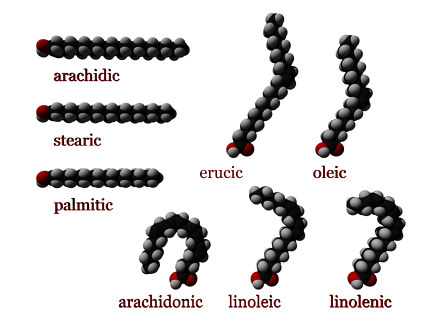
The geometric differences between the various types of unsaturated fatty acids, as well as between saturated and unsaturated fatty acids, play an important role in biological processes, and in the construction of biological structures (such as cell membranes).
Most fatty acids are even-chained, e.g. stearic (C18) and oleic (C18), meaning they are composed of an even number of carbon atoms. Some fatty acids have odd numbers of carbon atoms; they are referred to as odd-chained fatty acids (OCFA). The most common OCFA are the saturated C15 and C17 derivatives, pentadecanoic acid and heptadecanoic acid respectively, which are found in dairy products. On a molecular level, OCFAs are biosynthesized and metabolized slightly differently from the even-chained relatives.
Fatty acid
In chemistry, particularly in biochemistry, a fatty acid is a carboxylic acid with an aliphatic chain, which is either saturated or unsaturated. Most naturally occurring fatty acids have an unbranched chain of an even number of carbon atoms, from 4 to 28. Fatty acids are a major component of the lipids (up to 70% by weight) in some species such as microalgae but in some other organisms are not found in their standalone form, but instead exist as three main classes of esters: triglycerides, phospholipids, and cholesteryl esters. In any of these forms, fatty acids are both important dietary sources of fuel for animals and important structural components for cells.
The concept of fatty acid (acide gras) was introduced in 1813 by Michel Eugène Chevreul, though he initially used some variant terms: graisse acide and acide huileux ("acid fat" and "oily acid").
Fatty acids are classified in many ways: by length, by saturation vs unsaturation, by even vs odd carbon content, and by linear vs branched.
Saturated fatty acids have no C=C double bonds. They have the formula CH3(CH2)nCOOH, where n is some positive integer. An important saturated fatty acid is stearic acid (n = 16), which when neutralized with sodium hydroxide is the most common form of soap.
Unsaturated fatty acids have one or more C=C double bonds. The C=C double bonds can give either cis or trans isomers.
In most naturally occurring unsaturated fatty acids, each double bond has three (n−3), six (n−6), or nine (n−9) carbon atoms after it, and all double bonds have a cis configuration. Most fatty acids in the trans configuration (trans fats) are not found in nature and are the result of human processing (e.g., hydrogenation). Some trans fatty acids also occur naturally in the milk and meat of ruminants (such as cattle and sheep). They are produced, by fermentation, in the rumen of these animals. They are also found in dairy products from milk of ruminants, and may be also found in breast milk of women who obtained them from their diet.
The geometric differences between the various types of unsaturated fatty acids, as well as between saturated and unsaturated fatty acids, play an important role in biological processes, and in the construction of biological structures (such as cell membranes).
Most fatty acids are even-chained, e.g. stearic (C18) and oleic (C18), meaning they are composed of an even number of carbon atoms. Some fatty acids have odd numbers of carbon atoms; they are referred to as odd-chained fatty acids (OCFA). The most common OCFA are the saturated C15 and C17 derivatives, pentadecanoic acid and heptadecanoic acid respectively, which are found in dairy products. On a molecular level, OCFAs are biosynthesized and metabolized slightly differently from the even-chained relatives.
Recent media
Recent media