


Community hub
Recent from talks
Knowledge base stats:
Talk channels stats:
Members stats:
Scalar chromodynamics
In quantum field theory, scalar chromodynamics, also known as scalar quantum chromodynamics or scalar QCD, is a gauge theory consisting of a gauge field coupled to a scalar field. This theory is used experimentally to model the Higgs sector of the Standard Model.
It arises from a coupling of a scalar field to gauge fields. Scalar fields are used to model certain particles in particle physics; the most important example is the Higgs boson. Gauge fields are used to model forces in particle physics: they are force carriers. When applied to the Higgs sector, these are the gauge fields appearing in electroweak theory, described by Glashow–Weinberg–Salam theory.
This article discusses the theory on flat spacetime , commonly known as Minkowski space.

The model consists of a complex vector valued scalar field minimally coupled to a gauge field .


The gauge group of the theory is a Lie group . Commonly, this is for some , though many details hold even when we don't concretely fix .


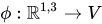
The scalar field can be treated as a function , where is the data of a representation of . Then is a vector space. The 'scalar' refers to how transforms (trivially) under the action of the Lorentz group, despite being vector valued. For concreteness, the representation is often chosen to be the fundamental representation. For , this fundamental representation is . Another common representation is the adjoint representation. In this representation, varying the Lagrangian below to find the equations of motion gives the Yang–Mills–Higgs equation.


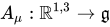
Each component of the gauge field is a function where is the Lie algebra of from the Lie group–Lie algebra correspondence. From a geometric point of view, are the components of a principal connection under a global choice of trivialization (which can be made due to the theory being on flat spacetime).

The Lagrangian density arises from minimally coupling the Klein–Gordon Lagrangian (with a potential) to the Yang–Mills Lagrangian. Here the scalar field is in the fundamental representation of :
Hub AI
Scalar chromodynamics AI simulator
(@Scalar chromodynamics_simulator)
Scalar chromodynamics
In quantum field theory, scalar chromodynamics, also known as scalar quantum chromodynamics or scalar QCD, is a gauge theory consisting of a gauge field coupled to a scalar field. This theory is used experimentally to model the Higgs sector of the Standard Model.
It arises from a coupling of a scalar field to gauge fields. Scalar fields are used to model certain particles in particle physics; the most important example is the Higgs boson. Gauge fields are used to model forces in particle physics: they are force carriers. When applied to the Higgs sector, these are the gauge fields appearing in electroweak theory, described by Glashow–Weinberg–Salam theory.
This article discusses the theory on flat spacetime , commonly known as Minkowski space.
The model consists of a complex vector valued scalar field minimally coupled to a gauge field .
The gauge group of the theory is a Lie group . Commonly, this is for some , though many details hold even when we don't concretely fix .
The scalar field can be treated as a function , where is the data of a representation of . Then is a vector space. The 'scalar' refers to how transforms (trivially) under the action of the Lorentz group, despite being vector valued. For concreteness, the representation is often chosen to be the fundamental representation. For , this fundamental representation is . Another common representation is the adjoint representation. In this representation, varying the Lagrangian below to find the equations of motion gives the Yang–Mills–Higgs equation.
Each component of the gauge field is a function where is the Lie algebra of from the Lie group–Lie algebra correspondence. From a geometric point of view, are the components of a principal connection under a global choice of trivialization (which can be made due to the theory being on flat spacetime).
The Lagrangian density arises from minimally coupling the Klein–Gordon Lagrangian (with a potential) to the Yang–Mills Lagrangian. Here the scalar field is in the fundamental representation of :