



Community hub
Recent from talks
Knowledge base stats:
Talk channels stats:
Members stats:
Scalene muscles
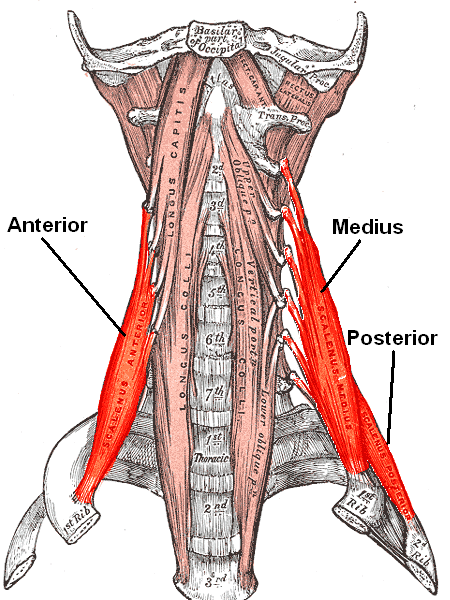
The scalene muscles are a group of three muscles on each side of the neck, identified as the anterior, the middle, and the posterior. They are innervated by the third to the eighth cervical spinal nerves (C3-C8).
The anterior and middle scalene muscles lift the first rib and bend the neck to the side they are on. The posterior scalene lifts the second rib and tilts the neck to the same side.
The muscles are named from the Ancient Greek σκαληνός (skalēnós), meaning 'uneven'.
The scalene muscles are attached at one end to bony protrusions on vertebrae C2 to C7 and at the other end to the first and second ribs.
The anterior scalene muscle (Latin: scalenus anterior), lies deeply at the side of the neck, behind the sternocleidomastoid muscle. It arises from the anterior tubercles of the transverse processes of the third, fourth, fifth, and sixth cervical vertebrae, and descending, almost vertically, is inserted by a narrow, flat tendon into the scalene tubercle on the inner border of the first rib, and into the ridge on the upper surface of the first rib in front of the subclavian groove. It is supplied by the anterior ramus of cervical nerve 5 and 6.
The middle scalene, (Latin: scalenus medius), is the largest and longest of the three scalene muscles. The middle scalene arises from the posterior tubercles of the transverse processes of the lower six cervical vertebrae. It descends along the side of the vertebral column to insert by a broad attachment into the upper surface of the first rib, posterior to the subclavian groove. The brachial plexus and the subclavian artery pass anterior to it.
The posterior scalene, (Latin: scalenus posterior) is the smallest and most deeply seated of the scalene muscles. It arises, by two or three separate tendons, from the posterior tubercles of the transverse processes of the fourth, fifth and sixth cervical vertebrae, and is inserted by a thin tendon into the outer surface of the second rib, behind the attachment of the anterior scalene. It is supplied by cervical nerves C5, C6 and C7. It is occasionally blended with the middle scalene.
A fourth muscle, the scalenus minimus (Sibson's muscle), is sometimes present behind the lower portion of the anterior scalene.
Hub AI
Scalene muscles AI simulator
(@Scalene muscles_simulator)
Scalene muscles
The scalene muscles are a group of three muscles on each side of the neck, identified as the anterior, the middle, and the posterior. They are innervated by the third to the eighth cervical spinal nerves (C3-C8).
The anterior and middle scalene muscles lift the first rib and bend the neck to the side they are on. The posterior scalene lifts the second rib and tilts the neck to the same side.
The muscles are named from the Ancient Greek σκαληνός (skalēnós), meaning 'uneven'.
The scalene muscles are attached at one end to bony protrusions on vertebrae C2 to C7 and at the other end to the first and second ribs.
The anterior scalene muscle (Latin: scalenus anterior), lies deeply at the side of the neck, behind the sternocleidomastoid muscle. It arises from the anterior tubercles of the transverse processes of the third, fourth, fifth, and sixth cervical vertebrae, and descending, almost vertically, is inserted by a narrow, flat tendon into the scalene tubercle on the inner border of the first rib, and into the ridge on the upper surface of the first rib in front of the subclavian groove. It is supplied by the anterior ramus of cervical nerve 5 and 6.
The middle scalene, (Latin: scalenus medius), is the largest and longest of the three scalene muscles. The middle scalene arises from the posterior tubercles of the transverse processes of the lower six cervical vertebrae. It descends along the side of the vertebral column to insert by a broad attachment into the upper surface of the first rib, posterior to the subclavian groove. The brachial plexus and the subclavian artery pass anterior to it.
The posterior scalene, (Latin: scalenus posterior) is the smallest and most deeply seated of the scalene muscles. It arises, by two or three separate tendons, from the posterior tubercles of the transverse processes of the fourth, fifth and sixth cervical vertebrae, and is inserted by a thin tendon into the outer surface of the second rib, behind the attachment of the anterior scalene. It is supplied by cervical nerves C5, C6 and C7. It is occasionally blended with the middle scalene.
A fourth muscle, the scalenus minimus (Sibson's muscle), is sometimes present behind the lower portion of the anterior scalene.