Hubbry Logo
Spinal nerveSpinal nerveMain
Open search
Spinal nerve
Community hub
Spinal nerve
logo
8 pages, 0 posts
0 subscribers
Be the first to start a discussion here.
Spinal nerve
Spinal nerve
from Wikipedia
Spinal nerve
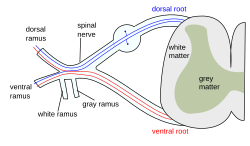
The formation of the spinal nerve from the posterior and anterior roots
Details
Identifiers
Latinnervus spinalis
MeSHD013127
TA98A14.2.00.027
TA26143
FMA5858
Anatomical terms of neuroanatomy

A spinal nerve is a mixed nerve, which carries motor, sensory, and autonomic signals between the spinal cord and the body. In the human body there are 31 pairs of spinal nerves, one on each side of the vertebral column.[1][2] These are grouped into the corresponding cervical, thoracic, lumbar, sacral and coccygeal regions of the spine.[1] There are eight pairs of cervical nerves, twelve pairs of thoracic nerves, five pairs of lumbar nerves, five pairs of sacral nerves, and one pair of coccygeal nerves. The spinal nerves are part of the peripheral nervous system.[1]

Structure

[edit]
Spinal nerve
Typical spinal nerve location

Each spinal nerve is a mixed nerve, formed from the combination of nerve root fibers from its dorsal and ventral roots. The dorsal root is the afferent sensory root and carries sensory information to the brain. The ventral root is the efferent motor root and carries motor information from the brain. The spinal nerve emerges from the spinal column through an opening (intervertebral foramen) between adjacent vertebrae. This is true for all spinal nerves except for the first spinal nerve pair (C1), which emerges between the occipital bone and the atlas (the first vertebra).[3] Thus the cervical nerves are numbered by the vertebra below, except spinal nerve C8, which exists below vertebra C7 and above vertebra T1. The thoracic, lumbar, and sacral nerves are then numbered by the vertebra above. In the case of a lumbarized S1 vertebra (also known as L6) or a sacralized L5 vertebra, the nerves are typically still counted to L5 and the next nerve is S1.

Scheme showing structure of a typical spinal nerve
1. Somatic efferent.
2. Somatic afferent.
3,4,5. Sympathetic efferent.
6,7. Autonomic afferent.

Outside the vertebral column, the nerve divides into branches. The dorsal ramus contains nerves that serve the posterior portions of the trunk carrying visceral motor, somatic motor, and somatic sensory information to and from the skin and muscles of the back (epaxial muscles). The ventral ramus contains nerves that serve the remaining anterior parts of the trunk and the upper and lower limbs (hypaxial muscles) carrying visceral motor, somatic motor, and sensory information to and from the ventrolateral body surface, structures in the body wall, and the limbs. The meningeal branches (recurrent meningeal or sinuvertebral nerves) branch from the spinal nerve and re-enter the intervertebral foramen to serve the ligaments, dura, blood vessels, intervertebral discs, facet joints, and periosteum of the vertebrae. The rami communicantes contain autonomic nerves that serve visceral functions carrying visceral motor and sensory information to and from the visceral organs.

Some anterior rami merge with adjacent anterior rami to form a nerve plexus, a network of interconnecting nerves. Nerves emerging from a plexus contain fibers from various spinal nerves, which are now carried together to some target location. The spinal plexuses are the cervical plexus, brachial plexus, lumbar plexus, the sacral plexus and the much smaller coccygeal plexus.[3]

Regional nerves

[edit]

Cervical nerves

[edit]
Cervical nerves

The cervical nerves are the spinal nerves from the cervical vertebrae in the cervical segment of the spinal cord. Although there are seven cervical vertebrae (C1–C7), there are eight cervical nerves C1C8. C1–C7 emerge above their corresponding vertebrae, while C8 emerges below the C7 vertebra. Everywhere else in the spine, the nerve emerges below the vertebra with the same name.

The posterior distribution includes the suboccipital nerve (C1), the greater occipital nerve (C2) and the third occipital nerve (C3). The anterior distribution includes the cervical plexus (C1–C4) and brachial plexus (C5–T1).

The cervical nerves innervate the sternohyoid, sternothyroid and omohyoid muscles.

A loop of nerves called ansa cervicalis is part of the cervical plexus.

Thoracic nerves

[edit]

The thoracic nerves are the twelve spinal nerves emerging from the thoracic vertebrae. Each thoracic nerve T1–T12 originates from below each corresponding thoracic vertebra. Branches also exit the spine and go directly to the paravertebral ganglia of the autonomic nervous system where they are involved in the functions of organs and glands in the head, neck, thorax and abdomen.

Anterior divisions

[edit]

The intercostal nerves come from thoracic nerves T1–T11, and run between the ribs. At T2 and T3, further branches form the intercostobrachial nerve. The subcostal nerve comes from nerve T12, and runs below the twelfth rib.

Posterior divisions

[edit]

The medial branches (ramus medialis) of the posterior branches of the upper six thoracic nerves run between the semispinalis dorsi and multifidus, which they supply; they then pierce the rhomboid and trapezius muscles, and reach the skin by the sides of the spinous processes. This sensitive branch is called the medial cutaneous ramus.

The medial branches of the lower six are distributed chiefly to the multifidus and longissimus dorsi, occasionally they give off filaments to the skin near the middle line. This sensitive branch is called the posterior cutaneous ramus.

Lumbar nerves

[edit]
Lumbar plexus and branches

The lumbar nerves are the five spinal nerves emerging from the lumbar vertebrae. They are divided into posterior and anterior divisions.

Posterior divisions

[edit]

The medial branches of the posterior divisions of the lumbar nerves run close to the articular processes of the vertebrae and end in the multifidus muscle.

The laterals supply the erector spinae muscles.

The upper three give off cutaneous nerves which pierce the aponeurosis of the latissimus dorsi at the lateral border of the erector spinae muscles, and descend across the posterior part of the iliac crest to the skin of the buttock, some of their twigs running as far as the level of the greater trochanter.

Anterior divisions

[edit]

The anterior divisions of the lumbar nerves (rami anteriores) increase in size from above downward. They are joined, near their origins, by gray rami communicantes from the lumbar ganglia of the sympathetic trunk. These rami consist of long, slender branches which accompany the lumbar arteries around the sides of the vertebral bodies, beneath the psoas major. Their arrangement is somewhat irregular: one ganglion may give rami to two lumbar nerves, or one lumbar nerve may receive rami from two ganglia.

The first and second, and sometimes the third and fourth lumbar nerves are each connected with the lumbar part of the sympathetic trunk by a white ramus communicans.

The nerves pass obliquely outward behind the psoas major, or between its fasciculi, distributing filaments to it and the quadratus lumborum.

The first three and the greater part of the fourth are connected together in this situation by anastomotic loops, and form the lumbar plexus.

The smaller part of the fourth joins with the fifth to form the lumbosacral trunk, which assists in the formation of the sacral plexus. The fourth nerve is named the furcal nerve, from the fact that it is subdivided between the two plexuses.

Sacral nerves

[edit]
Plan of sacral and pudendal plexuses

The sacral nerves are the five pairs of spinal nerves which exit the sacrum at the lower end of the vertebral column. The roots of these nerves begin inside the vertebral column at the level of the L1 vertebra, where the cauda equina begins, and then descend into the sacrum.[4][5]

There are five paired sacral nerves, half of them arising through the sacrum on the left side and the other half on the right side. Each nerve emerges in two divisions: one division through the anterior sacral foramina and the other division through the posterior sacral foramina.[4]

The nerves divide into branches and the branches from different nerves join with one another, some of them also joining with lumbar or coccygeal nerve branches. These anastomoses of nerves form the sacral plexus and the lumbosacral plexus. The branches of these plexus give rise to nerves that supply much of the hip, thigh, leg and foot.[4][6]

The sacral nerves have both afferent and efferent fibers, thus they are responsible for part of the sensory perception and the movements of the lower extremities of the human body. From the S2, S3 and S4 arise the pudendal nerve and parasympathetic fibers whose electrical potential supply the descending colon and rectum, urinary bladder and genital organs. These pathways have both afferent and efferent fibers and, this way, they are responsible for conduction of sensory information from these pelvic organs to the central nervous system (CNS) and motor impulses from the CNS to the pelvis that control the movements of these pelvic organs.[6]

Coccygeal nerves

[edit]

The bilateral coccygeal nerves, Co, are the 31st pair of spinal nerves. It arises from the conus medullaris, and its ventral ramus helps form the coccygeal plexus. It does not divide into a medial and lateral branch. Its fibers are distributed to the skin superficial and posterior to the coccyx bone via the anococcygeal nerve of the coccygeal nerve plexus.

Function

[edit]
Areas of distribution of the cutaneous branches of the posterior divisions of the spinal nerves. The areas of the medial branches are in black, those of the lateral in red
Actions of the spinal nerves
Level Motor function
C1C6 Neck flexors
C1T1 Neck extensors
C3, C4, C5 Supply diaphragm (mostly C4)
C5, C6 Move shoulder, raise arm (deltoid); flex elbow (biceps)
C6 externally rotate (supinate) the arm
C6, C7 Extend elbow and wrist (triceps and wrist extensors); pronate wrist
C7, C8 Flex wrist; supply small muscles of the hand
T1T6 Intercostals and trunk above the waist
T7L1 Abdominal muscles
L1L4 Flex hip joint
L2, L3, L4 Adduct thigh; Extend leg at the knee (quadriceps femoris)
L4, L5, S1 abduct thigh; Flex leg at the knee (hamstrings); Dorsiflex foot (tibialis anterior); Extend toes
L5, S1, S2 Extend leg at the hip (gluteus maximus); flex foot and flex toes

Spinal plexuses

[edit]

A spinal plexus is a weblike nerve plexus formed by the anterior nerve roots that branch and merge repeatedly. The only region that does not have a plexus is the thoracic region. The small cervical plexus is in the neck, the brachial plexus is in the shoulder, the lumbar plexus is in the lower back, beneath this is the sacral plexus, and next to the lower sacrum and coccyx is the very small coccygeal plexus.[3]

Clinical significance

[edit]

The muscles that one particular spinal root supplies are that nerve's myotome, and the dermatomes are the areas of sensory innervation on the skin for each spinal nerve. Lesions of one or more nerve roots result in typical patterns of neurologic defects (muscle weakness, abnormal sensation, changes in reflexes) that allow localization of the responsible lesion.

There are several procedures used in sacral nerve stimulation for the treatment of various related disorders.

Sciatica is generally caused by the compression of lumbar nerves L4, or L5 or sacral nerves S1, S2, or S3, or by compression of the sciatic nerve itself.

[edit]

See also

[edit]

References

[edit]
Revisions and contributorsEdit on WikipediaRead on Wikipedia
from Grokipedia
Spinal nerves are mixed nerves that originate from the and form part of the peripheral , transmitting sensory, motor, and autonomic signals between the and the body's periphery. There are 31 pairs of spinal nerves in total, distributed across five regions: 8 cervical (C1–C8), 12 thoracic (T1–T12), 5 (L1–L5), 5 sacral (S1–S5), and 1 coccygeal (Co1). Each spinal nerve emerges laterally from the through the intervertebral foramina, where it is formed by the union of a dorsal root (carrying sensory afferents) and a ventral root (carrying motor efferents), which join via fila radicularia. Immediately after exiting the spinal column, each spinal nerve divides into a , which innervates the posterior and muscles of the trunk and limbs, and a , which supplies the anterior and lateral regions, including the limbs. The dorsal root contains sensory fibers from the periphery, including somatic and visceral sensations organized into dermatomes, while the ventral root conveys motor fibers to skeletal muscles, forming myotomes. Additionally, spinal nerves include autonomic fibers: sympathetic preganglionic neurons originate from the thoracic and upper segments (T1–L2), whereas parasympathetic fibers arise from the sacral segments (S2–S4). These nerves are essential for integrating sensory input with motor output, enabling reflexes, voluntary movements, and regulation of involuntary functions such as and . to spinal nerves, often due to compression or inflammation, can lead to , characterized by , , or in specific dermatomes or myotomes, aiding in clinical .

Structure

Roots and formation

The spinal cord gives rise to 31 pairs of spinal nerves, which emerge bilaterally from its segments through distinct root structures. Each spinal nerve originates from the convergence of a dorsal (posterior) root and a ventral (anterior) root, with the dorsal root consisting of sensory fibers and the ventral root comprising motor fibers. These roots are formed by bundles of rootlets, typically numbering around 8 per root, that attach to the via the posterolateral and anterolateral sulci, respectively. The dorsal roots feature prominent swellings known as dorsal root ganglia, located just proximal to the union site; these ganglia contain the cell bodies of pseudounipolar sensory neurons whose peripheral processes extend to peripheral tissues and central processes enter the . In contrast, the ventral roots lack such ganglia, as their neuron cell bodies reside within the 's ventral horn. The rootlets of the dorsal root emerge from the cord and travel to the before continuing as the root proper, while ventral rootlets directly form the root without interruption. The dorsal and ventral roots converge to form the mixed spinal nerve within the , through which the nerve exits the vertebral canal. This union occurs distal to the and proximal to the nerve's subsequent divisions. Root lengths vary along the spinal axis: shorter in the cervical and thoracic regions, where they exit near their segmental origin, and progressively longer in the and sacral regions due to the terminating at the L1-L2 level, resulting in an elongated bundle known as the . Once formed, the spinal nerve briefly remains undivided before branching into dorsal and ventral rami to innervate surrounding structures.

Rami and branches

After exiting the intervertebral foramen, each spinal nerve divides into a dorsal (posterior) ramus and a ventral (anterior) ramus, both containing mixed sensory and motor fibers. The dorsal ramus is typically smaller and supplies the paraspinous muscles and overlying skin at the corresponding vertebral level. In contrast, the ventral ramus is larger and provides the primary innervation to the anterior and lateral trunk as well as the limbs. Spinal nerves also give rise to meningeal branches, including the recurrent meningeal nerve, which re-enters the vertebral to supply the , vertebrae, and intervertebral discs. The sinuvertebral nerve, a specific recurrent meningeal branch, originates from the just distal to the and combines with a sympathetic contribution from the before re-entering the through the . Additionally, spinal nerves connect to the via gray and white rami communicantes. The white rami communicantes, present from spinal levels T1 to L2, carry preganglionic sympathetic fibers from the spinal nerve to the paravertebral ganglia. The gray rami communicantes, found at all spinal levels, convey postganglionic sympathetic fibers from the sympathetic chain back to the spinal nerves for distribution to peripheral structures. The dorsal rami often divide into medial, lateral, and sometimes intermediate branches to reach the and associated dermatomes. Ventral rami, depending on the spinal level, either continue as for the or interconnect to form plexuses such as the cervical, brachial, or lumbosacral plexuses for limb innervation.

Development

Embryological origins

The embryological development of spinal nerves begins during the third week of with the formation of the from ectodermal cells induced by the underlying . By the end of the fourth week, the neural folds elevate and fuse to form the , which closes caudally by day 28 at approximately the 25-somite stage (site corresponding to the level of future 31), establishing the foundational structure for the . At this stage, cells delaminate from the dorsal and migrate ventrolaterally through the anterior half of the somites' sclerotome, aligning with the segmental metameres to ensure the future spinal nerves correspond to somite levels. Sensory components of the spinal nerves originate from cells during week 4, which migrate to form the dorsal root ganglia adjacent to the developing . These cells differentiate into pseudounipolar sensory neurons that extend central processes into the dorsal horn of the and peripheral processes to target tissues. In contrast, motor components arise from ventral horn motor neurons within the basal plate of the , which extend axons to form the ventral roots beginning in week 4. The dorsal and ventral roots initially develop separately but converge by embryonic stage 13 (approximately week 5, with around 30 somites), uniting to create the spinal nerve proper, with segmentation ensuring one pair per metamere. By week 8, the spinal nerves have segmented into 31 pairs, corresponding to the cervical (8), thoracic (12), (5), sacral (5), and coccygeal (1) levels, as the embryonic extends the full length of the vertebral canal and nerves exit through intervertebral foramina. This segmentation is tightly coupled with formation, which peaks at about 38-42 pairs but stabilizes to support the 31 spinal nerve pairs through sclerotome contributions to vertebrae. play a critical role in this process, providing rostrocaudal patterning through their clustered, collinear expression along the and crest derivatives; for instance, 3' (e.g., HoxA1) specify rostral identities, while 5' genes (e.g., ) define caudal ones, ensuring segment-specific nerve identities in neurons and motor pools.

Congenital variations

Congenital variations in spinal nerves arise from disruptions during embryonic development, leading to structural anomalies that can affect nerve root formation, attachment, and function. These variations often manifest as part of broader spinal dysraphisms and may result in neurological deficits, such as , motor weakness, or autonomic dysfunction, depending on the affected level. Spina bifida, a neural tube defect, is a prominent congenital anomaly associated with spinal nerve variations, including nerve root tethering and agenesis. In this condition, incomplete closure of the neural tube leads to exposure or malformation of the spinal cord and meninges, often causing the conus medullaris to remain low and tethered by fibrous bands or lipomatous tissue, which restricts nerve root mobility and can result in progressive stretching and ischemia of lumbosacral roots. Severe forms, such as myelomeningocele, may involve agenesis of multiple nerve roots due to direct neural tissue exposure and scarring. The incidence of spina bifida is approximately 3.5 per 10,000 live births (1 in 2,875) in the United States, as of 2024, with maternal folate deficiency as a key environmental risk factor that impairs DNA synthesis and neural tube closure; periconceptional folic acid supplementation reduces this risk by up to 70%. Caudal regression syndrome represents another critical variation impacting lumbosacral spinal nerves, characterized by partial or complete agenesis of the and lower , which disrupts the formation and caudal migration of neural elements. This results in a truncated (high conus) and hypoplastic or absent lumbosacral nerve roots, leading to neurogenic , lower limb , and sensory impairments. The syndrome is rare, with an incidence of about 1-2 per 100,000 births, and is linked to genetic factors such as maternal , alongside potential environmental influences. Anomalous nerve root formations, such as conjoined roots and duplicated ganglia, constitute subtler congenital variations that may remain or complicate surgical interventions. Conjoined nerve roots, the most common developmental anomaly of the , occur when adjacent roots (typically L4-S1) share a single dural sheath, affecting 6-14% of individuals and potentially mimicking disc herniation on due to altered root trajectories. Duplicated spinal ganglia, rarer and often associated with split cord malformations like , involve paramedian replication of dorsal root ganglia, as observed histologically in cases of duplication, leading to aberrant sensory innervation. These anomalies arise from incomplete separation of derivatives during weeks 4-6 of gestation. Prenatal diagnosis of these spinal nerve variations relies heavily on (MRI), which provides superior soft-tissue resolution compared to for detecting tethered cords, root , or duplicated structures. Fetal MRI, typically performed after 18 weeks gestation, can identify associated anomalies like Chiari II malformation in or sacral in caudal regression, enabling informed counseling and planning for postnatal interventions such as detethering surgery.

Regional characteristics

Cervical nerves

The cervical spinal nerves consist of eight pairs, designated C1 through C8, which emerge from the in the cervical region. Unlike the other spinal nerves, the first seven cervical nerves (C1–C7) exit the vertebral column superior to their correspondingly named e, while the C8 nerve exits inferior to the C7 and superior to the T1 vertebra. This configuration arises from an embryological caudal shift of the vertebral column relative to the spinal nerves during development, resulting in eight nerves despite only seven . The C1 spinal nerve, also known as the suboccipital nerve, is unique among the cervical nerves as it often lacks a distinct dorsal root ganglion; in approximately 50% of cases, its dorsal rootlets fuse with the spinal accessory nerve (cranial nerve XI), eliminating a separate ganglion. This nerve primarily provides motor innervation to the suboccipital muscles without significant sensory components. The courses of the cervical nerves vary by level. The C1–C4 nerves have relatively short trajectories within the neck, with their ventral rami contributing to the cervical plexus and piercing the investing layer of deep cervical fascia to supply local structures. In contrast, the C5–C8 nerves have longer paths, passing between the anterior and middle scalene muscles before their ventral rami interconnect to form the brachial plexus, which extends into the upper limb. Notable contributions from these nerves include the , formed by branches from the anterior rami of C3–C5, which provides essential motor and sensory innervation to the diaphragm. Additionally, the arises from the medial branch of the C2 dorsal ramus, supplying sensory innervation to the posterior and occipital . Cervical dermatomes and myotomes reflect segmental innervation patterns, with C2–C3 primarily serving the posterior head, , and regions for both sensory and motor functions. The C5–T1 nerves, in turn, supply the dermatomes and myotomes of the , encompassing the , , , and hand.

Thoracic nerves

The thoracic spinal nerves consist of 12 pairs, designated T1 through T12, emerging from the corresponding segments of the thoracic . Each nerve forms by the union of dorsal and ventral roots, with the dorsal root carrying sensory fibers and the ventral root carrying motor fibers, before exiting via the intervertebral foramina. Unlike cervical nerves, which contribute significantly to limb plexuses, thoracic nerves primarily provide segmental innervation to the trunk, with no major plexuses formed from their ventral rami except for a partial contribution from T1. The ventral rami of T2 through T11 give rise to the intercostal nerves, which course anteriorly within the intercostal spaces, traveling in the costal grooves along the inferior borders of the to protect the . These nerves supply the and associated structures of the chest wall. The ventral ramus of T1 largely joins the to innervate the and pectoral region, while its smaller intercostal branch participates in chest wall innervation. The ventral ramus of T12 forms the , which passes below the twelfth rib to enter the , avoiding the intercostal spaces. T7 through T11 are classified as , extending beyond the thoracic cage to reach the . The dorsal rami of all thoracic are smaller than the ventral rami and divide into medial and lateral branches shortly after formation, primarily innervating the paraspinal muscles such as the erector spinae and overlying skin in corresponding dermatomes. Above T6, the medial branches provide to the back, whereas below T6, the lateral branches assume this role. From the , lateral cutaneous branches emerge at the midaxillary line, dividing into anterior and posterior components to supply sensory innervation to the lateral skin of the chest and . Additionally, typical from T2 through T6 emit collateral branches that descend within the to innervate the inferior portions of the , parietal pleura, and of the . Thoracic nerves collectively innervate the skin and muscles of the chest wall via intercostal branches, with lower thoracic nerves (T7-T12) extending to the anterior abdominal wall, supplying muscles such as the external oblique, internal oblique, transversus abdominis, and rectus abdominis, as well as the overlying skin and parietal peritoneum. This segmental arrangement supports respiratory movements through intercostal muscle contraction and provides somatic sensation to the trunk.

Lumbar nerves

The lumbar spinal nerves comprise five pairs, labeled L1 through L5, each emerging from the spinal column via the intervertebral foramina directly inferior to its corresponding vertebra. Below the level of the L1 vertebra, these nerves travel as part of the cauda equina within the lumbar cistern before exiting. This arrangement positions the L1 to L5 nerves to primarily innervate structures of the lower trunk, pelvis, and lower limbs. Upon exiting the intervertebral foramina, each lumbar spinal nerve divides into a smaller dorsal (posterior) ramus and a larger ventral (anterior) ramus. The dorsal rami course posteriorly to supply the deep muscles of the back, such as the erector spinae, and the overlying skin along the paravertebral region. In contrast, the ventral rami of L1 through L4 travel obliquely through or anterior to the psoas major muscle, where they anastomose to form the lumbar plexus, a network that extends innervation to the anterior abdominal wall, iliac region, and proximal lower limb. Several key branches arise directly from the upper lumbar nerves before plexus formation. The iliohypogastric and ilioinguinal nerves, both originating primarily from L1 (with minor contributions from T12), pierce the internal oblique and transversus abdominis muscles to innervate the lower abdominal wall and provide sensory supply to the skin over the suprapubic region, upper medial thigh, and external genitalia. The genitofemoral nerve emerges from the ventral rami of L1 and L2, bifurcating into a genital branch that innervates the cremaster muscle in males and supplies sensation to the scrotum or labia majora, and a femoral branch that provides cutaneous innervation to the upper anterior thigh. Additionally, the ventral rami of L1 through L4 contribute to the innervation of the lower abdominal wall via direct muscular branches, while L2 through L4 specifically form the femoral nerve, which supplies motor innervation to the anterior thigh muscles (e.g., quadriceps femoris for knee extension) and sensory fibers to the skin of the anterior thigh and medial leg. The sensory distribution of the lumbar nerves follows distinct dermatomal patterns on the lower body. The L1 dermatome covers the groin, upper lateral thigh, and adjacent lower abdominal skin; the L4 dermatome includes the medial knee, anterior lower leg, and medial ankle; and the L5 dermatome encompasses the lateral leg, anterolateral calf, and dorsum of the foot up to the big toe.

Sacral and coccygeal nerves

The sacral spinal nerves comprise five pairs, labeled S1 through S5, originating from the sacral segments of the spinal cord, while the coccygeal nerves consist of a single pair, designated Co1, arising from the coccygeal segment. These nerves emerge as mixed sensory and motor pathways, with S1 through S4 exiting the sacral canal via the anterior and posterior sacral foramina, and S5 along with Co1 passing through the sacral hiatus. Upon formation, each nerve divides into a dorsal ramus and a ventral ramus; the dorsal rami of the sacral nerves innervate the paraspinal muscles and overlying skin in the gluteal area, whereas the ventral rami of S1-S4 converge on the posterior pelvic wall to form the sacral plexus, anterior to the piriformis muscle. The ventral ramus of Co1, in conjunction with those of S4 and S5, contributes to the small coccygeal plexus. Key branches from the sacral nerves include contributions from S2-S4 to the , which traverses the greater sciatic foramen, loops around the sacrospinous ligament, and re-enters the via the lesser sciatic foramen to supply the perineal structures. This nerve provides motor innervation to the external anal and , as well as sensory fibers to the perineal skin, including the genitalia and surrounding areas. The ventral rami of S1-S3, along with L4 and L5, form the , the largest branch of the , which exits the through the greater sciatic foramen and descends to innervate the posterior thigh muscles, such as the biceps femoris, semitendinosus, and semimembranosus. Additionally, arising from S2-S4 carry parasympathetic fibers to the and , regulating visceral functions like micturition and . The anococcygeal nerve, derived from the coccygeal plexus involving Co1, consists of fine filaments that pierce the to deliver sensory innervation exclusively to the skin overlying and around the . In terms of dermatomes, S2-S4 supply sensory coverage to the perianal region, encompassing the skin of the ' medial aspects, the gluteal cleft, genitals, and between the and genitalia, while the Co1 dermatome is limited to the thin adjacent to the . These distributions ensure comprehensive sensory mapping of the pelvic and lower posterior body regions.

Functions

Sensory roles

Spinal nerves convey sensory information from the periphery to the primarily through afferent fibers originating in the dorsal roots. These fibers transmit somatosensory signals, including touch, , and , as well as proprioceptive information about body position and movement. The cell bodies of these sensory neurons are located in the dorsal root ganglia, where they form pseudounipolar structures with a single that bifurcates into peripheral and central processes. The skin and underlying tissues are organized into dermatomes, which are segmental areas innervated by specific spinal nerves, allowing for precise localization of sensory input. For instance, the C6 dermatome covers the thumb and radial , while the L5 dermatome includes the big and dorsum of the foot. These mappings reflect the embryonic segmentation of the body and provide a clinical framework for assessing sensory integrity, though individual variations exist. Upon entering the via the dorsal roots, the central processes of these pseudounipolar neurons in the dorsal horn. Fine touch and ascend ipsilaterally through the dorsal column-medial lemniscus pathway, while and signals cross to the contralateral anterolateral system via the . This organization enables discriminatory and affective processing of sensory modalities in higher centers. Visceral afferents, conveying sensations from internal organs such as distension or chemical irritation, also travel through the dorsal s but often join spinal nerves via the white rami communicantes in the thoracolumbar region. These unmyelinated fibers originate from pseudounipolar neurons in the dorsal root ganglia and project to the dorsal horn, integrating with somatic pathways for autonomic sensory processing. Visceral afferents from pelvic organs (e.g., , , genitals) similarly enter via the dorsal roots of sacral spinal nerves (S2–S4), without involvement of rami communicantes. At the spinal level, pain transmission is modulated by the , which posits a gating mechanism in the dorsal horn where non-noxious inputs from large-diameter afferents can inhibit nociceptive signals from small-diameter fibers. This substantia gelatinosa-mediated process, influenced by descending pathways, explains phenomena like pain relief from rubbing an injured area. The theory, proposed by Melzack and Wall, revolutionized understanding of pain modulation by emphasizing central integration over peripheral specificity.

Motor roles

Spinal nerves carry efferent motor fibers originating from the ventral roots of the , which emerge from the anterior horn and convey signals to skeletal muscles for voluntary and reflexive movements. These fibers primarily consist of lower motor neurons, whose cell bodies reside in the ventral horn, enabling direct control over and posture. The efferent fibers include two main types of motor neurons: alpha motor neurons, which innervate extrafusal muscle fibers to produce force and movement, and gamma motor neurons, which regulate the sensitivity of s by innervating intrafusal fibers. Alpha motor neurons form large axons that exit via the ventral roots and travel through spinal nerves to reach skeletal muscles, while gamma motor neurons maintain muscle spindle tone during contraction. Myotomes represent the segmental organization of motor innervation, where each spinal nerve level supplies a specific group of muscles derived from the same embryological . For instance, the C5 spinal nerve primarily innervates the for shoulder abduction, while the S1 nerve supplies the gastrocnemius for plantar flexion of the foot. This mapping allows for precise assessment of spinal nerve integrity through targeted muscle testing. Lower motor neurons exit the through the ventral roots, which unite with dorsal roots to form spinal nerves; the motor fibers then predominantly course through the ventral rami to peripheral nerves, ultimately synapsing at neuromuscular junctions on fibers. At these junctions, release triggers , ensuring efficient transmission of motor commands. Spinal nerves facilitate reflex arcs, such as the monosynaptic , where sensory input from muscle spindles via dorsal roots directly excites alpha motor neurons in the ventral horn, leading to rapid without higher involvement. This arc exemplifies the 's role in automatic motor responses to maintain posture and limb position. Upper motor neurons from the descend through the to synapse on lower motor neurons in the ventral horn, modulating voluntary motor output and fine-tuning spinal reflexes via excitatory and inhibitory influences. Motor signals from spinal nerves are often distributed through plexuses, such as the for innervation.

Autonomic contributions

Spinal nerves carry autonomic fibers that contribute to the involuntary regulation of visceral functions, integrating with the sympathetic and parasympathetic divisions of the . The sympathetic component originates from preganglionic neurons in the intermediolateral cell column of the from levels T1 to L2, forming the thoracolumbar outflow. These preganglionic fibers exit the via the anterior roots of the corresponding spinal nerves and connect to the sympathetic chain ganglia through white rami communicantes, which are myelinated and carry efferent signals to paravertebral or prevertebral ganglia. Postganglionic fibers, which are unmyelinated and release norepinephrine, then rejoin all spinal nerves via gray rami communicantes, distributing to targets such as blood vessels, sweat glands, and arrector pili muscles throughout the body. This sympathetic pathway supports the "fight-or-flight" response, promoting physiological changes like in skeletal muscles, increased , and sweating to enhance survival during stress. For instance, sympathetic activation via spinal nerves triggers piloerection by stimulating arrector pili muscles, a that raises to trap air for insulation. Although autonomic fibers travel alongside somatic fibers in mixed spinal nerves, they diverge at the rami communicantes to innervate visceral and glandular targets independently of voluntary control. The parasympathetic contribution arises primarily from spinal nerves S2 to S4, constituting the sacral portion of the craniosacral outflow—though this classification has been debated since 2016, with some studies proposing it is sympathetic based on genetic and developmental evidence, a view not yet widely accepted in standard anatomy as of 2025. Preganglionic parasympathetic fibers exit these sacral spinal nerves through their anterior roots and form the (nervi erigentes), which bypass nearby ganglia and in intramural ganglia near target organs in the . These long preganglionic fibers, which release , innervate structures such as the descending and , , , and reproductive organs, with short postganglionic fibers also . Parasympathetic activity facilitates the "rest-and-digest" functions, such as promoting gastrointestinal and contraction for micturition. A key reflex example is the parasympathetic-mediated contraction in the , coordinated via S2-S4 spinal nerves to enable during relaxation. This sacral outflow complements cranial parasympathetic inputs but remains distinct in its reliance on spinal nerves for pelvic visceral control.

Spinal plexuses

Cervical and brachial plexuses

The is formed by the ventral rami of the first four cervical spinal nerves (C1–C4), which intermix in the to produce a network of sensory and motor branches primarily innervating the skin and muscles of the , as well as contributing to diaphragmatic function. These rami emerge from the intervertebral foramina and converge posterior to the , forming loops that give rise to superficial sensory nerves such as the lesser occipital (innervating the behind the ), great auricular (sensory to the skin over the and ), transverse cervical (sensory to the anterior and lateral ), and (sensory to the skin of the and upper chest). Motor branches include the , a loop (C1–C3) that supplies like the omohyoid, sternohyoid, and sternothyroid for flexion and head stabilization, while the (primarily C4 with contributions from C3–C5) provides essential motor innervation to the diaphragm, enabling respiration. The arises from the ventral rami of spinal nerves C5 through T1, which intermingle in the and to form a complex structure supplying motor and sensory innervation to the , including the , , , and hand. These roots exit the spinal column and unite into three trunks—superior (C5–C6), middle (C7), and inferior (C8–T1)—within the interscalene (scalene) triangle, a bounded by the anterior scalene muscle anteriorly, middle scalene posteriorly, and the first inferiorly, where the plexus accompanies the . Each trunk then divides into anterior and posterior divisions behind the , which recombine into three cords in the : lateral (anterior divisions of superior and middle trunks), posterior (posterior divisions of all trunks), and medial (anterior division of inferior trunk). The cords give rise to terminal branches, including the (from , innervating anterior muscles like the brachii for flexion), (from lateral and medial cords, supplying flexors and thenar hand muscles for and finger flexion), (from medial cord, innervating flexors and hand intrinsics for finger adduction and abduction), (from , motor to deltoid for abduction), and (from , innervating posterior and extensors for , , and finger extension). As the plexus passes through the costoclavicular —between the superiorly and first inferiorly—the cords and subclavian vessels are vulnerable to compression. The provides myotomal motor innervation to muscles (e.g., C5–C6 for abduction and flexion, C7 for extension and flexion, C8–T1 for finger flexion and intrinsics) and dermatomal sensory coverage (e.g., C5 over the lateral , C6–C7 along the and , C8–T1 to the medial hand and fingers). Formation involves extensive rami intermixing, allowing functional reorganization, but this complexity predisposes to injuries like (upper plexus traction at C5–C6, causing "waiter's tip" posture with adduction and internal rotation) and (lower plexus at C8–T1, leading to claw hand deformity with intrinsic muscle weakness).

Lumbosacral plexuses

The lumbosacral plexuses are complex networks of nerves formed by the anterior (ventral) rami of the spinal nerves from the and sacral regions, collectively innervating the lower , , , , thighs, legs, and feet. These plexuses arise from the ventral rami converging anterior to the and within the , enabling coordinated sensory and motor functions for lower body mobility and pelvic organ support. The lumbosacral trunk, a continuation of the L4 joined by L5, serves as a critical link between the and sacral plexuses, facilitating integrated innervation across the lower trunk. The lumbar plexus specifically originates from the ventral rami of spinal nerves L1 through L4, forming within the substance of the and projecting laterally and caudally from the intervertebral foramina. Its branches include the iliohypogastric and ilioinguinal nerves (primarily from L1), which provide sensory innervation to the skin of the and upper medial ; the (L1-L2), supplying the skin of the or and ; the lateral femoral cutaneous nerve (L2-L3), innervating the skin of the lateral ; the (L2-L4), the largest branch, which motor innervates the femoris, iliacus, pectineus, and sartorius muscles while providing sensory input from the anterior and medial via the ; and the (L2-L4), innervating the adductor muscles of the and providing sensory branches to the medial skin. Muscular branches also supply the , quadratus lumborum, and lumbar intertransversarii. The sacral plexus forms from the ventral rami of L4 through S4, located in the anterior to the and lateral to the , with contributions from the lumbosacral trunk augmenting its upper portion. Key branches include the superior and inferior gluteal nerves (L4-S1 and L5-S2, respectively), which motor innervate the , medius, and minimus for hip extension and abduction; the nerve to quadratus femoris (L4–S1), supplying the quadratus femoris and inferior gemellus; and the nerve to obturator internus (L5–S2), supplying the obturator internus and superior gemellus, for hip rotation; the posterior femoral cutaneous nerve (S1-S3), providing sensory innervation to the posterior thigh and ; the (S2-S4), innervating the , external genitalia, and muscles for sensory and motor functions in micturition and ; and the (L4-S3), the largest branch, which exits the through the greater sciatic foramen inferior to the and divides into the (L4-S3, innervating posterior thigh muscles like hamstrings, and posterior /sole of foot muscles and ) and common peroneal (fibular) nerve (L4-S2, supplying anterior and lateral muscles for dorsiflexion and eversion, plus foot ). Overall, these plexuses cover dermatomes from L1 (inguinal region) to S3 (), with examples including L4 for the medial and S1 for the lateral foot and sole.

Clinical significance

Injuries and trauma

Traumatic injuries to spinal nerves can occur through several mechanisms, including avulsion, where the is torn from the , often during high-force events such as injuries in . Compression injuries typically arise from external pressure, such as a herniated that impinges on the , leading to . Lacerations result from sharp , like stab wounds, which sever the nerve fibers directly. Specific examples illustrate the clinical impact of these injuries. Erb-Duchenne palsy, affecting the C5-C6 nerve roots in the upper , produces a characteristic "waiter's tip" posture due to paralysis of shoulder abductors, external rotators, and elbow flexors, with the arm adducted, internally rotated, and pronated. In the lower body, L5 spinal nerve root injury, such as from disc herniation, can cause , weakness in ankle dorsiflexion, and sensory deficits along the lateral leg and dorsum of the foot. Pathophysiologically, injury triggers in the distal nerve segment, involving axonal fragmentation and myelin sheath breakdown over days to weeks, which clears debris to potentially allow regeneration. Disorganized axonal sprouting may lead to formation, a tangled mass of nerve tissue that can cause or at the injury site. Diagnosis relies on clinical symptoms such as in affected myotomes and confined to specific dermatomes, alongside electrodiagnostic tests like (EMG) to detect and nerve conduction studies to measure slowed or absent impulses. Treatment often involves surgical intervention, such as nerve grafting to bridge gaps in lacerated or avulsed nerves using autologous donor tissue, combined with to preserve joint mobility, strengthen unaffected muscles, and facilitate reinnervation. Prognosis depends on injury severity and location as well as treatment timing; cervical injuries may benefit from shorter regeneration distances to targets compared to injuries to the lower limbs, though complexity can influence outcomes. Partial functional restoration is possible with early intervention.

Disorders and pathologies

Radiculopathy refers to the compression or irritation of spinal nerve roots, often due to degenerative changes such as herniated intervertebral discs or , leading to radiating along the affected nerve's distribution. In the lumbar region, particularly involving the L4-S1 nerve roots, this commonly manifests as , characterized by sharp, shooting extending from the lower back through the buttock and down the leg, accompanied by potential numbness or weakness in the foot. Cervical radiculopathy, frequently affecting the C6-C7 roots, produces similar symptoms in the upper limbs, including radiating to the , , and hand, along with sensory deficits or motor impairment in the or . Cauda equina syndrome results from compression of the lumbosacral spinal nerve roots below the , often due to massive disc herniation or tumor. Symptoms include severe , bilateral , , leg weakness, and bowel/bladder dysfunction. It requires urgent surgical decompression to prevent irreversible neurological deficits. Herpes zoster, commonly known as , results from the reactivation of the varicella-zoster virus (VZV) latent in the dorsal root ganglia of spinal nerves following an initial infection. This reactivation causes inflammation and neuronal damage, leading to a unilateral vesicular confined to one or two adjacent dermatomes, most often thoracic but potentially involving cervical or spinal nerves. The is typically preceded by prodromal pain or in the affected dermatome, and can persist as chronic beyond resolution. Diabetic neuropathy encompasses a range of disorders in individuals with mellitus, with distal symmetric (DSPN) being the predominant form affecting spinal nerves. DSPN primarily impacts the longer axons of lumbosacral nerves due to its length-dependent nature, resulting in symmetric , tingling, and burning pain starting in the distal lower extremities and progressing proximally. The lifetime prevalence of DSPN exceeds 50% in people with , driven by hyperglycemia-induced microvascular damage and , while severe cases leading to ulceration or occur in approximately 15-20% of affected patients. Guillain-Barré syndrome (GBS) is an acute immune-mediated polyradiculoneuropathy that involves inflammatory demyelination of peripheral nerves, including spinal nerve roots, often triggered by preceding infections. The most common subtype, acute inflammatory demyelinating polyradiculoneuropathy (AIDP), leads to ascending symmetric beginning in the lower limbs and progressing upward, with , areflexia, and potential respiratory involvement due to impaired nerve conduction. Diagnosis relies on clinical features supported by analysis showing elevated protein and nerve conduction studies revealing demyelination, with recovery varying based on early intervention. Tumor compression of spinal nerves arises from neoplasms such as schwannomas, which are benign sheath tumors originating from Schwann cells along spinal nerve roots. These tumors, accounting for about 25% of primary intradural tumors in adults, typically present with progressive , sensory changes, or motor deficits due to direct compression of the affected root, most commonly in the or thoracic regions. Schwannomas are often solitary and slow-growing, with an equal male-female incidence and peak occurrence in the fourth to sixth decades, though is rare.

References

Add your contribution
Related Hubs
User Avatar
No comments yet.