
Recent from talks
Scania K series
Knowledge base stats:
Talk channels stats:
Members stats:
Scania K series
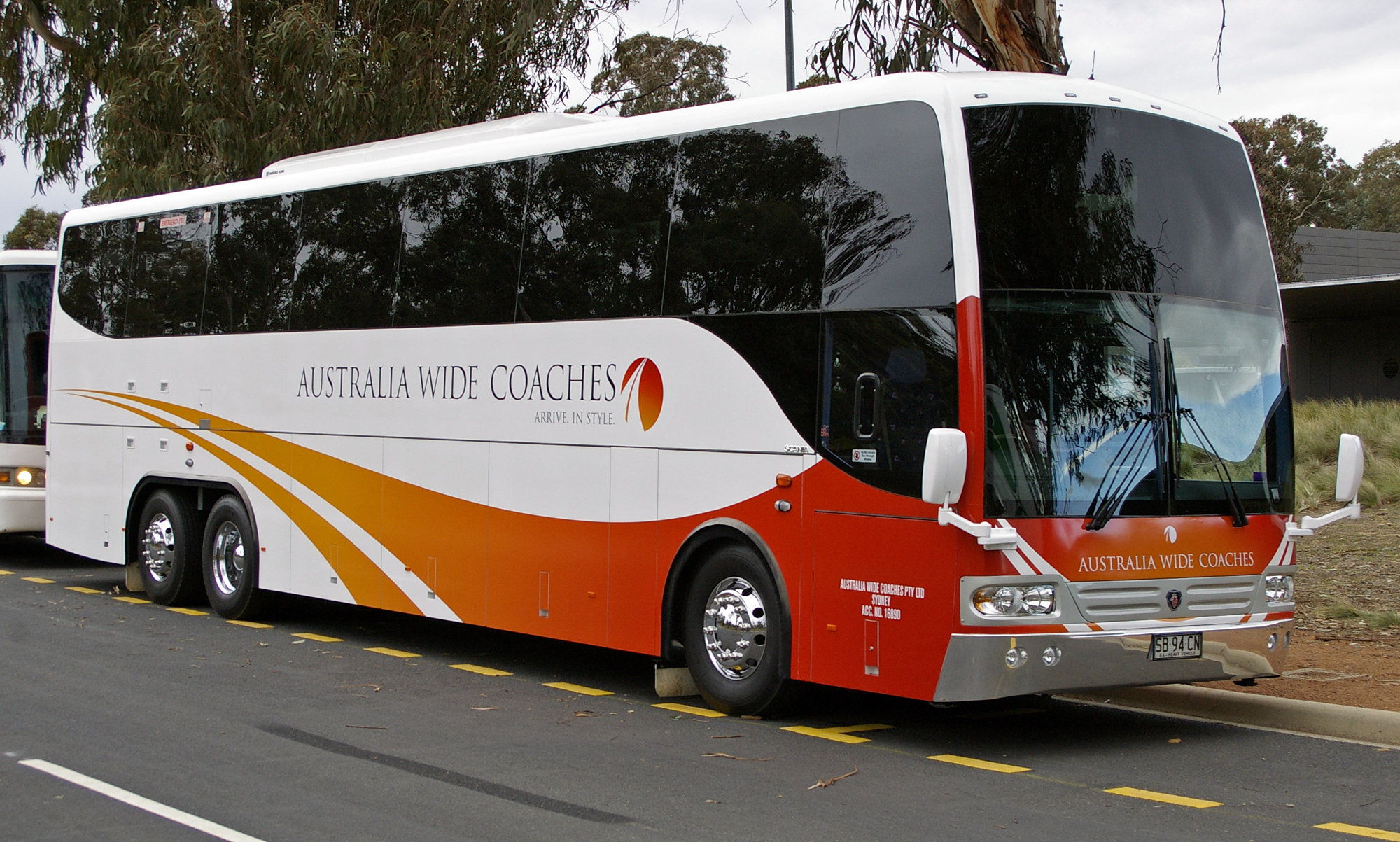
The Scania K series is a series of chassis in Scania's city bus and coach range with longitudinally, straight-up mounted engine at the rear, replacing the K- (K94, K114, K124) and L-type (L94) chassis of the 4 series. The K series was first presented on Busworld 2005 in Kortrijk, Belgium, and models were available from 2006.
Approximation of the power rating in hp to the nearest ten. The power code has spaces on both sides.
K230UB4x2LB would be a two-axle "low entry" city bus, while K480EB6x2*4NI would be a tri-axle long-distance coach with a steerable tag axle.
Note: One might think that double-decker coaches are designated as (e.g.) K 440 ED6x2*4NI. But they still use K EB for some reason.
When introduced, the K series was available with Euro IV-compliant 8.9-litre (8867 cc) 5-cylinder engines (DC9) with output of 230 hp (1050 Nm), 270 hp (1250 Nm) and 310 hp (1550 Nm) as well as the 11.7-litre (11705 cc) 6-cylinder engines (DC12) with output of 340 hp (1700 Nm), 380 hp (1900 Nm), 420 hp (2100 Nm) or 470 hp (2200 Nm), the latter being a DT12 turbo-compound engine. For the 5- and 6-cylinder engines Scania is using exhaust gas recirculation (EGR) and selective catalytic reduction (SCR) systems to fulfill the legal Euro emission standards.
In 2008 Scania released upgraded Euro V engines in order to meet these regulations. The 5-cylinder DC9 (later DC09) engines featured a larger bore and displace 9.3-litres (9291 cc) instead of 8.9-litres. The new DC13 engines feature both a larger bore and a longer stroke and therefore displace 12.7-litres (12742 cc) instead of 11.7-litres. Some engines also received slight performance improvements, for example the DC9 engine that outputs 310 hp (1550 Nm) was upgraded to 320 hp (1600 Nm).
With the introduction of Euro VI engines in 2013, the DC09 outputs 250 hp (1250 Nm), 280 hp (1400 Nm), 320 hp (1600 Nm) and 360 hp (1700 Nm), while the DC13 outputs 410 hp (2150 Nm), 450 hp (2350 Nm) and 490 hp (2550 Nm). Euro III, IV and V engines are still available for export markets.
For alternative fuels, the 9.3-litre was available as the OC9 CNG engine with power outputs of 270 hp (1100 Nm) and 305 hp (1250 Nm), which from the introduction of Euro VI was replaced by the OC09 with power outputs of 280 hp (1350 Nm) and 340 hp (1600 Nm). The 8.9-litre is available as the ethanol fueled DC9 E02 with a power output of 270 hp (1200 Nm).
Hub AI
Scania K series AI simulator
(@Scania K series_simulator)
Scania K series
The Scania K series is a series of chassis in Scania's city bus and coach range with longitudinally, straight-up mounted engine at the rear, replacing the K- (K94, K114, K124) and L-type (L94) chassis of the 4 series. The K series was first presented on Busworld 2005 in Kortrijk, Belgium, and models were available from 2006.
Approximation of the power rating in hp to the nearest ten. The power code has spaces on both sides.
K230UB4x2LB would be a two-axle "low entry" city bus, while K480EB6x2*4NI would be a tri-axle long-distance coach with a steerable tag axle.
Note: One might think that double-decker coaches are designated as (e.g.) K 440 ED6x2*4NI. But they still use K EB for some reason.
When introduced, the K series was available with Euro IV-compliant 8.9-litre (8867 cc) 5-cylinder engines (DC9) with output of 230 hp (1050 Nm), 270 hp (1250 Nm) and 310 hp (1550 Nm) as well as the 11.7-litre (11705 cc) 6-cylinder engines (DC12) with output of 340 hp (1700 Nm), 380 hp (1900 Nm), 420 hp (2100 Nm) or 470 hp (2200 Nm), the latter being a DT12 turbo-compound engine. For the 5- and 6-cylinder engines Scania is using exhaust gas recirculation (EGR) and selective catalytic reduction (SCR) systems to fulfill the legal Euro emission standards.
In 2008 Scania released upgraded Euro V engines in order to meet these regulations. The 5-cylinder DC9 (later DC09) engines featured a larger bore and displace 9.3-litres (9291 cc) instead of 8.9-litres. The new DC13 engines feature both a larger bore and a longer stroke and therefore displace 12.7-litres (12742 cc) instead of 11.7-litres. Some engines also received slight performance improvements, for example the DC9 engine that outputs 310 hp (1550 Nm) was upgraded to 320 hp (1600 Nm).
With the introduction of Euro VI engines in 2013, the DC09 outputs 250 hp (1250 Nm), 280 hp (1400 Nm), 320 hp (1600 Nm) and 360 hp (1700 Nm), while the DC13 outputs 410 hp (2150 Nm), 450 hp (2350 Nm) and 490 hp (2550 Nm). Euro III, IV and V engines are still available for export markets.
For alternative fuels, the 9.3-litre was available as the OC9 CNG engine with power outputs of 270 hp (1100 Nm) and 305 hp (1250 Nm), which from the introduction of Euro VI was replaced by the OC09 with power outputs of 280 hp (1350 Nm) and 340 hp (1600 Nm). The 8.9-litre is available as the ethanol fueled DC9 E02 with a power output of 270 hp (1200 Nm).
Recent media