



Community hub
Recent from talks
Knowledge base stats:
Talk channels stats:
Members stats:
Scuba skills
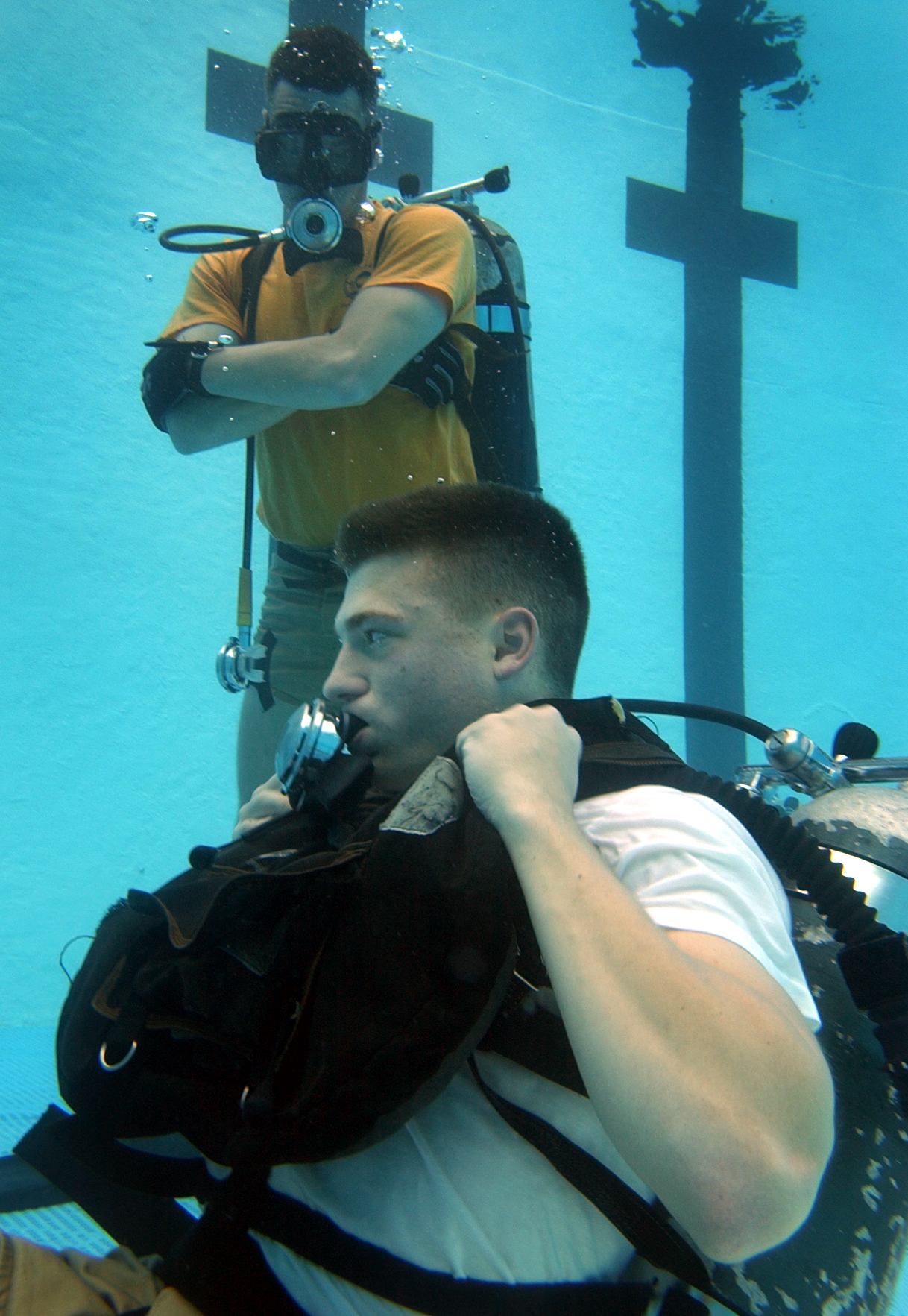
Scuba skills are skills required to dive safely using self-contained underwater breathing apparatus, known as a scuba set. Most of these skills are relevant to both open-circuit scuba and rebreather scuba, and many also apply to surface-supplied diving. Some scuba skills, which are critical to divers' safety, may require more practice than standard recreational training provides to achieve reliable competence.
Some skills are generally accepted by recreational diver certification agencies as basic and necessary in order to dive without direct supervision. Others are more advanced, although some diver certification and accreditation organizations may require these to endorse entry-level competence. Instructors assess divers on these skills during basic and advanced training. Divers are expected to remain competent at their level of certification, either by practice or through refresher courses. Some certification organizations recommend refresher training if a diver has a lapse of more than six to twelve months without a dive.
Skill categories include selection, functional testing, preparation and transport of scuba equipment, dive planning, preparation for a dive, kitting up for the dive, water entry, descent, breathing underwater, monitoring the dive profile (depth, time, and decompression status) and progress of the dive, personal breathing gas management, situational awareness, communicating with the dive team, buoyancy and trim control, mobility in the water, ascent, emergency and rescue procedures, exit from the water, removal of equipment after the dive, cleaning and preparation of equipment for storage and recording the dive, within the scope of the diver's certification.
A scuba diver should be able to assess what type of diving exposure suit is preferable for the planned dive, to confirm that it is in safe, usable condition and the right size, and to put it on correctly. Entry-level skills usually include the use of wet suits, but in countries where the water and/or weather conditions are cold, beginners may need dry suit training. Recreational divers trained in warm tropical waters may not initially need to learn any diving suit skills. Using a dry suit safely requires special skills, including buoyancy control, inversion recovery, emergency venting, and blowup recovery.
Divers are individually responsible for the function of their personal equipment. When diving as buddies with other divers, they are expected to familiarize themselves with the functional aspects of the buddy's equipment as well, to be able to operate it in an emergency.
The set is usually stored and transported as separate major components: harness and buoyancy compensator, cylinder(s) and regulator(s), and assembled for each use. Correct assembly and function are critical for safety and in some cases for survival. All certification agencies require all autonomous divers to be competent to assemble and test functionality of their own sets.
Scuba assembly generally entails mounting the cylinder(s) on the harness, connecting the regulator(s) to the cylinder valves, ensuring an uncontaminated and pressure-tight seal, and connecting the low-pressure hose to the buoyancy compensator inflation valve. Validating the function of the regulator and inflation valve is essential to proper scuba assembly, and always reviewed during pre-dive checks. Because there may be a significant interval between assembly and use, this check is commonly repeated just before putting the set on, and may be repeated just before descent.
Pre-dive checks include equipment inspection and function testing, and review of the dive plan with the team. Such checks can reveal problems that could make it necessary to abort the dive, including some which could potentially be fatal.
Hub AI
Scuba skills AI simulator
(@Scuba skills_simulator)
Scuba skills
Scuba skills are skills required to dive safely using self-contained underwater breathing apparatus, known as a scuba set. Most of these skills are relevant to both open-circuit scuba and rebreather scuba, and many also apply to surface-supplied diving. Some scuba skills, which are critical to divers' safety, may require more practice than standard recreational training provides to achieve reliable competence.
Some skills are generally accepted by recreational diver certification agencies as basic and necessary in order to dive without direct supervision. Others are more advanced, although some diver certification and accreditation organizations may require these to endorse entry-level competence. Instructors assess divers on these skills during basic and advanced training. Divers are expected to remain competent at their level of certification, either by practice or through refresher courses. Some certification organizations recommend refresher training if a diver has a lapse of more than six to twelve months without a dive.
Skill categories include selection, functional testing, preparation and transport of scuba equipment, dive planning, preparation for a dive, kitting up for the dive, water entry, descent, breathing underwater, monitoring the dive profile (depth, time, and decompression status) and progress of the dive, personal breathing gas management, situational awareness, communicating with the dive team, buoyancy and trim control, mobility in the water, ascent, emergency and rescue procedures, exit from the water, removal of equipment after the dive, cleaning and preparation of equipment for storage and recording the dive, within the scope of the diver's certification.
A scuba diver should be able to assess what type of diving exposure suit is preferable for the planned dive, to confirm that it is in safe, usable condition and the right size, and to put it on correctly. Entry-level skills usually include the use of wet suits, but in countries where the water and/or weather conditions are cold, beginners may need dry suit training. Recreational divers trained in warm tropical waters may not initially need to learn any diving suit skills. Using a dry suit safely requires special skills, including buoyancy control, inversion recovery, emergency venting, and blowup recovery.
Divers are individually responsible for the function of their personal equipment. When diving as buddies with other divers, they are expected to familiarize themselves with the functional aspects of the buddy's equipment as well, to be able to operate it in an emergency.
The set is usually stored and transported as separate major components: harness and buoyancy compensator, cylinder(s) and regulator(s), and assembled for each use. Correct assembly and function are critical for safety and in some cases for survival. All certification agencies require all autonomous divers to be competent to assemble and test functionality of their own sets.
Scuba assembly generally entails mounting the cylinder(s) on the harness, connecting the regulator(s) to the cylinder valves, ensuring an uncontaminated and pressure-tight seal, and connecting the low-pressure hose to the buoyancy compensator inflation valve. Validating the function of the regulator and inflation valve is essential to proper scuba assembly, and always reviewed during pre-dive checks. Because there may be a significant interval between assembly and use, this check is commonly repeated just before putting the set on, and may be repeated just before descent.
Pre-dive checks include equipment inspection and function testing, and review of the dive plan with the team. Such checks can reveal problems that could make it necessary to abort the dive, including some which could potentially be fatal.