



Community hub
Recent from talks
Knowledge base stats:
Talk channels stats:
Members stats:
Seam Zone
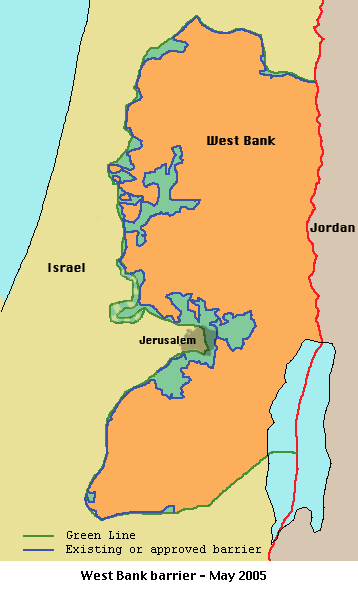
Seam Zone (Hebrew: מרחב התפר) is a term used to refer to a land area in the Israeli-occupied West Bank located east of the Green Line and west of Israel's separation barrier, populated largely by Israelis in settlements such as Alfei Menashe, Ariel, Beit Arye, Modi'in Illit, Giv'at Ze'ev, Ma'ale Adumim, Beitar Illit and Efrat.
As of 2006, it was estimated that about 57,000 Palestinians lived in villages located in enclaves in the seam zone, separated from the rest of the West Bank by the Wall (according to the ICJ Wall Case opinion). The United Nations estimated that if the series of walls, fences, barbed wire and ditches is completed along its planned route, about a third of West Bank Palestinians will be affected—274,000 will be located in enclaves in the seam zone and about 400,000 separated from their fields, jobs, schools and hospitals. The Supreme Court of Israel ordered changes to the barrier route to reduce the number of people leaving or affected by the seam zone—according to the court verdict the number now stands at 35,000.
In July 2006, B'Tselem forecast that 8.5 percent of the West Bank, including East Jerusalem, would be situated in the seam zone. This area also contains ninety-nine Israeli settlements (including twelve in East Jerusalem) in several densely populated areas near the Green Line—areas that Geneva Accord suggested could be transferred to Israel as part of a mutually agreed land-swap with the Palestinians. According to a 2004 estimate, the Seam Zone is home to some 381,000 Israeli settlers (192,000 in East Jerusalem).
According to Israeli officials, the decision to create the zone involved multiple reasons. Among them was, "The need to create a "buffer zone" by distancing the Barrier from the homes of Israelis living nearby, whether they be in communities in Israel or in the settlements." According to the State Attorney's Office, "this buffer zone is vital to strike against terrorists who are liable to cross the Barrier before carrying out their scheme." Another consideration cited is the need to "defend the forces protecting the barrier by running the route in areas that cannot be controlled [topographically] from east of the barrier." It is contended that, due to the topography of the area, running the entire Barrier along the Green Line "would not enable protection of the soldiers patrolling the Barrier, who would find themselves in many cases in a lower topographical position."
The seam zone is designated as a "closed area" for persons other than Israelis and Jews abroad by way of a military order, the IDF Order Regarding Security Regulations (Judea and Samaria) (No. 378), 5730-1970, Declaration Concerning Closing an Area no. S/2/03 (Seam Zone), issued on 2 October 2003. The order stipulates that "no person will enter the seam area and no one will remain there". The regulation does not, however, apply to Israelis. For the purposes of the order, an "Israeli" is defined as either "a citizen of the State of Israel, a resident of the State of Israel registered in the population registry in accordance with the Population Registry Law or anyone who is eligible to emigrate to Israel in accordance with the Law of Return."
The day prior to the issuing of the military order, the Israeli Ministry of Foreign Affairs released a Cabinet Communique which explained that the establishment of the seam zone was of the "utmost importance," citing also the "strong security need for building a security barrier in the 'seam zone' and in the 'Jerusalem envelope'."
Palestinians who live near the seam zone are allowed to enter and stay if they possess a written permit, taṣrīḥ (تصريح) in Arabic, authorizing permanent residence. Palestinians who are not residents of the seam zone can apply for personal permits provided they have a specific reason. Permits must be applied for in advance. There are 12 different categories of personal permits, including for farmers, employees, business owners and employees of the Palestinian Authority. Specific criteria for the acceptance or refusal of personal permits is not outlined in the regulations.
Permit holders must apply for special permission if they wish to travel by automobile, bring in goods or stay overnight in the seam zone. Even those holding permanent or personal permits are limited to crossing the barrier at the single gate specified in the permit. Personal permits granted, including those issued to farmers who wish to access their land, are often only valid for a limited period. Access to the seam zone for permit holders is further limited by the specific operating regimes of the gate in question. Procedures and their opening hours differ from gate to gate and are not always entirely predictable.
Hub AI
Seam Zone AI simulator
(@Seam Zone_simulator)
Seam Zone
Seam Zone (Hebrew: מרחב התפר) is a term used to refer to a land area in the Israeli-occupied West Bank located east of the Green Line and west of Israel's separation barrier, populated largely by Israelis in settlements such as Alfei Menashe, Ariel, Beit Arye, Modi'in Illit, Giv'at Ze'ev, Ma'ale Adumim, Beitar Illit and Efrat.
As of 2006, it was estimated that about 57,000 Palestinians lived in villages located in enclaves in the seam zone, separated from the rest of the West Bank by the Wall (according to the ICJ Wall Case opinion). The United Nations estimated that if the series of walls, fences, barbed wire and ditches is completed along its planned route, about a third of West Bank Palestinians will be affected—274,000 will be located in enclaves in the seam zone and about 400,000 separated from their fields, jobs, schools and hospitals. The Supreme Court of Israel ordered changes to the barrier route to reduce the number of people leaving or affected by the seam zone—according to the court verdict the number now stands at 35,000.
In July 2006, B'Tselem forecast that 8.5 percent of the West Bank, including East Jerusalem, would be situated in the seam zone. This area also contains ninety-nine Israeli settlements (including twelve in East Jerusalem) in several densely populated areas near the Green Line—areas that Geneva Accord suggested could be transferred to Israel as part of a mutually agreed land-swap with the Palestinians. According to a 2004 estimate, the Seam Zone is home to some 381,000 Israeli settlers (192,000 in East Jerusalem).
According to Israeli officials, the decision to create the zone involved multiple reasons. Among them was, "The need to create a "buffer zone" by distancing the Barrier from the homes of Israelis living nearby, whether they be in communities in Israel or in the settlements." According to the State Attorney's Office, "this buffer zone is vital to strike against terrorists who are liable to cross the Barrier before carrying out their scheme." Another consideration cited is the need to "defend the forces protecting the barrier by running the route in areas that cannot be controlled [topographically] from east of the barrier." It is contended that, due to the topography of the area, running the entire Barrier along the Green Line "would not enable protection of the soldiers patrolling the Barrier, who would find themselves in many cases in a lower topographical position."
The seam zone is designated as a "closed area" for persons other than Israelis and Jews abroad by way of a military order, the IDF Order Regarding Security Regulations (Judea and Samaria) (No. 378), 5730-1970, Declaration Concerning Closing an Area no. S/2/03 (Seam Zone), issued on 2 October 2003. The order stipulates that "no person will enter the seam area and no one will remain there". The regulation does not, however, apply to Israelis. For the purposes of the order, an "Israeli" is defined as either "a citizen of the State of Israel, a resident of the State of Israel registered in the population registry in accordance with the Population Registry Law or anyone who is eligible to emigrate to Israel in accordance with the Law of Return."
The day prior to the issuing of the military order, the Israeli Ministry of Foreign Affairs released a Cabinet Communique which explained that the establishment of the seam zone was of the "utmost importance," citing also the "strong security need for building a security barrier in the 'seam zone' and in the 'Jerusalem envelope'."
Palestinians who live near the seam zone are allowed to enter and stay if they possess a written permit, taṣrīḥ (تصريح) in Arabic, authorizing permanent residence. Palestinians who are not residents of the seam zone can apply for personal permits provided they have a specific reason. Permits must be applied for in advance. There are 12 different categories of personal permits, including for farmers, employees, business owners and employees of the Palestinian Authority. Specific criteria for the acceptance or refusal of personal permits is not outlined in the regulations.
Permit holders must apply for special permission if they wish to travel by automobile, bring in goods or stay overnight in the seam zone. Even those holding permanent or personal permits are limited to crossing the barrier at the single gate specified in the permit. Personal permits granted, including those issued to farmers who wish to access their land, are often only valid for a limited period. Access to the seam zone for permit holders is further limited by the specific operating regimes of the gate in question. Procedures and their opening hours differ from gate to gate and are not always entirely predictable.