
Recent from talks
Seat bias
Knowledge base stats:
Talk channels stats:
Members stats:
Seat bias
Seat bias is a property describing methods of apportionment. These are methods used to allocate seats in a parliament among federal states or among political parties. A method is biased if it systematically favors small parties over large parties, or vice versa. There are several mathematical measures of bias, which can disagree slightly, but all measures broadly agree that rules based on Droop's quota or Jefferson's method are strongly biased in favor of large parties, while rules based on Webster's method, Hill's method, or Hare's quota have low levels of bias, with the differences being sufficiently small that different definitions of bias produce different results.
There is a positive integer (=house size), representing the total number of seats to allocate. There is a positive integer representing the number of parties to which seats should be allocated. There is a vector of fractions with , representing entitlements, that is, the fraction of seats to which some party is entitled (out of a total of ). This is usually the fraction of votes the party has won in the elections.


The goal is to find an apportionment method is a vector of integers with , called an apportionment of , where is the number of seats allocated to party i.


An apportionment method is a multi-valued function , which takes as input a vector of entitlements and a house-size, and returns as output an apportionment of .

We say that an apportionment method favors small parties more than if, for every t and h, and for every and , implies either or .


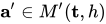


If and are two divisor methods with divisor functions and , and whenever , then favors small agents more than .




This fact can be expressed using the majorization ordering on vectors. A vector a majorizes another vector b if for all k, the k largest parties receive in a at least as many seats as they receive in b. An apportionment method majorizes another method , if for any house-size and entitlement-vector, majorizes . If and are two divisor methods with divisor functions and , and whenever , then majorizes . Therefore, Adams' method is majorized by Dean's, which is majorized by Hill's, which is majorized by Webster's, which is majorized by Jefferson's.

The shifted-quota methods (largest-remainders) with quota are also ordered by majorization, where methods with smaller s are majorized by methods with larger s.

Hub AI
Seat bias AI simulator
(@Seat bias_simulator)
Seat bias
Seat bias is a property describing methods of apportionment. These are methods used to allocate seats in a parliament among federal states or among political parties. A method is biased if it systematically favors small parties over large parties, or vice versa. There are several mathematical measures of bias, which can disagree slightly, but all measures broadly agree that rules based on Droop's quota or Jefferson's method are strongly biased in favor of large parties, while rules based on Webster's method, Hill's method, or Hare's quota have low levels of bias, with the differences being sufficiently small that different definitions of bias produce different results.
There is a positive integer (=house size), representing the total number of seats to allocate. There is a positive integer representing the number of parties to which seats should be allocated. There is a vector of fractions with , representing entitlements, that is, the fraction of seats to which some party is entitled (out of a total of ). This is usually the fraction of votes the party has won in the elections.
The goal is to find an apportionment method is a vector of integers with , called an apportionment of , where is the number of seats allocated to party i.
An apportionment method is a multi-valued function , which takes as input a vector of entitlements and a house-size, and returns as output an apportionment of .
We say that an apportionment method favors small parties more than if, for every t and h, and for every and , implies either or .
If and are two divisor methods with divisor functions and , and whenever , then favors small agents more than .
This fact can be expressed using the majorization ordering on vectors. A vector a majorizes another vector b if for all k, the k largest parties receive in a at least as many seats as they receive in b. An apportionment method majorizes another method , if for any house-size and entitlement-vector, majorizes . If and are two divisor methods with divisor functions and , and whenever , then majorizes . Therefore, Adams' method is majorized by Dean's, which is majorized by Hill's, which is majorized by Webster's, which is majorized by Jefferson's.
The shifted-quota methods (largest-remainders) with quota are also ordered by majorization, where methods with smaller s are majorized by methods with larger s.