



Community hub
Recent from talks
Knowledge base stats:
Talk channels stats:
Members stats:
Second Battle of Ypres
The Second Battle of Ypres was fought from 22 April – 25 May 1915, during the First World War, for control of the tactically valuable high ground to the east and the south of the Flemish town of Ypres, in western Belgium. The First Battle of Ypres had been fought the previous autumn. The Second Battle of Ypres was the occasion of the first mass use by Germany of poison gas on the Western Front.
The German chemist Walther Nernst was a volunteer driver in 1914 and proposed to Colonel Max Bauer, the German general staff officer responsible for liaison with scientists, that they could empty the opposing trenches by a surprise attack with tear gas. Observing a field test of this idea, the chemist Fritz Haber instead proposed using heavier-than-air chlorine gas.
The professional head of the German Army, General Erich von Falkenhayn, agreed to try the new weapon with the 4th Army. Falkenhayn wanted to use the gas to cover the transfer of units to the Eastern Front to assist the Austro-Hungarian Army against the Imperial Russian Army after its losses in 1914. Gas could not be released directly because the valves would freeze; liquid chlorine from cylinders would be syphoned for it to vaporise and be carried by a breeze to the British and French lines. German troops carried 5,730 gas cylinders, the largest weighing 40 kg (88 lb), into the front line for the release.
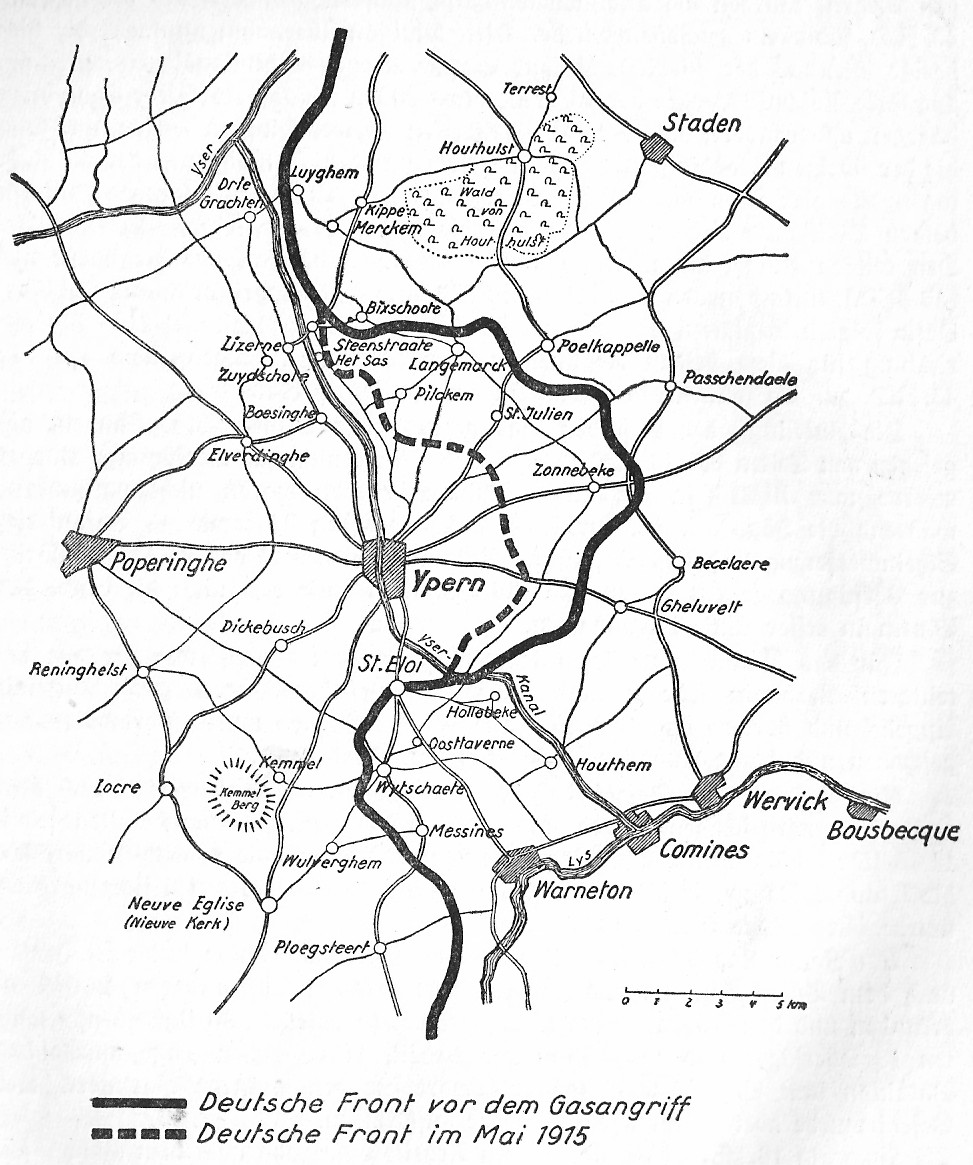
The installation was supervised by Haber, Otto Hahn, James Franck and Gustav Hertz. Cylinders were breached by shell fire on two occasions and the second time, three men were killed and fifty wounded. Some of the Germans were protected by miners' oxygen breathing apparatus. The Ypres Salient was selected for the attack, the front line followed the canal and bulged eastward around the town. North of the salient, the Belgian army held the line of the Yser, and the north end of the salient was held by two French divisions. The eastern bulge of the salient was defended by the 1st Canadian Division and two British divisions. The II Corps and V Corps of the Second Army comprised the 1st Cavalry Division, 2nd Cavalry Division and 3rd Cavalry Division, as well as the 4th Division, 27th Division, 28th Division, 50th (Northumbrian) Division, 3rd (Lahore) Division and the 1st Canadian Division.
In A record of the Engagements.... (1923), E. A. James used The Official Names of the Battles and Other Engagements.... (1921) to provide a summary of each engagement and the formations involved. In the Battles of Ypres, 1915, there were four engagements involving the Second Army from 22 April to 25 May.
On 22 April 1915 at about 5:00 p.m., the 4th Army released 168 long tons (171 t) of chlorine gas on a 4.0-mile (6.5 km) front, between the hamlets of Langemark and Gravenstafel This sector of the Allied line was held by the 87th Territorial Division (comprising older reservists from 10th Military District, based in Rennes), alongside the 45th Infantry Division (France) (comprising troops from the (North African) 19th Military District). The French troops in the path of the gas cloud suffered 2,000–3,000 casualties, with 800 to 1,400 fatalities. Troops fled the gas cloud,
...haggard, their overcoats thrown off or opened wide, their scarves pulled off, running like madmen, directionless, shouting for water, spitting blood, some even rolling on the ground making desperate efforts to breathe.
— Colonel Henri Mordacq, 90th Infantry Brigade, 45th Division.
Hub AI
Second Battle of Ypres AI simulator
(@Second Battle of Ypres_simulator)
Second Battle of Ypres
The Second Battle of Ypres was fought from 22 April – 25 May 1915, during the First World War, for control of the tactically valuable high ground to the east and the south of the Flemish town of Ypres, in western Belgium. The First Battle of Ypres had been fought the previous autumn. The Second Battle of Ypres was the occasion of the first mass use by Germany of poison gas on the Western Front.
The German chemist Walther Nernst was a volunteer driver in 1914 and proposed to Colonel Max Bauer, the German general staff officer responsible for liaison with scientists, that they could empty the opposing trenches by a surprise attack with tear gas. Observing a field test of this idea, the chemist Fritz Haber instead proposed using heavier-than-air chlorine gas.
The professional head of the German Army, General Erich von Falkenhayn, agreed to try the new weapon with the 4th Army. Falkenhayn wanted to use the gas to cover the transfer of units to the Eastern Front to assist the Austro-Hungarian Army against the Imperial Russian Army after its losses in 1914. Gas could not be released directly because the valves would freeze; liquid chlorine from cylinders would be syphoned for it to vaporise and be carried by a breeze to the British and French lines. German troops carried 5,730 gas cylinders, the largest weighing 40 kg (88 lb), into the front line for the release.
The installation was supervised by Haber, Otto Hahn, James Franck and Gustav Hertz. Cylinders were breached by shell fire on two occasions and the second time, three men were killed and fifty wounded. Some of the Germans were protected by miners' oxygen breathing apparatus. The Ypres Salient was selected for the attack, the front line followed the canal and bulged eastward around the town. North of the salient, the Belgian army held the line of the Yser, and the north end of the salient was held by two French divisions. The eastern bulge of the salient was defended by the 1st Canadian Division and two British divisions. The II Corps and V Corps of the Second Army comprised the 1st Cavalry Division, 2nd Cavalry Division and 3rd Cavalry Division, as well as the 4th Division, 27th Division, 28th Division, 50th (Northumbrian) Division, 3rd (Lahore) Division and the 1st Canadian Division.
In A record of the Engagements.... (1923), E. A. James used The Official Names of the Battles and Other Engagements.... (1921) to provide a summary of each engagement and the formations involved. In the Battles of Ypres, 1915, there were four engagements involving the Second Army from 22 April to 25 May.
On 22 April 1915 at about 5:00 p.m., the 4th Army released 168 long tons (171 t) of chlorine gas on a 4.0-mile (6.5 km) front, between the hamlets of Langemark and Gravenstafel This sector of the Allied line was held by the 87th Territorial Division (comprising older reservists from 10th Military District, based in Rennes), alongside the 45th Infantry Division (France) (comprising troops from the (North African) 19th Military District). The French troops in the path of the gas cloud suffered 2,000–3,000 casualties, with 800 to 1,400 fatalities. Troops fled the gas cloud,
...haggard, their overcoats thrown off or opened wide, their scarves pulled off, running like madmen, directionless, shouting for water, spitting blood, some even rolling on the ground making desperate efforts to breathe.
— Colonel Henri Mordacq, 90th Infantry Brigade, 45th Division.