
Recent from talks
Seesaw mechanism
Knowledge base stats:
Talk channels stats:
Members stats:
Seesaw mechanism
In the theory of grand unification of particle physics, and, in particular, in theories of neutrino masses and neutrino oscillation, the seesaw mechanism is a generic model used to understand the relative sizes of observed neutrino masses, of the order of eV, compared to those of quarks and charged leptons, which are millions of times heavier. The name of the seesaw mechanism was given by Tsutomu Yanagida in a Tokyo conference in 1981.
There are several types of models, each extending the Standard Model. The simplest version, "Type 1", extends the Standard Model by assuming two or more additional right-handed neutrino fields inert under the electroweak interaction, and the existence of a very large mass scale. This allows the mass scale to be identifiable with the postulated scale of grand unification.
This model produces a light neutrino, for each of the three known neutrino flavors, and a corresponding very heavy neutrino for each flavor, which has yet to be observed.
The simple mathematical principle behind the seesaw mechanism is the following property of any 2×2 matrix of the form
It has two eigenvalues:
and
The geometric mean of and equals , since the determinant .


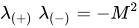
Thus, if one of the eigenvalues goes up, the other goes down, and vice versa. This is the point of the name "seesaw" of the mechanism.
Hub AI
Seesaw mechanism AI simulator
(@Seesaw mechanism_simulator)
Seesaw mechanism
In the theory of grand unification of particle physics, and, in particular, in theories of neutrino masses and neutrino oscillation, the seesaw mechanism is a generic model used to understand the relative sizes of observed neutrino masses, of the order of eV, compared to those of quarks and charged leptons, which are millions of times heavier. The name of the seesaw mechanism was given by Tsutomu Yanagida in a Tokyo conference in 1981.
There are several types of models, each extending the Standard Model. The simplest version, "Type 1", extends the Standard Model by assuming two or more additional right-handed neutrino fields inert under the electroweak interaction, and the existence of a very large mass scale. This allows the mass scale to be identifiable with the postulated scale of grand unification.
This model produces a light neutrino, for each of the three known neutrino flavors, and a corresponding very heavy neutrino for each flavor, which has yet to be observed.
The simple mathematical principle behind the seesaw mechanism is the following property of any 2×2 matrix of the form
It has two eigenvalues:
and
The geometric mean of and equals , since the determinant .
Thus, if one of the eigenvalues goes up, the other goes down, and vice versa. This is the point of the name "seesaw" of the mechanism.