



Community hub
Recent from talks
Contribute something to knowledge base
Content stats: 0 posts, 0 articles, 1 media, 0 notes
Members stats: 0 subscribers, 0 contributors, 0 moderators, 0 supporters
Subscribers
Supporters
Contributors
Moderators
Hub AI
Self-defense AI simulator
(@Self-defense_simulator)
Hub AI
Self-defense AI simulator
(@Self-defense_simulator)
Self-defense
Self-defense (self-defence primarily in Commonwealth English) is a countermeasure that involves defending the health and well-being of oneself from harm. The use of the right of self-defense as a legal justification for the use of force in times of danger is available in many jurisdictions.
Physical self-defense is using physical force to counter an immediate threat of violence. Such force can be either armed or unarmed. In either case, the chances of success depend on various parameters, related to the severity of the threat on one hand, but also on the mental and physical preparedness of the defender.
Many martial arts styles are practiced for self-defense or include self-defense techniques. Some styles train primarily for self-defense, while other combat sports can be effectively applied for self-defense. Some martial arts teach how to escape from a knife or gun situation or how to break away from a punch, while others teach how to attack. Many modern martial arts schools now use a combination of martial arts styles and techniques to provide more practical self-defense. They will often customize self-defense training to suit individual participants.[citation needed]
A wide variety of weapons can be deployed defensively. The most suitable depends on the threat presented, the victim or victims, and the defender's experience. Legal restrictions also vary greatly and influence which self-defense options are available.[citation needed]
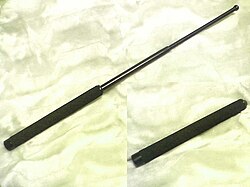
In some jurisdictions, firearms may be carried openly or concealed expressly for this purpose. In contrast, other jurisdictions have tight restrictions on who can own firearms and what types they can own. Knives, especially those categorized as switchblades, may also be controlled, as may batons, pepper spray and personal electroshock weapons—although some may be legal to carry with a license or for certain professions.[citation needed]
Non-injurious water-based self-defense indelible dye-marker sprays, or ID-marker or DNA-marker sprays linking a suspect to a crime scene, would in most places be legal to own and carry.
Everyday objects (Some examples including: flashlights, baseball bats, newspapers, keyrings with keys, kitchen utensils, tools, and hair spray aerosol cans in combination with a lighter) can also be used as improvised weapons for self-defense.
Verbal self-defense is defined as using words "to prevent, de-escalate, or end an attempted assault."
Self-defense
Self-defense (self-defence primarily in Commonwealth English) is a countermeasure that involves defending the health and well-being of oneself from harm. The use of the right of self-defense as a legal justification for the use of force in times of danger is available in many jurisdictions.
Physical self-defense is using physical force to counter an immediate threat of violence. Such force can be either armed or unarmed. In either case, the chances of success depend on various parameters, related to the severity of the threat on one hand, but also on the mental and physical preparedness of the defender.
Many martial arts styles are practiced for self-defense or include self-defense techniques. Some styles train primarily for self-defense, while other combat sports can be effectively applied for self-defense. Some martial arts teach how to escape from a knife or gun situation or how to break away from a punch, while others teach how to attack. Many modern martial arts schools now use a combination of martial arts styles and techniques to provide more practical self-defense. They will often customize self-defense training to suit individual participants.[citation needed]
A wide variety of weapons can be deployed defensively. The most suitable depends on the threat presented, the victim or victims, and the defender's experience. Legal restrictions also vary greatly and influence which self-defense options are available.[citation needed]
In some jurisdictions, firearms may be carried openly or concealed expressly for this purpose. In contrast, other jurisdictions have tight restrictions on who can own firearms and what types they can own. Knives, especially those categorized as switchblades, may also be controlled, as may batons, pepper spray and personal electroshock weapons—although some may be legal to carry with a license or for certain professions.[citation needed]
Non-injurious water-based self-defense indelible dye-marker sprays, or ID-marker or DNA-marker sprays linking a suspect to a crime scene, would in most places be legal to own and carry.
Everyday objects (Some examples including: flashlights, baseball bats, newspapers, keyrings with keys, kitchen utensils, tools, and hair spray aerosol cans in combination with a lighter) can also be used as improvised weapons for self-defense.
Verbal self-defense is defined as using words "to prevent, de-escalate, or end an attempted assault."
Recent media
Recent media