Hubbry Logo
Semple StadiumSemple StadiumMain
Open search
Semple Stadium
Community hub
Semple Stadium
logo
8 pages, 0 posts
0 subscribers
Be the first to start a discussion here.
Semple Stadium
Semple Stadium
from Wikipedia

FBD Semple Stadium is the home of hurling and Gaelic football[2] for Tipperary GAA and for the province of Munster. Located in Thurles, County Tipperary, it is the second largest GAA stadium in Ireland (after Croke Park), with a capacity of 45,690 and named after Tom Semple, the captain of the Thurles "Blues". He won All-Ireland Senior Hurling Championship medals in 1900, 1906, and 1908.[1]

Key Information

The stadium is the leading venue for Munster hurling followers, having hosted the Munster Hurling Final on many memorable occasions.

Facilities

[edit]
Semple Stadium, exterior south side

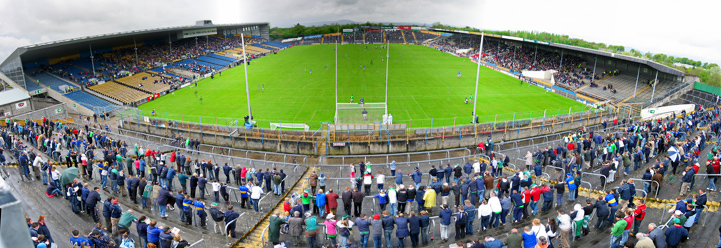
The main or 'Old Stand' of the ground (also known as the 'Ardán Ó Coinneáin' or 'Dr Kinane Stand' named after Jeremiah Kinane) lies across from the 'New Stand' (also known as the 'Ardán Ó Riáin') both of which are covered. Behind the goals are two uncovered terraces known as the 'Town End' (also known as the 'Davin Terrace') and the 'Killinan End' (also known as the 'Maher Terrace') respectively.[3]

Currently the stadium has a capacity of 45,690, of which 24,000 are seated.

The Dome

[edit]

The sports hall accommodates a full-sized basketball court suitable for national standard competition. The hall is also lined for badminton, volleyball, and indoor soccer. It is used in the evenings and weekends by the Tipperary hurling and football teams for training and on match days; the building is used to accommodate GAA and sponsor guests for corporate lunches and functions. It has also been used as a music venue.

Proposed development

[edit]

In July 2018 Tipperary County Board prepared to submit plans to Tipperary County Council to see the Kinane stand redeveloped into a multi-purpose facility.

The proposal would see the "Old Stand" as it is known to many, have a second level created over the concourse at the back of the stand. The half nearest the Killinan End terrace will be dedicated to players and will include a full-sized gym, physio room, stats/analysis room plus changing rooms and toilet facilities. The other half, towards the Sarsfields Centre side, would include a function room to accommodate up to 250 people, with adjoining bar and kitchen facility for catering. The development will also include a new corridor leading to a new VIP enclosure area in the Kinnane stand. The estimated cost of the project is €5 million.[4]

The planning application for the development was lodged with Tipperary County Council in April 2019. The planning application included reconfiguration of the seating area and modifications to the ground floor, including turnstiles, the construction of a new exit gate, and three service cores providing access to upper floor levels, which would include wheelchair-accessible turnstiles. Wilson Architecture in Cork was commissioned to help put together the planning application.[5] Planning permission was granted in April 2020.[6]

History

[edit]
Semple Stadium, north-east corner

The grounds on which Semple Stadium is built were formerly known as Thurles Sportsfield. The site was offered for sale in 1910 at the wish of Canon M.K. Ryan and was purchased by local Gaelic games enthusiasts for £900. To meet the cost of the purchase, an issue of shares was subscribed by the townspeople. The grounds remained in the hands of the shareholders until 1956 when they were transferred to the Gaelic Athletic Association.

In 1934 in anticipation of the All-Ireland Hurling Final being held in the grounds to mark the golden jubilee of the Association, extensive improvements were made to bring the field requirements up to the demands which a crowd of up to 60,000 would make. The embankments around the field were raised and extended and the stand accommodation was also extended. However, the jubilee final was held in Croke Park and it was another 50 years before the stadium would host the All-Ireland final as a showpiece to mark the centenary.[citation needed]

In 1968 further developments took place when the Dr. Kinane Stand was completed and opened. In 1971 the stadium was named after Tom Semple, who was captain of the Thurles "Blues". He won All-Ireland Senior Hurling Championship medals in 1900, 1906 and 1908. The Ardán Ó Riáin opposite the Kinane Stand and the terracing at the town end of the field were completed in 1981 at a cost of £500,000. This development and the terracing at the Killinan end of the field were part of a major improvement scheme for the celebration of the centenary All-Ireland Hurling Final between Cork and Offaly in 1984.

Dublin v Kerry in the quarter-finals of the 2001 All-Ireland Senior Football Championship was held at Semple Stadium.[7]

In April 2006 Tipperary County Board announced an €18 million redevelopment plan for the Stadium. The three-year project aimed to boost capacity to over 55,000, as well as providing a wide range of modern facilities such as corporate space concessions, dining and changing areas within both main stands. There were also plans to upgrade the standing terraces and install a modern floodlighting facility.[8] Phase one of the upgrade project, upgrading the Kinnane Stand side of the stadium, involved expenditure of €5.5 million.

On 14 February 2009 the new state of the art floodlights were switched on by GAA President Nickey Brennan before the National Hurling League game against Cork.[9][10]

In 2016, Hawk-Eye was installed in the stadium and used for the first time during the Munster Championship quarter-final between Tipperary and Cork.[11]

After 28 minutes of play in a 2022 Tipperary Senior Hurling Championship game for Clonoulty–Rossmore against Kilruane at Semple Stadium, Dillon Quirke collapsed and died.[12][13]

An architectural consultancy has been[when?] appointed to lead a design team, tasked with preparing a master plan for the redevelopment of Semple Stadium.[citation needed]

Music festival

[edit]

The Féile Festival, ran from 1990 to 1994 (and returned in 1997 for one day), was held at Semple Stadium. At the height of its success, an estimated 150,000 people attended the festival, which was also known as "The Trip to Tipp".[14] Irish and international artists participated, including The Prodigy, The Cranberries, Blur, Bryan Adams, Van Morrison, Rage Against the Machine, The Saw Doctors and Christy Moore.

The Féile Classical Concerts took place at Semple Stadium in September 2018. Line up included Irish musical acts that played in the 1990s at the Féile festivals.[15] Named as Tipp Classical, it will return in September 2019.[16]

Transport

[edit]

Rail

[edit]

Semple Stadium is a five-minute walk from Thurles railway station. The station is on the Dublin to Cork main rail line with connections to Limerick and Tralee lines. Iarnród Éireann operates 'GAA Specials' to the station on the date of certain matches at Semple stadium.[17][failed verification]

Naming rights

[edit]

In 2022, FBD Insurance entered into a naming rights agreement which provided for the stadium to be referred to as "FBD Semple Stadium".[18]

Images

[edit]

See also

[edit]

References

[edit]
[edit]
Revisions and contributorsEdit on WikipediaRead on Wikipedia
from Grokipedia
Semple Stadium is a (GAA) located in , , , primarily used for hurling and matches. Owned by the GAA, it is the second-largest dedicated to these sports in , with a capacity of 45,690, and is celebrated for its exceptional playing surface, considered the finest in the country. The , originally known as Thurles Sportsfield, was purchased by local Gaelic enthusiasts in 1910 for £900 and officially transferred to the GAA in 1956. In 1971, it was renamed in honor of Tom Semple, a legendary hurler and captain of Thurles Sarsfields who won medals in 1900, 1906, and 1908. Semple Stadium has hosted numerous high-profile events, including the Hurling Final of 1934 and the 1984 centenary final between Cork and Offaly, underscoring its status as a historic venue for hurling. Key developments include major upgrades to embankments and stands in 1934, the Dr. Kinane Stand in 1968, and the Ardan O'Riain Stand in 1981, followed by a comprehensive €18 million redevelopment from 2007 to 2009 that introduced floodlights, enhanced seating, and modern facilities. The pitch measures 145 meters by 80 meters, supporting its reputation for top-quality play.

General Information

Location and Site

Semple Stadium is situated in Thurles, County Tipperary, Ireland, specifically on Bohernave Road in the townland of Gortataggart. Its geographic coordinates are approximately 52°40′58″N 7°49′19″W. The stadium lies about 1.25 kilometers west of the Cathedral of the Assumption, a prominent local landmark in central Thurles. The site occupies the east bank of the River Suir, which flows through the heart of and contributes to the town's scenic and historical character. itself is a with a population of 8,185 as recorded in the 2022 , serving as a key regional center in . Semple Stadium functions as a central community hub, drawing residents and visitors for and events that foster local identity and engagement. The surrounding terrain is predominantly flat, providing ample space that has supported ongoing expansions and developments at the venue. Adjacent GAA facilities include the Tipperary County Board offices at Lár na Páirce on Slievenamon Road, forming part of a broader in that enhances the site's role in regional Gaelic athletics.

Naming and Dedication

is named in honor of Tom Semple (1879–1943), a prominent Tipperary hurler and (GAA) administrator. Semple captained the Thurles Sarsfields club, known as the "Blues," and led Tipperary to victories in 1900, 1906, and 1908. He also served as chairman of the Tipperary County Board and represented the county on the and Central Councils of the GAA. Semple played a key role in the early development of the GAA in Tipperary, including involvement in the 1910 purchase of the site that became the stadium. Prior to its official naming, the venue was known as Thurles Sportsfield, a name it held since its acquisition by local GAA interests in 1910. In 1971, it was formally renamed Semple Stadium to commemorate his contributions to hurling and the GAA. Locally, the stadium has long been affectionately referred to as "Tom Semple's Field," reflecting the enduring reverence for its namesake among Tipperary supporters. In a nod to commercial partnerships in modern GAA, the stadium acquired sponsorship in 2022. FBD Insurance, a long-time sponsor of activities, secured a five-year agreement, rebranding the venue as FBD Semple Stadium through 2026. This deal preserves Semple's name while integrating corporate support, a practice increasingly common for sustaining venue operations without altering its historical identity.

Facilities and Infrastructure

Main Stands and Terraces

The primary viewing areas at Semple Stadium consist of two main covered stands and two uncovered terraces, providing accommodation for both seated and standing spectators during events. The Dr. Kinane Stand, also known as the Old Stand, was completed in 1968 and offers covered seating along one sideline. Opposite it lies the larger Ardán Ó Riáin Stand, referred to as the New Stand, which was constructed in 1981 and provides extensive covered seating with improved sightlines for the pitch. These stands together contribute to the stadium's seated capacity of approximately 24,000. The uncovered terraces at the Town End and Killinan End, both developed as part of the 1981 upgrades, allow for substantial standing accommodation behind each goal, enabling the venue to host large crowds for matches. The overall stadium capacity stands at 45,690 spectators, making it the second-largest GAA venue in Ireland after . This configuration supports high attendance for provincial hurling and football competitions, where the terraces often fill to create an intense atmosphere. In terms of safety and infrastructure, the stadium features embankments around the field to contain crowds and facilitate safe viewing from the terraces. Technological enhancements include floodlights installed in 2009, which were officially switched on during a match between Tipperary and Cork on February 14. Additionally, the video replay system for line calls in hurling was introduced in 2016, debuting in a quarter-final between Tipperary and Cork on May 22.

The Dome

The Dome is an indoor multi-sport facility located adjacent to Semple Stadium in , , , serving as a key component of the venue's infrastructure for year-round activities. Constructed as part of a major upgrade project between 2007 and 2009, it functions as a covered arena behind the Ardán Ó Riain stand, providing sheltered space independent of the main outdoor pitch. Measuring 21.3 meters by 54.4 meters, the Dome features a fully insulated with a conventional internal fit-out, including dedicated , toilets, showers, and storage areas to support athletic and event needs. A level houses fitness equipment, creating an integrated space for strength and conditioning . The main hall accommodates a full-sized , lined for multiple sports such as , , and at national competition standards, making it versatile for both competitive play and practice sessions. Primarily utilized for indoor training by teams in hurling and during evenings and weekends, the facility ensures consistent preparation regardless of weather conditions. It also hosts community and school activities, including sports, exams, drama productions, and assemblies on weekdays, fostering local engagement. On match days, the Dome supports overflow functions by accommodating up to 600 GAA and sponsor guests for corporate lunches and events, with its design allowing seamless integration with the broader stadium operations. Additionally, it occasionally serves as a venue for music performances.

Redevelopment Projects

In 2007–2009, Semple Stadium underwent a major €18 million upgrade project, funded through a combination of grants from the GAA Central Council, Council, and the National Lottery, along with advance ticket sales and venue income. The first phase, costing €5.5 million, focused on structural repairs to the Kinane Stand, including the addition of four dressing rooms, referees' rooms, a testing facility, first aid room, and upgraded spectator amenities such as toilets, concession outlets, and bar code turnstiles. Phase two extended improvements to the Ardán Uí Riain terrace, pitch access, VIP and corporate areas, and the installation of modern floodlighting and irrigation systems, enhancing the venue's capacity for evening events. These works were completed by February 2009, marking a significant modernization effort to maintain the stadium's status as a premier GAA facility. In 2018, proposed a €5 million redevelopment of the Kinane Stand, aimed at adding a new upper tier with a gym, physiotherapy rooms, VIP hospitality areas, function rooms, and media facilities to support both sporting and non-sporting events. for this project was granted by Tipperary County Council in April 2020, with the design led by Wilson Architects in Cork, though construction was delayed due to the and funding priorities. By 2025, the estimated cost for the Kinane Stand redevelopment had escalated to €8 million, primarily due to and the scope shifting toward essential rather than expansive improvements, including new seating and structural reinforcements. This funding is supported in part by GAA's record €8 million in gate receipts from 2024 hurling championship matches, which has bolstered regional infrastructure investments despite ongoing challenges in securing central GAA grants. Broader site enhancements are guided by ongoing planning efforts, including provisions for a new pitch and corporate facilities, with permission valid until 2025. Future objectives for Semple Stadium emphasize transforming it into a more versatile venue through improved multi-purpose capabilities, such as expanded corporate and event spaces, alongside better accessibility features like enhanced ramps and seating for diverse audiences, and sustainability measures including energy-efficient lighting and water management. These goals align with integration plans for the nearby Centre of Excellence at Dr. Morris Park, where 14 acres of land were gifted by businessman in November 2025 to develop separate training pitches and facilities, complementing the stadium's role in high-profile competitions.

Historical Development

Origins and Acquisition

The site that would become Semple Stadium was originally known as Thurles Sportsfield and served as a venue for various local sporting and community activities following the founding of the (GAA) in in 1884. Prior to its formal acquisition for , the land was owned by the Thurles Agricultural Society and used primarily for agricultural shows and related events in the late . In 1910, at the initiative of Canon M. K. Ryan, the grounds were offered for sale and purchased by a committee of local Gaelic enthusiasts, including prominent figure Tom Semple, for £900 to secure a dedicated space for hurling and . The acquisition was funded through the sale of shares to the community, establishing it as a community-owned asset that quickly became Tipperary's primary county ground for GAA matches. At this stage, the facilities were rudimentary, consisting of a basic grass pitch with minimal spectator accommodations, such as simple banking along the sidelines. The grounds remained under shareholder ownership for decades, with gradual enhancements like the raising and extension of embankments in 1934 to accommodate larger crowds for the Hurling Final. It was not until 1956 that full legal transfer to GAA control occurred, solidifying its role as a central asset of and enabling further development under the association's governance.

Key Upgrades and Milestones

One of the earliest significant upgrades to Semple Stadium occurred in 1934, when embankments were raised and extended around the field to improve viewing angles and enhance spectator safety, while stand accommodation was also expanded in preparation for hosting an Hurling Final. These modifications allowed for a temporary increase in capacity to approximately 60,000, marking a substantial enhancement to the venue's early and enabling larger crowds for major . In 1968, the construction of the Dr. Kinane Stand represented a pivotal milestone, introducing the stadium's first covered seating area with space for around 3,000 spectators and named in honor of Dr. Pat Kinane, a prominent figure in circles. This development provided vital protection from the elements for fans, improving comfort and accessibility, and laid the groundwork for future expansions by establishing a modern stand on the site. A major phase of growth came in 1981 with the completion of the Ó Riáin Stand—named after Ned Ó Riáin, a key administrator—and the addition of town-end terracing, constructed at a cost of £500,000 to accommodate the 1984 centenary All-Ireland Hurling Final. These additions incorporated approximately 12,000 seats along with extensive standing areas, elevating the overall capacity beyond 40,000 and solidifying Semple Stadium's status as a premier venue for provincial and national competitions. The installation of floodlights in 2009, switched on by GAA President Nickey Brennan on February 14, formed a key component of a broader €18 million refurbishment program that included upgrades to the Kinane Stand in 2007 and enhancements to the Ó Riáin Stand, terracing, VIP facilities, and field irrigation. This technological advancement enabled the hosting of evening matches, extending the stadium's usability and supporting its role in contemporary GAA events without disrupting daytime schedules.

Significant Events and Incidents

Semple Stadium has maintained a longstanding tradition of hosting the finals, a practice that began in and has made it a central venue for provincial hurling rivalries. One of the most notable events in the stadium's history occurred on September 2, 1984, when it hosted the final to commemorate the GAA's centenary year, featuring Cork against Offaly in a match relocated from . Cork secured a 3-16 to 1-12 victory, drawing an estimated crowd of up to 60,000 spectators, which marked a record attendance for the venue and underscored its capacity to accommodate major national fixtures. In 2001, Semple Stadium demonstrated its versatility beyond hurling by hosting the quarter-final between and Kerry on August 4, a rare inter-county football match at the primarily hurling-focused ground. The game ended in a dramatic 1-14 to 2-11 draw, highlighted by a late point from Kerry's Maurice Fitzgerald, before a replay at . A technological milestone was achieved on May 22, 2016, when technology was introduced at Semple Stadium for the first time during the quarter-final between Tipperary and Cork, using eight cameras to assist referees with line calls and scoring decisions. A tragic incident unfolded on August 5, 2022, during a match between Clonoulty-Rossmore and Kilruane MacDonaghs, when 24-year-old hurler collapsed from sudden adult death syndrome (SADS) and later died in hospital, prompting widespread tributes and the establishment of the Dillon Quirke Foundation to promote cardiac screening in . The event led to enhanced medical protocols and reviews within the GAA to prevent similar occurrences.

Usage and Events

GAA Competitions

Semple Stadium serves as the home ground for the Tipperary senior hurling and teams, providing a dedicated venue for their county matches and training. As a central hub for (GAA) activities in , it frequently hosts high-profile competitions, including finals, semi-finals, and qualifiers, underscoring its status as one of Ireland's premier GAA stadia. The stadium's grass pitch measures 145 meters in length by 80 meters in width, designed and maintained to meet the rigorous demands of elite hurling play. The venue has a long tradition of accommodating large crowds for these events, with an official capacity of 45,690 spectators. Historical attendances have exceeded this figure, notably reaching approximately 60,000 for the 1984 final, a centenary match between Cork and Offaly that highlighted the stadium's ability to draw massive provincial support. More recent records include 45,148 attendees at the 2024 final, contributing to the competition's overall success. In 2024, matches at Semple Stadium played a key role in the achieving record gate receipts of €6.794 million across the province, a 26% increase from the previous year and providing substantial funding for GAA development initiatives. This financial milestone reflects the enduring popularity of hurling at the venue, where Tipperary's home games and inter-county fixtures continue to attract dedicated fans and generate significant revenue for the association.

Music and Cultural Events

Semple Stadium has hosted notable music festivals and cultural events beyond its primary role in , transforming the venue into a vibrant hub for artistic expression during the and beyond. The most prominent of these was the Féile Festival, originally titled "The Trip to Tipp," which ran annually from 1990 to 1994 and returned for a single day in 1997. This three-day event drew massive crowds, with approximately 60,000 attendees over the weekends, featuring a mix of international and Irish acts that captured the era's and indie scene. The festival showcased groundbreaking performances, including The Cranberries' appearance in 1994, alongside headliners like , , and , which helped establish Féile as one of Europe's largest music gatherings at the time. Local opposition grew due to issues with crowd behavior and site cleanup, leading to the event's relocation after 1994, though it briefly returned to Semple Stadium in 1997 with acts such as , , and before ceasing altogether amid mounting logistical challenges. In more recent years, Semple Stadium revived its music legacy with Tipp Classical, a series of orchestral concerts held in 2018, attracting around 20,000 spectators. These seated events featured performances by groups like , , and , often themed around hurling culture and performed across the main pitch and The Dome's indoor space. The event returned in 2019 as Féile '19 on September 20-22, with acts including , , and Therapy?. Following the 1997 Féile, the stadium shifted toward smaller-scale cultural programming in response to stricter safety regulations emphasizing seated arrangements and controlled capacities, reducing large festivals in favor of contained events. This evolution enabled diverse uses, including community festivals that celebrate local heritage and corporate entertainment gatherings, such as sponsored homecomings and initiatives that leverage the venue's historic ambiance for private functions.

Access and Transport

Rail Connections

Semple Stadium is located approximately 700 meters northwest of railway station, providing convenient pedestrian access via a short walk of about 10 minutes along established town paths. The station serves as the primary rail hub for visitors, situated directly on the –Cork mainline, which offers direct connections from major cities including Heuston and Cork Kent. Irish Rail maintains regular intercity services to throughout the day, with multiple daily trains facilitating travel for both everyday commuters and event attendees. For major (GAA) matches at the stadium, Irish Rail charters special "GAA Trains" to accommodate large crowds, often transporting thousands of supporters from and Cork in a single journey to enhance match-day logistics and reduce road congestion. These dedicated services have become a hallmark of rail integration with GAA events, ensuring reliable and efficient access. The rail connection to was established in 1848 with the opening of the station on the line, predating the stadium's development by over six decades. This infrastructure has supported GAA crowds since the venue's inaugural match in 1910, enabling early enthusiasts to travel from across and fostering the sport's growth in the region through consistent rail access. Over time, special trains for fixtures in have evolved into a traditional element of GAA culture, reflecting the symbiotic relationship between the railways and Irish sports heritage.

Road and Bus Access

Semple Stadium is primarily accessed by road via the N62, the main Dublin–Limerick route, which passes directly through Thurles. Visitors traveling from Dublin or Limerick can join the N62 from the M8 motorway at Exit 6 near Horse & Jockey, approximately 10 km northeast of the stadium. From the south, such as Waterford, drivers take the N24 to Tipperary town, then the N74 to Cashel and the M8 northbound to the same exit before following the N62 into Thurles. Parking facilities are managed through a network of designated lots on approach roads to avoid congestion around the , with Gardaí directing to sites such as Dr Morris Park, Greyhound Stadium, and club grounds like Thurles Gaels GAA on the Nenagh-Newport road. Coach parking is provided in allocated areas near event routes, while limited on-site spaces prioritize team buses, officials, and disabled visitors. Illegal parking in residential areas is enforced with fines to maintain access. Public bus services to the stadium are operated by and TFI Local Link, with Route 391 providing direct connections from Limerick Bus Station to stops adjacent to Semple Stadium, running several times daily. Travelers from can take Expressway services to Limerick (Routes 12 or 72) and transfer to the 391 for . From Waterford, Route 55 connects to Limerick for onward travel, though no direct service exists; match-day specials may operate via private operators. Local shuttles from town center, such as TFI Local Link Route 396, run every few hours to the stadium entrance, about a 2-minute journey. Accessibility features include pedestrian pathways linking the stadium to Thurles town center and the nearby train station, a 10-15 minute walk along lit routes. Disabled parking is available at ground level in front of the main stands, with wheelchair-accessible entrances and viewing areas in the New Stand (Ardán Uí Riain). These provisions, along with upgraded turnstiles and pathways, were enhanced during the 2007-2009 redevelopment project, which focused on improving overall site access and facilities. High demand for parking and buses occurs during major GAA events, prompting early arrival recommendations.

References

Add your contribution
Related Hubs
User Avatar
No comments yet.