



Community hub
Recent from talks
Knowledge base stats:
Talk channels stats:
Members stats:
Sendai Mediatheque
Sendai Mediatheque is a library in Sendai, Miyagi Prefecture, Japan. It was designed by Toyo Ito in 1995 and completed in 2001.
The Sendai Mediatheque held its official opening in January 2001.
Ito also refers to Mies' Barcelona Pavilion and Le Corbusier’s Dom-ino house as precedents for his work, and indeed, the Mediatheque appears to mix concepts from the two projects, combining le Corbusier’s play with slab and column structure, with Mies “fluid” spatial effects achieved through combined transparency and reflectivity of materials.
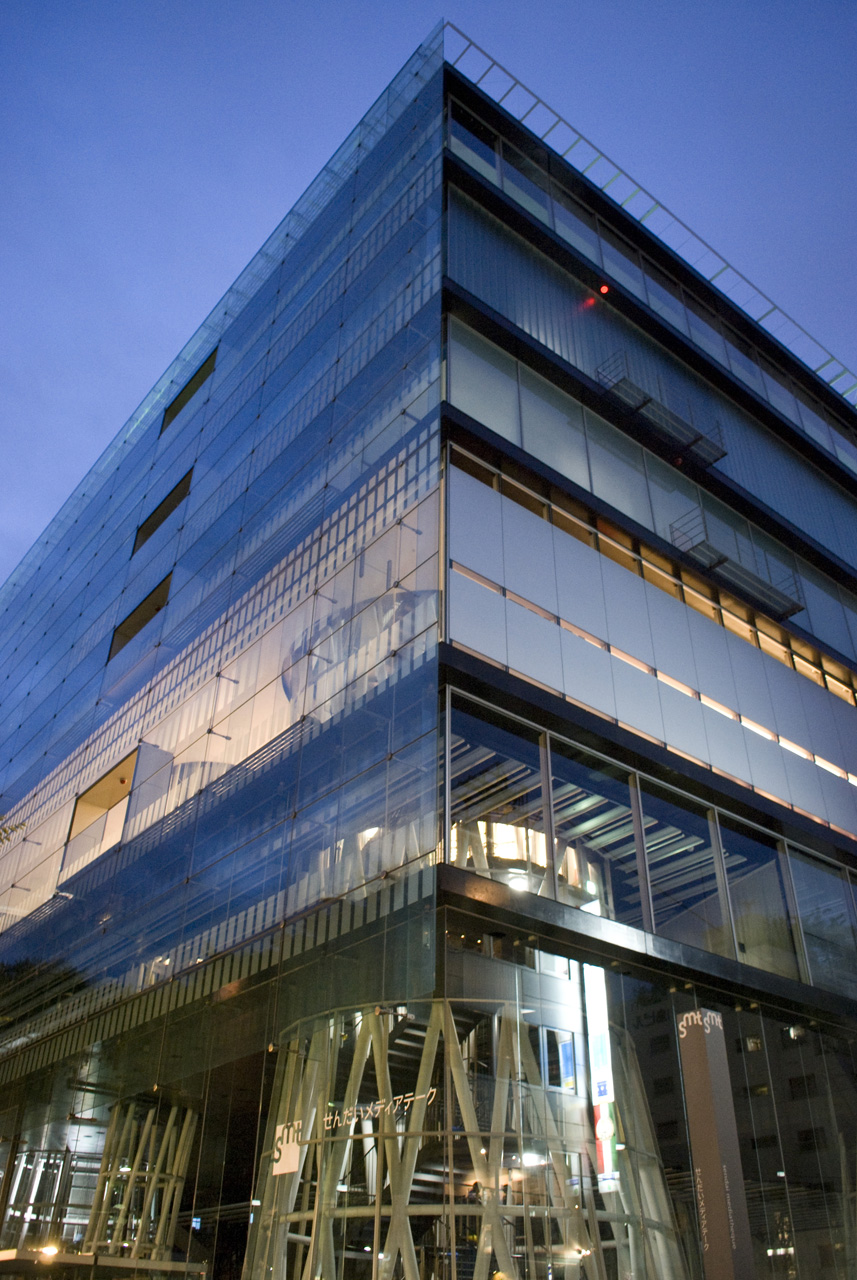
The Sendai Mediatheque is located in the heart of the city of Sendai, only a few blocks away from the city hall. The building sits flush with Jozenji street, a six-lane divided boulevard, although there are entrances on all four sides of the building. The diaphanous glass and metal façade of the institution, while differing from the mainly white, opaque volumes of the neighboring buildings, blends harmoniously with the environment during the daytime due to its reflectivity, while at night the interior lighting scheme transforms the volume into a multi-hued lantern. The ground floor is conceived as an extension of the street, with a cafe, bookstore, and event plaza sitting freely (without partitions) within the ground floor space, with views to the sidewalk through the double-glazed facade facing Jozenji Street.
This extension of the city into the building continues throughout all seven floors above ground; a gesture which reinforces Ito's resistance to the rigid limitation of activities in the building to within predetermined areas.
...this building has many free spaces, that is, spaces that are not intended, as rooms are, to serve specific functions. Such spaces exist, for example, between the tubes and the building perimeter. Visitors will be able to use such spaces as they use the city streets, for various activities. ... I am hoping that, as such spaces are used, the Mediatheque will become a place for thinking about the city.
— Toyo Ito (2001),
The Sendai Mediatheque is a mixed-program public facility which combines library and art gallery functions located in the city of Sendai, Japan. Toyo Ito's winning entry for an open competition commissioned by the city of Sendai in 1995, the innovative building opened to the public in January 2001. The Mediatheque's seven levels of facilities offer a range of services including a conventional book-lending library, an extensive collection of film and audio recordings with stations for both viewing and editing, a theater, to a cafe and bookstore, all housed in a nearly cubic glass enclosure. The seven platforms are supported by what Ito calls "characterizing" architectural elements: a forest of 13 non-uniform tubes which appear to rise fluidly through the building. Architecturally, the building is considered an important milestone in Ito's career.
Hub AI
Sendai Mediatheque AI simulator
(@Sendai Mediatheque_simulator)
Sendai Mediatheque
Sendai Mediatheque is a library in Sendai, Miyagi Prefecture, Japan. It was designed by Toyo Ito in 1995 and completed in 2001.
The Sendai Mediatheque held its official opening in January 2001.
Ito also refers to Mies' Barcelona Pavilion and Le Corbusier’s Dom-ino house as precedents for his work, and indeed, the Mediatheque appears to mix concepts from the two projects, combining le Corbusier’s play with slab and column structure, with Mies “fluid” spatial effects achieved through combined transparency and reflectivity of materials.
The Sendai Mediatheque is located in the heart of the city of Sendai, only a few blocks away from the city hall. The building sits flush with Jozenji street, a six-lane divided boulevard, although there are entrances on all four sides of the building. The diaphanous glass and metal façade of the institution, while differing from the mainly white, opaque volumes of the neighboring buildings, blends harmoniously with the environment during the daytime due to its reflectivity, while at night the interior lighting scheme transforms the volume into a multi-hued lantern. The ground floor is conceived as an extension of the street, with a cafe, bookstore, and event plaza sitting freely (without partitions) within the ground floor space, with views to the sidewalk through the double-glazed facade facing Jozenji Street.
This extension of the city into the building continues throughout all seven floors above ground; a gesture which reinforces Ito's resistance to the rigid limitation of activities in the building to within predetermined areas.
...this building has many free spaces, that is, spaces that are not intended, as rooms are, to serve specific functions. Such spaces exist, for example, between the tubes and the building perimeter. Visitors will be able to use such spaces as they use the city streets, for various activities. ... I am hoping that, as such spaces are used, the Mediatheque will become a place for thinking about the city.
— Toyo Ito (2001),
The Sendai Mediatheque is a mixed-program public facility which combines library and art gallery functions located in the city of Sendai, Japan. Toyo Ito's winning entry for an open competition commissioned by the city of Sendai in 1995, the innovative building opened to the public in January 2001. The Mediatheque's seven levels of facilities offer a range of services including a conventional book-lending library, an extensive collection of film and audio recordings with stations for both viewing and editing, a theater, to a cafe and bookstore, all housed in a nearly cubic glass enclosure. The seven platforms are supported by what Ito calls "characterizing" architectural elements: a forest of 13 non-uniform tubes which appear to rise fluidly through the building. Architecturally, the building is considered an important milestone in Ito's career.