
Recent from talks
Senegambian stone circles
Knowledge base stats:
Talk channels stats:
Members stats:
Senegambian stone circles
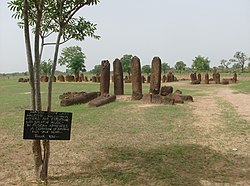
The Senegambian stone circles (French: Cercles mégalithiques de Sénégambie), or the Wassu stone circles, are groups of megalithic stone circles located in the Gambia north of Janjanbureh and in central Senegal. Spread across a region 30,000 km2 (12,000 sq mi), they are sometimes divided into the Wassu (Gambian) and Sine-Saloum (Senegalese) circles, but this is purely a national division. Containing over 1,000 stone circles and tumuli (1,145 sites are recorded by a 1982 study) spread across an area 350 km (220 mi) long and 100 km (62 mi) wide, the Senegambian stone circles are the largest concentration of stone circles seen anywhere in the world, and they are an extensive sacred landscape that was used for more than 1,500 years. The sites were inscribed on the UNESCO World Heritage List in 2006.
The stone circles and other megaliths found in Senegal and Gambia are sometimes divided into four large sites: Sine Ngayène and Wanar in Senegal, and Wassu and Kerr Batch in the Central River Division in Gambia. Among these four main areas, there are approximately 29,000 stones, 17,000 monuments, and 2,000 individual sites. The monuments consist of what were originally upright blocks or pillars (some have collapsed), mostly made of laterite, with smooth surfaces. The monoliths are found in circles, double circles, isolated or standing apart from circles (usually to the east) in rows, or individually. Stones found standing apart are called frontal stones. When there are frontal stones in two parallel, connected rows, they are called lyre-stones.
Researchers are not certain when these monuments were built, but the generally accepted range is between the 3rd century BCE and the 16th century CE. Burial mounds near the Wassu complex have been dated to AD 927–1305, although it is not clear whether the burial mounds were constructed before or after the stone circles. Archaeologists have also found pottery shards, human burials, and some grave goods and metals around the megalithic circles. A small collection of these can be found in the British Museum's collection that was donated by the colonial administrator Richmond Palmer.
The construction of the stone monuments shows evidence of a prosperous and organized society based on the amount of labor required to build such structures. The stones were extracted from laterite quarries using iron tools, although few of these quarries have been identified as directly linked to particular sites. After extracting the stone, identical pillars were made, either cylindrical or polygonal, with averages at two meters high and weighing seven tons. The builders of these megaliths are unknown. Possible candidates are the ancestors of the Jola people or the Wolof, but some researchers believe that the Serer people are the builders. This hypothesis comes from the fact that the Serer still use funerary houses like those found at Wanar.
The Gambia:
Senegal:
Kerr Batch, an area comprising nine stone circles and one double circle, is located in Gambia's Nianija district. Kerr Batch features a V-shaped, "bifid" stone (the only one in the region) that had broken in three places and fallen. This stone, which had been part of a frontal line, was restored during the 1965 Anglo-Gambian Stone Circles Expedition, led by Paul Ozanne. During this expedition, Ozanne and his team excavated the double circle at Kerr Batch.
Wassu is located in the Niani district of Gambia and is made up of 11 stone circles and their associated frontal stones. The tallest stone is found in this area, with a height of 2.59 meters. The builders of the monuments here possessed great knowledge of their local geology in order to find the sources of laterite stones. They must also have had great technical ability in order to extract these stones without splitting or cracking them. The most recent excavations conducted on these megalithic circles date to the Anglo-Gambian campaign led by Evans and Ozanne in 1964 and 1965. The discovery of burials enabled the dating of the monuments to between AD 927 and 1305.
Hub AI
Senegambian stone circles AI simulator
(@Senegambian stone circles_simulator)
Senegambian stone circles
The Senegambian stone circles (French: Cercles mégalithiques de Sénégambie), or the Wassu stone circles, are groups of megalithic stone circles located in the Gambia north of Janjanbureh and in central Senegal. Spread across a region 30,000 km2 (12,000 sq mi), they are sometimes divided into the Wassu (Gambian) and Sine-Saloum (Senegalese) circles, but this is purely a national division. Containing over 1,000 stone circles and tumuli (1,145 sites are recorded by a 1982 study) spread across an area 350 km (220 mi) long and 100 km (62 mi) wide, the Senegambian stone circles are the largest concentration of stone circles seen anywhere in the world, and they are an extensive sacred landscape that was used for more than 1,500 years. The sites were inscribed on the UNESCO World Heritage List in 2006.
The stone circles and other megaliths found in Senegal and Gambia are sometimes divided into four large sites: Sine Ngayène and Wanar in Senegal, and Wassu and Kerr Batch in the Central River Division in Gambia. Among these four main areas, there are approximately 29,000 stones, 17,000 monuments, and 2,000 individual sites. The monuments consist of what were originally upright blocks or pillars (some have collapsed), mostly made of laterite, with smooth surfaces. The monoliths are found in circles, double circles, isolated or standing apart from circles (usually to the east) in rows, or individually. Stones found standing apart are called frontal stones. When there are frontal stones in two parallel, connected rows, they are called lyre-stones.
Researchers are not certain when these monuments were built, but the generally accepted range is between the 3rd century BCE and the 16th century CE. Burial mounds near the Wassu complex have been dated to AD 927–1305, although it is not clear whether the burial mounds were constructed before or after the stone circles. Archaeologists have also found pottery shards, human burials, and some grave goods and metals around the megalithic circles. A small collection of these can be found in the British Museum's collection that was donated by the colonial administrator Richmond Palmer.
The construction of the stone monuments shows evidence of a prosperous and organized society based on the amount of labor required to build such structures. The stones were extracted from laterite quarries using iron tools, although few of these quarries have been identified as directly linked to particular sites. After extracting the stone, identical pillars were made, either cylindrical or polygonal, with averages at two meters high and weighing seven tons. The builders of these megaliths are unknown. Possible candidates are the ancestors of the Jola people or the Wolof, but some researchers believe that the Serer people are the builders. This hypothesis comes from the fact that the Serer still use funerary houses like those found at Wanar.
The Gambia:
Senegal:
Kerr Batch, an area comprising nine stone circles and one double circle, is located in Gambia's Nianija district. Kerr Batch features a V-shaped, "bifid" stone (the only one in the region) that had broken in three places and fallen. This stone, which had been part of a frontal line, was restored during the 1965 Anglo-Gambian Stone Circles Expedition, led by Paul Ozanne. During this expedition, Ozanne and his team excavated the double circle at Kerr Batch.
Wassu is located in the Niani district of Gambia and is made up of 11 stone circles and their associated frontal stones. The tallest stone is found in this area, with a height of 2.59 meters. The builders of the monuments here possessed great knowledge of their local geology in order to find the sources of laterite stones. They must also have had great technical ability in order to extract these stones without splitting or cracking them. The most recent excavations conducted on these megalithic circles date to the Anglo-Gambian campaign led by Evans and Ozanne in 1964 and 1965. The discovery of burials enabled the dating of the monuments to between AD 927 and 1305.
Recent media
