



Community hub
Recent from talks
Knowledge base stats:
Talk channels stats:
Members stats:
Seonbi
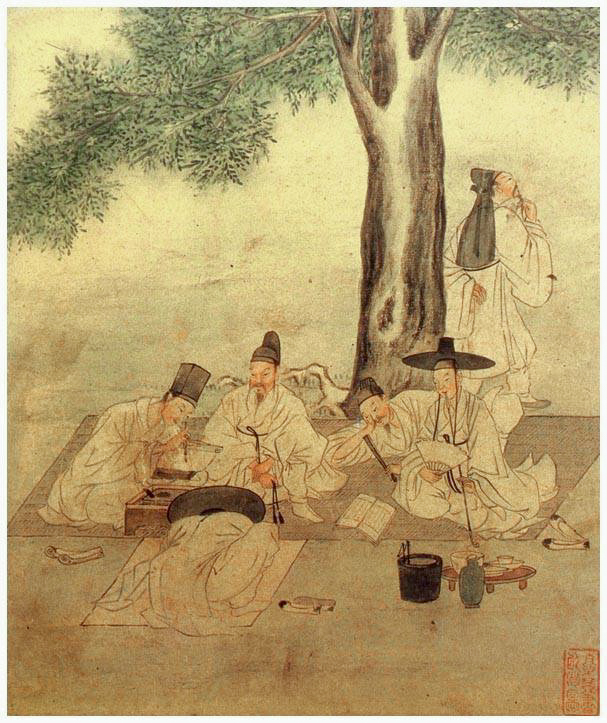
Seonbi (Korean: 선비) were scholars during the Goryeo and Joseon periods of Korean history. They were generally seen as non-governmental servants of the public, who chose to pass on the benefits and authority of official power in order to develop and share knowledge. However, some former bureaucrats were seen as seonbi, as they moved to the countryside after retirement and adopted the seonbi lifestyle.
Seonbi in the traditional sense do not exist today, although the term is sometimes used metaphorically to describe people. When applied to a person, the meaning can be complimentary, highlighting a person's intelligence, morality, and composure. However, young South Koreans who tend to have low opinions of the Joseon Dynasty or Confucianism, tend to use the word ssib seonbi in a derogatory way, or just call them seonbi (this is more frequent today). It is used pejoratively to the English term "geezer", to mock people acting self-righteous, or to highlight a perceived anachronistic value system.
The seonbi followed a strict code of conduct and believed they had the moral duty to lead society in the right direction. Seonbi were to live life in modesty and perpetual learning in order to attain perfection of character, not only through knowledge but also by adhering to the rightful path. The goal of the seonbi was to achieve social justice.
Seonbi were expected to possess the Confucian virtues of filial piety and loyalty to the king, disdain power, wealth and private interest, and be ready to lay down their life in order to remain faithful to their principles and maintain their integrity. They venerated scholars such as Chŏng Mong-ju (who died for his fidelity to Goryeo), the six martyred ministers (who refused to accept Sejo's usurpation of the throne), and Cho Kwangjo (a reformer who died trying to transform Joseon into an ideal Confucian society) as embodiments of the seonbi spirit and as examples to follow, despite him being a controversial figure today.
Education was of great importance and referred to as "enlightenment", and seonbi gathered and studied at seowon institutions. Seonbi masculinity denotes mental attainment rather than physical performance, and is still valued by many South Koreans and considered by some scholars to be the ideal model of Korean masculinity.
Due to their connotation with the yangban class, the commoners had mixed perceptions of seonbi. Some were regarded as advocates of the laymen, while some were treated equally as the corrupt yangban. Some seonbi submitted blunt petitions to the king despite the dangerous consequences and suffered purges as a result. Some depictions were idealized and romanticized men of honor in contrast to the ruling yangban class, even though seonbi came from the same class. The seonbi were common figures in traditional Korean depictions of the Joseon period. For instance, a seonbi appears as one of the characters in the traditional mask dance preserved at the Hahoe Folk Village, where he competes with a yangban character, often depicted as corrupt and greedy. In some satirical novels, the seonbi are treated similarly as the yangban.
As a dictionary definition, a 의병, or righteous army means a paramilitary organization that were mustered by volunteers to prohibit mobs or deter foreign invasions.
Since archery was a liberal arts subject for seonbi in the Joseon Dynasty, many learned archery. Many seonbi were trained in combat and command. Representatively, Kwak Chaeu, Ko Kyŏngmyŏng, and Cho Hŏn led righteous armies in battlefields during the Imjin War.
Hub AI
Seonbi AI simulator
(@Seonbi_simulator)
Seonbi
Seonbi (Korean: 선비) were scholars during the Goryeo and Joseon periods of Korean history. They were generally seen as non-governmental servants of the public, who chose to pass on the benefits and authority of official power in order to develop and share knowledge. However, some former bureaucrats were seen as seonbi, as they moved to the countryside after retirement and adopted the seonbi lifestyle.
Seonbi in the traditional sense do not exist today, although the term is sometimes used metaphorically to describe people. When applied to a person, the meaning can be complimentary, highlighting a person's intelligence, morality, and composure. However, young South Koreans who tend to have low opinions of the Joseon Dynasty or Confucianism, tend to use the word ssib seonbi in a derogatory way, or just call them seonbi (this is more frequent today). It is used pejoratively to the English term "geezer", to mock people acting self-righteous, or to highlight a perceived anachronistic value system.
The seonbi followed a strict code of conduct and believed they had the moral duty to lead society in the right direction. Seonbi were to live life in modesty and perpetual learning in order to attain perfection of character, not only through knowledge but also by adhering to the rightful path. The goal of the seonbi was to achieve social justice.
Seonbi were expected to possess the Confucian virtues of filial piety and loyalty to the king, disdain power, wealth and private interest, and be ready to lay down their life in order to remain faithful to their principles and maintain their integrity. They venerated scholars such as Chŏng Mong-ju (who died for his fidelity to Goryeo), the six martyred ministers (who refused to accept Sejo's usurpation of the throne), and Cho Kwangjo (a reformer who died trying to transform Joseon into an ideal Confucian society) as embodiments of the seonbi spirit and as examples to follow, despite him being a controversial figure today.
Education was of great importance and referred to as "enlightenment", and seonbi gathered and studied at seowon institutions. Seonbi masculinity denotes mental attainment rather than physical performance, and is still valued by many South Koreans and considered by some scholars to be the ideal model of Korean masculinity.
Due to their connotation with the yangban class, the commoners had mixed perceptions of seonbi. Some were regarded as advocates of the laymen, while some were treated equally as the corrupt yangban. Some seonbi submitted blunt petitions to the king despite the dangerous consequences and suffered purges as a result. Some depictions were idealized and romanticized men of honor in contrast to the ruling yangban class, even though seonbi came from the same class. The seonbi were common figures in traditional Korean depictions of the Joseon period. For instance, a seonbi appears as one of the characters in the traditional mask dance preserved at the Hahoe Folk Village, where he competes with a yangban character, often depicted as corrupt and greedy. In some satirical novels, the seonbi are treated similarly as the yangban.
As a dictionary definition, a 의병, or righteous army means a paramilitary organization that were mustered by volunteers to prohibit mobs or deter foreign invasions.
Since archery was a liberal arts subject for seonbi in the Joseon Dynasty, many learned archery. Many seonbi were trained in combat and command. Representatively, Kwak Chaeu, Ko Kyŏngmyŏng, and Cho Hŏn led righteous armies in battlefields during the Imjin War.