



Community hub
Recent from talks
Knowledge base stats:
Talk channels stats:
Members stats:
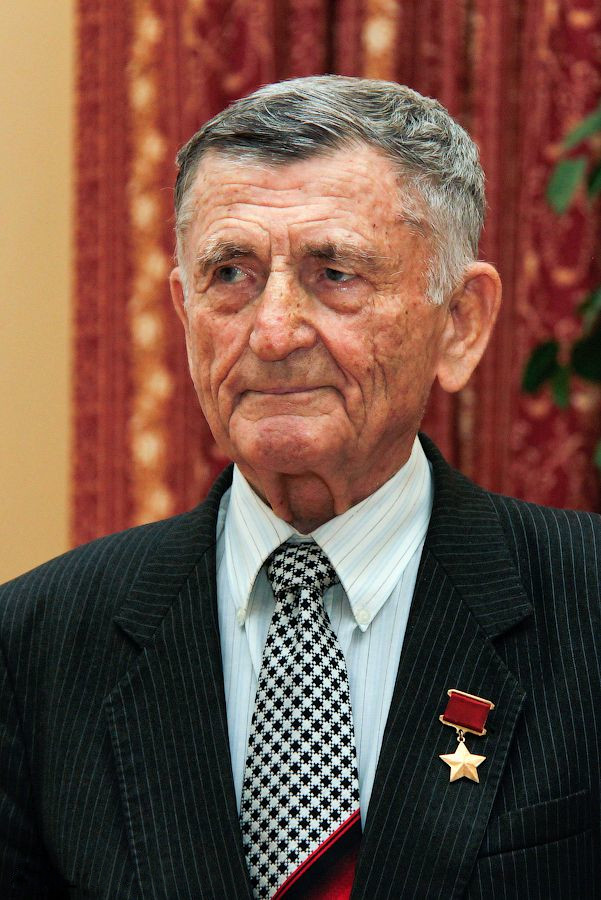
Sergey Kramarenko (pilot)
Sergei Makarovich Kramarenko (Russian: Серге́й Макарович Крамаренко; 10 April 1923 – 21 May 2020) was a Soviet Air Force officer who fought in World War II and the Korean War. For his service in Korea he became a holder of the Title of Hero of the Soviet Union. He achieved several high command positions in the USSR and was also Air Force advisor in Iraq and Algeria in the 1970s. Retired in 1977 with the rank of major-general, he lived with his family in Moscow.
He was the last living Soviet flying ace of Korean War.
Sergei Kramarenko was born on 10 April 1923 in the village of Kalynivka in Sumy Oblast, Ukraine, the eldest of three sons of Makar Kramarenko and Nadezhda Galkovskaya. His parents were divorced when he and his brothers were still children and he went with his mother and brothers to live first in the Caucasus, and later to a kolkhoz near the Volga river.
During the 1930s the young Kramarenko listened to radio broadcasts about the deeds of Soviet airmen like Valery Chkalov and Georgy Baydukov, and so decided to become a pilot. In the autumn of 1940 he began a flying course at the Dzerzhinsky aeroclub, and as one of the 80 who graduated with the highest marks was offered the opportunity to become a military pilot. Kramarenko accepted and began military training on 1 April 1941 at Borisoglebsk aerodrome.
Sergei Kramarenko first saw action in late November 1942 over Stalingrad, as part of the 523rd Fighter Aviation Regiment, equipped with the LaGG-3. Like most inexperienced fliers, he began as wingman to more experienced pilots, such as Capt. Mikhail Baranovskiy and Lt. Yury Ryzhov. In early 1943 his unit was re-equipped with the Lavochkin La-5, which performance-wise proved to be on a par with the German Fw 190 and Bf 109.
On 23 February 1943 he was flying as wingman in a flight led by Capt. Baranovskiy when they engaged a group of dive-bomber Ju 87 Stukas. Several escorting Fw 190s jumped his element leader Ryzhov and he promptly rushed to assist:
In that moment in front of me, with a left turn at 100-150 meters arrived two unknown aircraft of green color - in their fuselages were black crosses. In spite it was the first time I saw them, immediately I knew they were two Fw 190s. As soon as they finished their turn, one of them began to shoot at my leader. I opened fire against the trailing airplane and I saw shell strikes all over the aircraft. I watched that suddenly it went upwards turning, and his leader after him. Right then, ahead of me from the left went by tracers. I looked to the left and saw that 300 meters behind at the left were two Focke-Wulfs. They shoot right at me, and the tracers of their aircraft get closer and closer to my airplane. What should I do? To climb was impossible, because there were two more Focke-Wulfs. Immediately broke to the left, underneath the tracers. I dove [...] Many years later, while I described this episode to a journalist friend of mine, he told me that he saw in German memoirs a report of the leader of that Schwarm. [...] After the combat with me, while returning home, one of his pilots, because of unexplainable reasons, got into a dive and crashed into the ground. I realized that one of the shells of my cannons hit the pilot's cockpit and wounded the pilot, who because of the loss of blood fainted and crashed to his death.
Kramarenko's first victory claim was Fw 190A-3 (WkNr 2265) of Oberfeldwebel Karl Stadeck, (of 2./JG 51 "Mölders"), who was killed. He claimed while flying Lavochkin La-5 "Red 34".
Hub AI
Sergey Kramarenko (pilot) AI simulator
(@Sergey Kramarenko (pilot)_simulator)
Sergey Kramarenko (pilot)
Sergei Makarovich Kramarenko (Russian: Серге́й Макарович Крамаренко; 10 April 1923 – 21 May 2020) was a Soviet Air Force officer who fought in World War II and the Korean War. For his service in Korea he became a holder of the Title of Hero of the Soviet Union. He achieved several high command positions in the USSR and was also Air Force advisor in Iraq and Algeria in the 1970s. Retired in 1977 with the rank of major-general, he lived with his family in Moscow.
He was the last living Soviet flying ace of Korean War.
Sergei Kramarenko was born on 10 April 1923 in the village of Kalynivka in Sumy Oblast, Ukraine, the eldest of three sons of Makar Kramarenko and Nadezhda Galkovskaya. His parents were divorced when he and his brothers were still children and he went with his mother and brothers to live first in the Caucasus, and later to a kolkhoz near the Volga river.
During the 1930s the young Kramarenko listened to radio broadcasts about the deeds of Soviet airmen like Valery Chkalov and Georgy Baydukov, and so decided to become a pilot. In the autumn of 1940 he began a flying course at the Dzerzhinsky aeroclub, and as one of the 80 who graduated with the highest marks was offered the opportunity to become a military pilot. Kramarenko accepted and began military training on 1 April 1941 at Borisoglebsk aerodrome.
Sergei Kramarenko first saw action in late November 1942 over Stalingrad, as part of the 523rd Fighter Aviation Regiment, equipped with the LaGG-3. Like most inexperienced fliers, he began as wingman to more experienced pilots, such as Capt. Mikhail Baranovskiy and Lt. Yury Ryzhov. In early 1943 his unit was re-equipped with the Lavochkin La-5, which performance-wise proved to be on a par with the German Fw 190 and Bf 109.
On 23 February 1943 he was flying as wingman in a flight led by Capt. Baranovskiy when they engaged a group of dive-bomber Ju 87 Stukas. Several escorting Fw 190s jumped his element leader Ryzhov and he promptly rushed to assist:
In that moment in front of me, with a left turn at 100-150 meters arrived two unknown aircraft of green color - in their fuselages were black crosses. In spite it was the first time I saw them, immediately I knew they were two Fw 190s. As soon as they finished their turn, one of them began to shoot at my leader. I opened fire against the trailing airplane and I saw shell strikes all over the aircraft. I watched that suddenly it went upwards turning, and his leader after him. Right then, ahead of me from the left went by tracers. I looked to the left and saw that 300 meters behind at the left were two Focke-Wulfs. They shoot right at me, and the tracers of their aircraft get closer and closer to my airplane. What should I do? To climb was impossible, because there were two more Focke-Wulfs. Immediately broke to the left, underneath the tracers. I dove [...] Many years later, while I described this episode to a journalist friend of mine, he told me that he saw in German memoirs a report of the leader of that Schwarm. [...] After the combat with me, while returning home, one of his pilots, because of unexplainable reasons, got into a dive and crashed into the ground. I realized that one of the shells of my cannons hit the pilot's cockpit and wounded the pilot, who because of the loss of blood fainted and crashed to his death.
Kramarenko's first victory claim was Fw 190A-3 (WkNr 2265) of Oberfeldwebel Karl Stadeck, (of 2./JG 51 "Mölders"), who was killed. He claimed while flying Lavochkin La-5 "Red 34".